Showing posts with label Biology. Show all posts

10th Science Important Questions & Study Material for Public Exam 2026

10th Science Important for Public Exam 2026

Comprehensive study materials, important questions, and problems for Physics, Chemistry, and Biology.

Science Exam Strategies (2026)

  • Physics: Focus on numerical problems and laws.
  • Chemistry: Practice balancing chemical equations.
  • Biology: Draw neat, labeled diagrams for 5-mark questions.

10th Science Part 2 July 2025 Board Exam Question Paper with Solutions

Question 1

(A) Choose the correct alternatives:

(i) Our muscle cells perform __________ type of respiration during exercise.
  • (A) Aerobic
  • (B) Anaerobic
  • (C) Fermentation
  • (D) Krebs Cycle
Answer: (B) Anaerobic
(ii) Which of the following animals can regenerate its broken body part?
  • (A) Cockroach
  • (B) Frog
  • (C) Sparrow
  • (D) Starfish
Answer: (D) Starfish
(iii) Government of India has encouraged the __________ for improving the productivity by launching NKM-16.
  • (A) Apiculture
  • (B) Cultivation of medicinal plants
  • (C) Pisciculture
  • (D) Fruit processing
Answer: (C) Pisciculture (Note: NKM-16 usually refers to the Neel Kranti Mission/Blue Revolution).
(iv) At the district level __________ is responsible for disaster management and implementation of rehabilitation schemes.
  • (A) Collector
  • (B) Tahsildar
  • (C) Education Officer
  • (D) Chief Executive Officer
Answer: (A) Collector
(v) __________ of West Bengal is reserved for tigers.
  • (A) Manas National Park
  • (B) Western Ghat
  • (C) Molai Jungle
  • (D) Sundarban National Park
Answer: (D) Sundarban National Park

(B) Answer the following questions:

(i) State whether the following statement is True or False: Evolution is the gradual change occurring in living organisms over a long duration.
Answer: True
(ii) Write the name of any one sexual disease.
Answer: Syphilis (or Gonorrhea / AIDS)
(iii) Select odd man out: Gutkha, Yoga, Alcoholic drinks, Cigarette.
Answer: Yoga (Others are addictive and harmful substances).
(iv) Fill in the box with proper word: Kinetic Energy in wind -> [ ______ ]
Answer: Kinetic Energy in Turbine (or eventually Electrical Energy).
(v) Match the correct pair:
Column A Column B
Xylitol (b) To impart sweetness

Question 2

(A) Give scientific reasons (any two):

(i) Some of the organs in human body are most valuable.
Reason: Certain organs like the kidneys, heart, liver, and eyes are vital for survival or quality of life. If these organs fail, a person's life is at risk. However, these organs can be donated (after death or in some cases like kidneys/liver lobe while alive) to save the lives of patients in need. Due to their life-saving potential and scarcity, they are considered most valuable.
(ii) Hydroelectric energy, solar energy and wind energy are called renewable energies.
Reason: These energy sources are obtained from inexhaustible natural resources (water, sun, wind) that are continuously replenished by nature. Unlike fossil fuels, they do not run out after use and are generally eco-friendly. Hence, they are called renewable energies.
(iii) Fibres are one of the important nutrients.
Reason: Although human bodies cannot digest fibres, they are crucial for digestion. They help in the digestion of other substances and facilitate the excretion of undigested food (egestion), preventing constipation. Therefore, they are considered important nutrients.

(B) Answer the following questions (any three):

(i) Observe the given animals (Fig A: Duck-billed Platypus, Fig B: Lungfish) and answer the questions:
(a) Identify the animals:
Fig A: Duck-billed Platypus
Fig B: Lungfish

(b) State the type of evidence of evolution:
Connecting Links.
(ii) Complete the chart: Asexual reproduction in multicellular organisms.
1. Fragmentation
2. Regeneration
3. Budding
4. Vegetative Propagation
5. Spore Formation
(iii) Complete the table:
Sr. No. Microbe used Name of beverage
1. Lactobacillus brevis Coffee
2. Candida, Hansenula, Pichia, Saccharomyces Cocoa
3. Saccharomyces cerevisiae Wine
4. Saccharomyces cerevisiae Cider
(iv) Give two examples of each:
(a) Physical problems arising due to excessive use of mobile phones:
1. Headache / Insomnia
2. Vision problems / Joint pain

(b) Activities under the jurisdiction of cyber crime laws:
1. Hacking of information / Bank frauds
2. Identity theft / Cyber stalking
(v) Write any two objectives of disaster management.
1. To save human lives and property from disasters.
2. To supply essential commodities (food, water, medicine) to affected people.
3. To rehabilitate the affected people and restore normalcy in the area.

Question 3

Answer the following questions (any five):

(i) Distinguish between Sexual reproduction and Asexual reproduction.
Sexual Reproduction Asexual Reproduction
Two parents (male and female) are involved. Only one parent is involved.
Germ cells (Gametes) are formed. Gametes are not formed.
Offspring show genetic variation. Offspring are genetically identical (clones).
It is a slower process. It is a faster process.
(ii) Complete the chart (Respiration / Glycolysis):
(a) Fatty acids
(b) Amino acids
(c) Pyruvic acid
(d) Acetyl Co-A
(e) Krebs Cycle
(f) CO2 + H2O + Energy
(iii) Answer the following questions (Vestigial Organs):
(a) Define vestigial organs: Degenerated or underdeveloped useless organs of organisms are called vestigial organs.
(b) Two vestigial organs in human body: Appendix, Tail bone (Coccyx), Wisdom teeth, Ear muscles.
(c) Organs non-functional in humans but functional in others: Appendix (functional in ruminants), Ear muscles (functional in monkeys).
(iv) Complete the following flow chart (Thermal Energy):
Generation of electrical energy using thermal energy:
Fuel Coal [Boiler for conversion of water to steam] [Steam Turbine] Generator Electrical energy

Energy transformation:
Chemical energy in coal [Thermal energy] [Kinetic energy in steam] [Kinetic energy in turbine] Electrical energy
(v) Complete the paragraph regarding Cheese Production:
Cheese is produced on large scale from the abundantly available milk all over the world. First chemical and microbiological tests of milk are performed. Some colours and microbes like Lactobacillus lactis, Lactobacillus cremoris and Streptococcus thermophilus are mixed with milk. It imparts sourness to the milk. After this, to impart the dense texture, whey needs to be removed. An enzyme rennet obtained from alimentary canal of cattle was being traditionally used earlier. However an enzyme protease obtained from fungi is used at present to produce cheese.
(vi) Write a short note on the importance of medicinal plants.
India has a great tradition of Ayurveda that cures diseases with the help of natural resources. Medicinal plants are the main source of these cures. For example, Adulsa is used for cough and cold, Tulsi is an immunity booster, and Ashwagandha is used for vitality. Conservation of these plants is crucial as they provide side-effect-free remedies.
(vii) Explain the importance of good communication with others.
Good communication helps to express one's feelings, problems, and thoughts effectively. It helps in relieving stress and mental pressure. Communicating with parents, teachers, and friends helps in finding solutions to problems, thereby preventing depression and maintaining good social health.
(viii) Identify the type of disaster and write its effect:
Event Type of Disaster Effect
(a) Terrorism Man-made (Intentional) Loss of life, Property damage, Fear/Panic
(b) Forest Fire Natural or Man-made Loss of biodiversity, Air pollution
(c) Theft Man-made (Intentional) Financial loss, Mental stress

Question 4

Answer the following questions (any one):

(i) Complete the following flow chart explaining my role in environmental conservation:
My Role in Environmental Conservation:
  • Conservation: Conserving the available resources.
  • Control: Preventing the harm; stopping the harmful activities.
  • Production: Revival of harmed factors of environment; attempting innovation.
  • Awareness: Education, guidance, awareness, imitation, organization, participation.
  • Prevention: Preventing possible harms; designing new plans; factors harmful to environment.
  • Preservation: Preserving whatever has been left; preserving biodiversity.
(ii) Observe the picture (Fig A: Fish, Fig B: Pigeon) and answer the questions:
(a) Identify the class of animals shown in above picture.
Fig A (Fish) belongs to Class Pisces.
Fig B (Pigeon) belongs to Class Aves.

(b) Which similarities are shown in above animals from the adaptation point of view?
Both animals have a spindle-shaped (streamlined) body. This adaptation minimizes the resistance of the surrounding medium (water for fish, air for birds) during movement.

(c) Why these animals are included in different classes inspite of their similarities?
Despite the streamlined shape, they have major differences:
  • Respiration: Fish use gills, Birds use lungs.
  • Habitat: Fish are aquatic, Birds are aerial/terrestrial.
  • Skin: Fish have scales, Birds have feathers.
  • Thermoregulation: Fish are cold-blooded (Poikilotherms), Birds are warm-blooded (Homeotherms).
Question Paper Page No. 1 Question Paper Page No. 2 Question Paper Page No. 3 Question Paper Page No. 4 Question Paper Page No. 5 Question Paper Page No. 6 Question Paper Page No. 7 Question Paper Page No. 8

10th Science and Technology Part 2 March 2025 Board Exam Question Paper with Solutions

Q. 1. (A) Choose the correct option and write the correct alternative.

(i) A molecule of glucose is completely oxidised in aerobic respiration and molecules of \(H_{2}O\) and __________ are produced along with energy.
  • (A) \(CO_{2}\)
  • (B) \(O_{2}\)
  • (C) NaOH
  • (D) \(HNO_{3}\)
Answer: (A) \(CO_{2}\)
(ii) Vinegar contains __________ acid.
  • (A) acetic
  • (B) lactic
  • (C) tartaric
  • (D) hydrochloric
Answer: (A) acetic
(iii) Any nucleotide of the gene suddenly changes its position that causes a minor change which is nothing but the __________.
  • (A) changes
  • (B) mutation
  • (C) disability
  • (D) translocation
Answer: (B) mutation
(iv) In humans, sperm production occurs in the __________ organ.
  • (A) vas deferens
  • (B) ejaculatory duct
  • (C) testes
  • (D) urinogenital duct
Answer: (C) testes
(v) Solar photovoltaic cell converts the solar radiation energy directly into __________ energy.
  • (A) Chemical
  • (B) Solar
  • (C) Mechanical
  • (D) Electrical
Answer: (D) Electrical

Q. 1. (B) Answer the following questions.

(i) Find the odd one out: Fragmentation, Regeneration, Budding, Fertilization.
Answer: Fertilization
Reason: Fertilization involves sexual reproduction, while Fragmentation, Regeneration, and Budding are types of asexual reproduction.
(ii) Write the correct co-relation: Diabetes : Insulin :: Cancer : _______
Answer: Interferon (or Chemotherapy)
(iii) State whether true or false: Study of fossils is an important aspect of the study of evolution.
Answer: True
(iv) Give any two commercial uses of Biotechnology.
Answer:
  1. Production of vaccines and antibiotics.
  2. Production of genetically modified crops (e.g., Bt Cotton).
  3. Production of yogurt and other dairy products.
(v) Being a fish, I perform respiration with the help of lungs. Who am I?
Answer: Lungfish

Q. 2. (A) Give scientific reasons (any two).

(i) Sometimes, higher plants and animals too perform anaerobic respiration.
Reason:
  • Aerobic respiration requires oxygen. However, when the oxygen level in the surroundings is depleted, higher plants and animals switch to anaerobic respiration to survive.
  • For example, during heavy exercise, human muscle cells perform anaerobic respiration due to a lack of oxygen, producing lactic acid.
  • Similarly, plants may perform anaerobic respiration if the soil is waterlogged and roots cannot access oxygen.
(ii) It is not right to consider the mother responsible for giving birth to a girl child.
Reason:
  • Human females have two X chromosomes (XX), so all egg cells produced carry an X chromosome.
  • Human males have one X and one Y chromosome (XY). Therefore, 50% of sperms carry the X chromosome and 50% carry the Y chromosome.
  • The sex of the child depends entirely on which sperm fertilizes the egg. If an X-bearing sperm fertilizes the egg, the child is a girl (XX). If a Y-bearing sperm fertilizes the egg, the child is a boy (XY). Thus, the father determines the sex of the child.
(iii) The energy generated from nuclear fuels is not environment friendly.
Reason:
  • Nuclear power plants produce radioactive waste which is hazardous and difficult to dispose of safely.
  • There is a risk of harmful radiation leakage which can cause severe health problems, including cancer and genetic mutations.
  • Accidents in nuclear plants can lead to catastrophic environmental disasters.

Q. 2. (B) Answer the following questions (any three).

(i) Complete the following food chain: Grass -> ______ -> Frog -> ______ -> Eagle -> ______
Complete the following food chain: Grass -> ______ -> Frog -> ______ -> Eagle
Answer:
Grass -> Grasshopper -> Frog -> Snake -> Eagle -> Fungi
Complete the following food chain: Grass -> ______ -> Frog -> ______ -> Eagle Complete the following food chain: Grass -> ______ -> Frog -> ______ -> Eagle
(ii) Distinguish between Class Pisces and Class Reptilia (Reptiles).
Class Pisces Class Reptilia
They are aquatic animals (live in water). They are mostly terrestrial (live on land) and creep/crawl.
Respiration occurs through gills. Respiration occurs through lungs.
Body is covered with scales. Skin is dry and rough with scales/scutes.
(iii) Observe the picture (Train in flood water) and write any two effects of this disaster.
Observe the picture (Train in flood water) and write any two effects of this disaster.
Note: The image depicts a flood situation. Effects of Floods:
  1. Disruption of life: Transportation systems (like trains) collapse, and daily life comes to a standstill.
  2. Economic Loss: Huge loss of life and property; damage to crops and infrastructure.
  3. Health Hazards: Spread of water-borne diseases and contamination of drinking water sources.
(iv) Write any four methods to reduce stress.
Answer:
  1. Regular Exercise and Yoga.
  2. Meditation.
  3. Pursuing hobbies like reading, painting, or singing.
  4. Communication with parents and friends (Socializing).
(v) Complete the following conceptual picture: Sewage after processing.
Complete the following conceptual picture: Sewage after processing.
Answer: The by-products obtained after sewage processing are:
Potable Water / Clean Water
Biogas (Fuel)
Sludge (Fertilizer/Manure)
Electricity (from Biogas)

Q. 3. Answer the following questions (any five).

(i) Define heredity. Explain the mechanism of hereditary changes.
Definition: Heredity is the transfer of biological characters from one generation to another via genes.

Mechanism of Hereditary Changes:
  • Mutation: Sometimes, any nucleotide of the gene changes its position, causing a minor change in the genetic code. This is called mutation.
  • Recombination: During meiosis (gamete formation), crossing over occurs between homologous chromosomes, leading to genetic variation.
  • These changes can lead to evolution and the development of new species over long periods.
(ii) Write any four stages of mitosis and explain any two of them.
The four stages of Mitosis (Karyokinesis) are: 1. Prophase 2. Metaphase 3. Anaphase 4. Telophase.

Explanation:
  • Prophase: Chromosomes condense and become visible. The nuclear membrane and nucleolus start to disappear. Centrioles move to opposite poles.
  • Metaphase: Chromosomes align parallel to the equatorial plane (center) of the cell. Spindle fibers attach to the centromere of each chromosome.
(iii) Explain with examples types of asexual reproduction in unicellular organism.
Types of Asexual Reproduction in Unicellular Organisms:
  1. Binary Fission: The parent cell divides into two equal daughter cells. Example: Amoeba, Paramecium.
  2. Multiple Fission: Under unfavorable conditions, the parent creates a cyst and divides many times inside to produce multiple daughter cells. Example: Amoeba.
  3. Budding: A small outgrowth (bud) forms on the parent cell, grows, and eventually detaches to form a new organism. Example: Yeast.
(iv) Which fuel is used in thermal power plant? Write any two problems associated with this type of power generation.
Fuel Used: Coal.

Problems:
  1. Air Pollution: Burning coal releases harmful gases like Carbon Dioxide (\(CO_2\)), Sulphur Dioxide (\(SO_2\)), and Nitrogen Oxide (\(NO_x\)) which cause respiratory issues and acid rain.
  2. Soot Particles: Minute soot particles released into the air can cause serious health problems related to the respiratory system.
(v) Write three characteristics of phylum-Mollusca.
Characteristics of Phylum Mollusca:
  1. Body Structure: They have a soft, slimy body. They are the second-largest phylum in the animal kingdom.
  2. Shell: Most molluscs have a hard, calcareous shell which provides protection. It may be external or internal.
  3. Locomotion: They move with the help of a muscular foot.
  4. Habitat: They are aquatic (marine or fresh water) or terrestrial. (Example: Snail, Octopus, Bivalve).
(vi) What are the constituents of acid rain? What are its two effects on earth's surface?
Constituents: Sulphuric acid (\(H_2SO_4\)) and Nitric acid (\(HNO_3\)). These are formed when oxides of sulphur and nitrogen react with rain water.

Effects:
  1. Soil and Water Bodies: Acidity of soil and water bodies increases, harming aquatic life and plants.
  2. Damage to Structures: Acid rain causes corrosion of buildings, bridges, historical monuments (like the Taj Mahal), and metal structures.
(vii) Solve the following crossword (Based on Social Health).
Solve the Following Cross-word1. Continuous Consumption of Alcoholic and Tobacco-materials.2. this App May Cause the Cyber Crimes.3. a Remedy to Resolve Stress.4. Requirement for Stress Free Life. 5 - Science and Technology 2
Solve the Following Cross-word1. Continuous Consumption of Alcoholic and Tobacco-materials.2. this App May Cause the Cyber Crimes.3. a Remedy to Resolve Stress.4. Requirement for Stress Free Life. 5 - Science and Technology 2 Clues & Answers:
  • 1. (Across) Continuous consumption of alcoholic and tobacco materials: ADDICTION
  • 2. (Down) This app may cause cyber crimes (6 letters, crosses 'C'): SOCIAL (Referring to Social Media) or MOBILE.
  • 3. (Down) A remedy to resolve stress (Crosses 'N'): FRIEND (Spending time with friends reduces stress) or SINGING.
  • 4. (Down) Requirement for stress free life (Crosses 'D'): GARDEN (Hobbies) or INDOOR (Games).
*Note: In the context of the syllabus, answers typically revolve around "Addiction", "Social Media/Facebook", "Hobbies/Singing".
(viii) Write down the reasons, effects and remedial measures taken for any one disaster seen or heard by you.
Example Disaster: Earthquake
  • Reasons: Movement of tectonic plates inside the earth's crust, volcanic eruptions, or mining activities.
  • Effects: Collapse of buildings, loss of life, landslides, disruption of electricity and communication lines.
  • Remedial Measures:
    • Take cover under a strong table or door frame.
    • Move to open ground away from buildings.
    • Help victims and call emergency services.

Q. 4. Answer the following questions (any one).

(i) What is biodiversity? Write any four steps to conserve biodiversity.
Biodiversity: It is the richness of living organisms in nature due to the presence of varieties of organisms, ecosystems, and genetic variations within a species.

Steps to Conserve Biodiversity:
  1. Protecting rare species of organisms.
  2. Establishing National Parks and Sanctuaries.
  3. Declaring some regions as "Bio-reserves".
  4. Projects for conservation of special species.
  5. Observing the rules regarding the ban on poaching/hunting.
(ii) What is stem cell? Write any four uses of stem cell.
Stem Cell: Stem cells are special types of undifferentiated cells in multicellular organisms that have the ability to differentiate into various types of specialized cells (like muscle cells, blood cells, etc.).

Uses of Stem Cells:
  1. Regenerative Therapy: Used in Cell Therapy to replace dead cells in diseases like Diabetes and Alzheimer's.
  2. Organ Transplantation: Used to produce organs like the liver or kidney for patients in need.
  3. Blood Cell Production: To treat blood diseases like Thalassemia and Leukemia.
  4. Research: Used to study the development of diseases and test new drugs.
Question Paper Page No. 1 Question Paper Page No. 2 Question Paper Page No. 3 Question Paper Page No. 4 Question Paper Page No. 5 Question Paper Page No. 6 Question Paper Page No. 7 Question Paper Page No. 8

Maharashtra Board Class 12 Biology Question Paper Solution March 2019

Board Question Paper : March 2019
BIOLOGY

Note:
  1. All questions are compulsory.
  2. Draw neat, labelled diagrams wherever necessary.
  3. Question paper consists of 30 questions divided into FOUR sections namely A, B, C and D.
  4. Section A: contains Q. No. 1 to 4 of multiple choice type of questions carrying one mark each and Q. No. 5 to 8 are very short answer type of questions carrying one mark each.
  5. Section B: contains Q. No. 9 to 18 of short answer type questions carrying two marks each. Internal choice is provided only to one question.
  6. Section C: contains Q. No. 19 to 27 of short answer type of questions carrying three marks each. Internal choice is provided only to one question.
  7. Section D: contains Q. No. 28 to 30 of long answer type of questions carrying five marks each. Internal choice is provided to each question.
  8. For each MCQ, correct answer must be written along with its alphabet, e.g., (a) ……. / (b) ……. / (c) ……. / (d) ……. etc.
  9. In case of MCQs, (i.e. Q. No. 1 to 4) evaluation would be done for the first attempt only.
  10. Start each section on a new page.
  11. Figures to the right indicate full marks.
SECTION A
(1)

Q.1 As the base sequence present on one strand of DNA decides the base sequence of other strand, this strand is considered as _______

(A) Descending strand
(B) Leading strand
(C) Lagging strand
(D) Complimentary strand
Answer: (D) Complimentary strand
(1)

Q.2 _______ shows haplo-diploid type of sex-determination.

(A) Pigeon
(B) Honey bee
(C) Parrot
(D) Snake
Answer: (B) Honey bee
(1)

Q.3 Membrane bound receptors and hormones produce second messengers like _______.

(A) Renin
(B) IP3
(C) ANF
(D) GHRF
Answer: (B) IP3
(1)

Q.4 During double fertilization second male gamete fuses with _______.

(A) antipodal cell
(B) egg cell
(C) secondary nucleus
(D) synergids
Answer: (C) secondary nucleus
(1)

Q.5 What is Sinus arrhythmias?

Answer: Sinus arrhythmia is a normal variation in heart rate in which the heart rate increases during inspiration (breathing in) and decreases during expiration (breathing out). It is commonly seen in healthy individuals.
(1)

Q.6 By which process ammonia is converted into urea in liver?

Answer: Ammonia is converted into urea in the liver by the Ornithine cycle (also known as the Urea cycle or Krebs-Henseleit cycle).
(1)

Q.7 Give the role of plasmids in bacterial cell.

Answer: Plasmids provide additional genetic characteristics to the bacterial cell, such as antibiotic resistance (R-plasmids) or the ability to produce toxins. In biotechnology, they are used as vectors to transfer foreign DNA into host cells.
(1)

Q.8 A person is showing symptoms like increased BMR, heart rate, pulse rate, blood pressure and deposition of fats in eye sockets. Name the disease he is suffering from.

Answer: The person is suffering from Exophthalmic Goiter (also known as Graves' disease), which is a form of Hyperthyroidism.
SECTION B
(2)

Q.9 Define apiculture. Name the products obtained from it.

Answer: Definition: Apiculture (or beekeeping) is the scientific method of rearing, care, and management of honey bees for the production of honey and other products.

Products obtained:
  • Honey
  • Beeswax
  • Royal Jelly
  • Bee Venom (Apitoxin)
(2)

Q.10 Define biofertilizers. Give two types of fungal biofertilizers.

Answer: Definition: Biofertilizers are preparations containing live or latent cells of efficient strains of nitrogen-fixing, phosphate-solubilizing, or cellulolytic microorganisms used for application to seed, soil, or composting areas to increase soil fertility.

Types of Fungal Biofertilizers (Mycorrhiza):
  1. Ectomycorrhiza: Fungal hyphae form a mantle on the root surface (e.g., in Pines).
  2. Endomycorrhiza (VAM): Fungal hyphae penetrate the root cortex cells (e.g., in Orchids, Grasses).
(2)

Q.11 Give the types of blood proteins and human hormones produced by recombinant DNA-technique.

Answer: 1. Blood Proteins:
  • Factor VIII (for Hemophilia A treatment)
  • Factor IX (for Hemophilia B treatment)
  • Erythropoietin (for Anemia)
  • Tissue Plasminogen Activator (tPA)
2. Human Hormones:
  • Insulin (Humulin - for Diabetes)
  • Somatotropin (Human Growth Hormone)
  • Somatostatin
(2)

Q.12 Write any two scientific and commercial values of transgenic animals in favour of human being.

Answer: 1. Study of Disease (Human Models): Transgenic animals are designed to carry genes for specific human diseases (like cancer, cystic fibrosis, Alzheimer's) to understand how genes contribute to disease and to test new treatments.
2. Biological Products (Molecular Farming): Transgenic animals can be used to produce valuable biological products. For example, 'Rosie', the first transgenic cow, produced human protein-enriched milk (alpha-lactalbumin) which is nutritionally more balanced for human babies than natural cow milk.
(2)

Q.13 Define ‘Respiratory Quotient’ (RQ) and calculate the Respiratory Quotient for Carbohydrate.

Answer: Definition: Respiratory Quotient (RQ) is defined as the ratio of the volume of Carbon dioxide (\(CO_2\)) evolved to the volume of Oxygen (\(O_2\)) consumed during respiration.
$$ RQ = \frac{\text{Volume of } CO_2 \text{ evolved}}{\text{Volume of } O_2 \text{ consumed}} $$ RQ for Carbohydrate:
When carbohydrates are used as respiratory substrate, they are completely oxidized. The equation is:
$$ C_6H_{12}O_6 + 6O_2 \rightarrow 6CO_2 + 6H_2O + \text{Energy} $$ $$ RQ = \frac{6CO_2}{6O_2} = 1.0 $$ Therefore, the RQ for Carbohydrate is 1.0.
(2)

Q.14 Light and dark reactions are interdependent – Explain.

Answer: Light and dark reactions of photosynthesis are interdependent because:
  1. Product Dependency: The Light reaction (photochemical phase) traps solar energy to produce assimilatory power in the form of ATP and NADPH. These products are absolutely essential for the Dark reaction.
  2. Utilization: The Dark reaction (biosynthetic phase) utilizes the ATP and NADPH produced in the light reaction to reduce \(CO_2\) into carbohydrates (glucose). Without the products of the light reaction, the dark reaction cannot proceed.
  3. Regeneration: The Dark reaction regenerates ADP, iP (inorganic phosphate), and NADP+, which are returned to the light reaction to be reused for the synthesis of more ATP and NADPH.
(2)

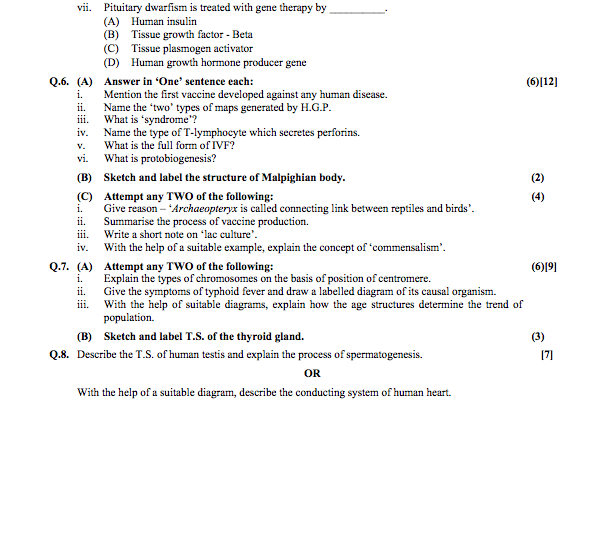
Q.15 Classify the chromosomes on the basis of position of centromere.

Answer: Based on the position of the centromere, chromosomes are classified into four types:
  1. Metacentric: The centromere is situated in the middle of the chromosome. The two arms are nearly equal in length. It appears 'V' shaped during anaphase.
  2. Sub-metacentric: The centromere is situated slightly away from the middle. One arm is shorter than the other. It appears 'L' shaped during anaphase.
  3. Acrocentric: The centromere is situated near the end of the chromosome. One arm is very short and the other is very long. It appears 'J' shaped during anaphase.
  4. Telocentric: The centromere is situated at the tip (proximal end) of the chromosome. It has only one arm and appears rod-shaped ('i' shaped).
(2)

Q.16 Sketch and label structure of male gametophyte in angiosperm.

Answer:
Male Gametophyte Diagram (A diagram should be drawn showing a germinating pollen grain with a pollen tube containing two male gametes, a tube nucleus, and cytoplasm.)
Labels required:
  • Exine / Intine (Pollen wall)
  • Pollen Tube
  • Tube Nucleus
  • Male Gametes (Two)
  • Cytoplasm
(2)

Q.17 Match the following and rewrite:

Group ‘A’Group ‘B’
i. Diethyle Carbamacinea. AIDS
ii. Widal testb. Pneumonia
iii. Albendazolec. Filariasis
iv. HAARTd. Typhoid
e. Ascariasis
Answer:
Group ‘A’ Correct Match (Group ‘B’)
i. Diethyle Carbamacine c. Filariasis
ii. Widal test d. Typhoid
iii. Albendazole e. Ascariasis
iv. HAART (Highly Active Antiretroviral Therapy) a. AIDS
(2)

Q.18 Complete the following chart and rewrite:

AgenciesType of Pollination
i. Water……….
ii. ……….Entomophily
iii. Bat……….
iv. ……….Ornithophily
OR

Explain outbreeding devices in angiospermic plants.

Answer (Main Question):
AgenciesType of Pollination
i. WaterHydrophily
ii. InsectsEntomophily
iii. BatChiropterophily
iv. BirdsOrnithophily

Answer (OR Question): Outbreeding Devices: These are mechanisms that discourage self-pollination and encourage cross-pollination to prevent inbreeding depression.
  1. Unisexuality (Dicliny): The plant bears either male or female flowers, making self-pollination impossible (e.g., Papaya).
  2. Dichogamy: Anthers and stigma mature at different times.
    • Protandry: Anthers mature first (e.g., Sunflower).
    • Protogyny: Stigma matures first (e.g., Gloriosa).
  3. Prepotency: Pollen of other flowers germinates rapidly over the stigma than the pollen from the same flower (e.g., Apple).
  4. Heterostyly: Anthers and stigma are placed at different levels (e.g., Primrose).
  5. Self-sterility (Self-incompatibility): Pollen grains fail to germinate on the stigma of the same flower (e.g., Tobacco).
SECTION C
(3)

Q.19 What is Biofortification? Explain selective breeding with suitable example.

Answer: Biofortification: It is the method of breeding crops with higher levels of vitamins, minerals, or higher protein and healthier fats to improve public health and overcome hidden hunger.

Selective Breeding (Conventional Breeding):
  • Selective breeding is a traditional method of plant breeding where parents with desirable traits (like high nutrient content or high yield) are selected and crossed.
  • The progeny (offspring) are then selected based on the presence of the desired combination of traits. This process is repeated over generations to stabilize the trait.
  • Example: Hybrid maize with twice the amount of amino acids lysine and tryptophan was developed using selective breeding. Wheat variety 'Atlas 66' with high protein content has been used as a donor for improving cultivated wheat.
(3)

Q.20 In the light of Griffith’s experiment, explain the action of two strains of Diplococcus pneumoniae and give his conclusion.

Answer: Frederick Griffith used two strains of Diplococcus pneumoniae (Streptococcus pneumoniae):
  1. S-Strain (Smooth): Virulent, pathogenic, encapsulated (has a mucous coat), causes pneumonia.
  2. R-Strain (Rough): Non-virulent, non-pathogenic, non-capsulated, does not cause pneumonia.
The Experiment Steps:
  • Step 1: Injected Live R-strain into mice → Mice Survived (No disease).
  • Step 2: Injected Live S-strain into mice → Mice Died (Pneumonia).
  • Step 3: Injected Heat-killed S-strain into mice → Mice Survived.
  • Step 4: Injected Heat-killed S-strain + Live R-strain into mice → Mice Died.
Conclusion: Griffith recovered live S-strain bacteria from the dead mice in Step 4. He concluded that some "Transforming Principle" from the heat-killed S-strain had entered the live R-strain bacteria and transformed them into virulent S-strain bacteria by enabling them to synthesize a smooth polysaccharide capsule.
(3)

Q.21 Give scientific reasons:

(A) The pyramid of energy is always upright.
(B) In an ecosystem the energy flow is always unidirectional.
(C) Ozone present in the stratosphere is called as “good ozone”.
Answer: (A) The pyramid of energy is always upright: According to the second law of thermodynamics and the 10% law, when energy is transferred from one trophic level to the next, only about 10% is stored as biomass. The remaining 90% is lost as heat for metabolic activities. Therefore, energy decreases at each successive trophic level, keeping the base broad and the top narrow.

(B) In an ecosystem the energy flow is always unidirectional: Energy enters the ecosystem from the Sun (captured by producers). It passes to consumers and decomposers. However, energy lost as heat to the environment cannot be reused by plants for photosynthesis. It cannot flow backward from consumers to producers; hence, it is unidirectional.

(C) Ozone present in the stratosphere is called as “good ozone”: This ozone layer acts as a shield absorbing ultraviolet (UV) radiation from the sun. UV rays are highly injurious to living organisms (causing skin cancer, mutation, etc.). Since stratospheric ozone protects life on Earth, it is called "good ozone" (unlike tropospheric ozone, which is a pollutant).
(3)

Q.22 Define ‘reproductive isolation’ and explain two types of reproductive isolation.

Answer: Definition: Reproductive isolation refers to the mechanisms or barriers that prevent two different species from interbreeding and producing fertile offspring, thereby maintaining the integrity of the species.

Types of Reproductive Isolation (Pre-mating mechanisms):
  1. Temporal Isolation: Different species breed at different times of the day, different seasons, or different years, preventing them from mating. (e.g., American toad mates in early summer, Fowler's toad in late summer).
  2. Ethological (Behavioral) Isolation: Members of two populations have different mating rituals or courtship behaviors. If the female does not recognize the courtship display of the male, mating does not occur.
(Other types include Mechanical Isolation, Habitat Isolation, Gametic Mortality, etc.)
(3)

Q.23 Name the connecting link between glycolysis and TCA cycle and explain it.

Answer: The connecting link between Glycolysis and TCA (Krebs) cycle is the Acetylation of Pyruvate (or Link Reaction).

Explanation:
  • The end product of glycolysis is Pyruvate (3-carbon), which is produced in the cytoplasm.
  • Pyruvate enters the mitochondrial matrix.
  • It undergoes oxidative decarboxylation. One molecule of \(CO_2\) is removed, and NAD+ is reduced to NADH + \(H^+\).
  • The remaining 2-carbon fragment (acetyl group) combines with Coenzyme-A (CoA) to form Acetyl Co-A.
Reaction:
$$ \text{Pyruvate} + \text{NAD}^+ + \text{CoA} \xrightarrow[\text{Pyruvate Dehydrogenase}]{\text{Mg}^{++}} \text{Acetyl-CoA} + \text{NADH} + \text{H}^+ + \text{CO}_2 $$
(3)

Q.24 Explain internal structure of kidney with the help of suitable diagram.

Answer:
L.S. of Kidney Diagram (Diagram of L.S. of Kidney showing Cortex, Medulla, Pyramids, Pelvis, Ureter)
Explanation:
  1. Capsule: The kidney is covered by a tough, fibrous connective tissue layer called the renal capsule.
  2. Cortex: The outer dark red region is called the Cortex. It contains Malpighian bodies, PCT, and DCT of nephrons.
  3. Medulla: The inner pale red region is the Medulla. It is divided into conical masses called Renal Pyramids (6 to 20 in number). It contains the Loop of Henle and collecting ducts.
  4. Columns of Bertini: The extensions of the cortex into the medulla between the pyramids are called Renal Columns of Bertini.
  5. Pelvis: The broad funnel-shaped space near the hilum is called the Renal Pelvis. The tips of pyramids (Renal Papillae) open into calyces which lead to the pelvis and finally the ureter.
(3)

Q.25 Explain the mechanism of reflex action with the help of a suitable diagram.

Answer:
Reflex Arc Diagram (Diagram showing Receptor, Sensory Neuron, Spinal Cord/Interneuron, Motor Neuron, Effector Muscle)
Mechanism of Reflex Action: It is a sudden, involuntary, and instantaneous response to a stimulus. The path traveled by the impulse is called the Reflex Arc.
  1. Receptor: Receives the stimulus (e.g., skin touching a hot object).
  2. Sensory Neuron (Afferent): Transmits the impulse from the receptor to the spinal cord via the dorsal root.
  3. Association Neuron (Interneuron): Located in the spinal cord, it processes the information and transfers it to the motor neuron.
  4. Motor Neuron (Efferent): Carries the impulse from the spinal cord to the effector organ via the ventral root.
  5. Effector: The muscle or gland that responds (e.g., muscle contraction to withdraw hand).
(3)

Q.26 Define pollution. “Industries are pouring poison in water”– Explain.

Answer: Definition: Pollution is an undesirable change in the physical, chemical, or biological characteristics of air, water, or land that is harmful to human life and other living organisms.

"Industries are pouring poison in water" – Explanation:
  • Industrial effluents often contain toxic substances like heavy metals (Mercury, Lead, Cadmium), organic compounds, acids, and alkalis.
  • When released into water bodies without treatment, these substances kill aquatic life (fish, plants).
  • Bioaccumulation: Toxins like mercury and DDT enter the food chain and their concentration increases at successive trophic levels (Biomagnification), eventually poisoning humans (e.g., Minamata disease).
  • High organic load from industries like sugar mills increases Biological Oxygen Demand (BOD), reducing dissolved oxygen and suffocating aquatic life. Thus, untreated industrial waste acts as poison for the water ecosystem.
(3)

Q.27 With the help of a suitable diagram, describe ultra structure of the cell organelle, which is essential for photosynthesis.

OR

During photosynthesis “O2 is evolved from water molecule and not from CO2”. Give the experimental proof given by Robert Hill.

Answer (Main Question - Chloroplast):
Ultrastructure of Chloroplast (Diagram showing Double membrane, Stroma, Granum, Thylakoids, Intergranal lamellae)
The organelle essential for photosynthesis is the Chloroplast.
  1. Envelope: It is bounded by a double membrane (outer and inner).
  2. Stroma (Matrix): The colorless, proteinaceous ground substance inside. It contains enzymes for the Dark reaction, DNA, RNA, and ribosomes (70S).
  3. Thylakoids: Flattened sac-like structures present in the stroma. The membrane of thylakoids contains photosynthetic pigments (Chlorophyll).
  4. Grana: Thylakoids are stacked like coins to form Grana. This is the site of the Light reaction.
  5. Intergranal Lamellae (Stroma Lamellae): These connect different grana.

Answer (OR Question - Hill's Reaction): Robert Hill's Experiment (1937):
  • Robert Hill suspended isolated chloroplasts from spinach leaves in water which was free of \(CO_2\).
  • He added a hydrogen acceptor (like ferric salts or hemoglobin) to the suspension.
  • On illuminating the suspension, he observed that oxygen bubbles were evolved and the hydrogen acceptor was reduced (Ferric to Ferrous).
  • Since there was no \(CO_2\) present in the mixture, the oxygen must have come from the water ($H_2O$).
  • Conclusion: This proved that the source of \(O_2\) evolved during photosynthesis is the photolysis of water, not carbon dioxide.
SECTION D
(5)

Q.28 Explain with help of a suitable diagram conducting system of human heart.

OR

Give reasons:

(A) Lymphatic vessels are milky in appearance.
(B) Monocytes are called scavengers.
(C) The wall of left ventricle is thicker than right ventricle.
(D) Valves are present in the veins.
(E) Pulmonary veins carry oxygenated blood.
Answer (Main Question): The conducting system consists of specialized cardiac muscle fibers that initiate and conduct cardiac impulses.
Conducting System of Heart (Diagram showing SA Node, AV Node, Bundle of His, Purkinje Fibers)
  1. SA Node (Sino-atrial Node): Located in the wall of the right atrium near the opening of the superior vena cava. It acts as the "Pacemaker" because it generates the impulse for heart contraction.
  2. AV Node (Atrio-ventricular Node): Located in the lower left corner of the right atrium near the inter-atrial septum. It receives the impulse from the SA node.
  3. Bundle of His (AV Bundle): Arises from the AV node and divides into right and left branches running down the interventricular septum.
  4. Purkinje Fibers: Fine fibers arising from the bundle branches that spread into the walls of the ventricles. They convey the impulse to the ventricular muscles causing contraction.

Answer (OR Question):
  1. Lymphatic vessels are milky: The lymph vessels originating from the intestine (lacteals) absorb fats. The presence of these absorbed fats gives the lymph a milky appearance, hence they are called lacteals or look milky.
  2. Monocytes are scavengers: Monocytes are large phagocytic WBCs. They engulf and destroy damaged cells, dead tissue, and cellular debris at the site of infection, effectively "cleaning" the area.
  3. Left ventricle wall is thicker: The left ventricle has to pump blood to all parts of the body (systemic circulation) against high pressure, whereas the right ventricle only pumps to the lungs nearby. The thick muscular wall provides the force required.
  4. Valves in veins: Blood pressure in veins is very low, and they carry blood against gravity towards the heart. Valves prevent the backflow of blood.
  5. Pulmonary veins carry oxygenated blood: By definition, veins carry blood towards the heart. Pulmonary veins bring blood from the lungs (where oxygenation occurs) to the left atrium; hence, they carry oxygenated blood.
(5)

Q.29 Which phenomenon gives 2:1 ratio instead of 3:1 ratio? Describe with graphical representation.

OR

A pea plant homozygous for yellow round seed is crossed with its recessive parents. Calculate the phenotypic and genotypic ratio with the help of checker board.

Answer (Main Question): The phenomenon is Lethal Genes. In certain cases, a gene in the homozygous condition causes the death of the organism.
Example: Coat color in Mice or Sickle Cell Anemia.
Sickle Cell Anemia Example:
  • \(Hb^A\): Normal gene (Dominant)
  • \(Hb^S\): Sickle cell gene (Recessive/Co-dominant)
Cross between two Carriers (Sickle-cell trait):
Parents: Carrier (\(Hb^A Hb^S\)) x Carrier (\(Hb^A Hb^S\))

Gametes \(Hb^A\) \(Hb^S\)
\(Hb^A\) \(Hb^A Hb^A\) (Normal) \(Hb^A Hb^S\) (Carrier)
\(Hb^S\) \(Hb^A Hb^S\) (Carrier) \(Hb^S Hb^S\) (Sickle cell Anaemic - Dies)

Result:
  • Genotypes produced: 1 \(Hb^A Hb^A\) : 2 \(Hb^A Hb^S\) : 1 \(Hb^S Hb^S\)
  • Since \(Hb^S Hb^S\) is lethal and the individual dies, the surviving ratio is modified.
  • Ratio: 1 Normal : 2 Carriers i.e., 2:1.

Answer (OR Question): Note: The question states "Homozygous (YYRR) crossed with recessive parents (yyrr)". This produces F1 hybrids. Usually, a 5-mark question implies finding the F2 ratio (Dihybrid Cross) or a Dihybrid Test Cross. Below is the solution for the Dihybrid Cross (F2 generation) as per standard board pattern.

1. Parents: Yellow Round (YYRR) x Green Wrinkled (yyrr)
2. F1 Generation: All Yellow Round (YyRr)
3. Selfing F1: YyRr x YyRr
Gametes: YR, Yr, yR, yr

Checker Board (F2 Generation):
♂ / ♀ YR Yr yR yr
YR YYRR (Yellow Round) YYRr (Yellow Round) YyRR (Yellow Round) YyRr (Yellow Round)
Yr YYRr (Yellow Round) YYrr (Yellow Wrinkled) YyRr (Yellow Round) Yyrr (Yellow Wrinkled)
yR YyRR (Yellow Round) YyRr (Yellow Round) yyRR (Green Round) yyRr (Green Round)
yr YyRr (Yellow Round) Yyrr (Yellow Wrinkled) yyRr (Green Round) yyrr (Green Wrinkled)

Phenotypic Ratio: 9 Yellow Round : 3 Yellow Wrinkled : 3 Green Round : 1 Green Wrinkled (9:3:3:1)
Genotypic Ratio: 1:2:1:2:4:2:1:2:1
(5)

Q.30 After puberty human female shows cyclic changes in her reproductive system. Explain structural and hormonal changes in the uterus.

OR

Give reasons:

(A) Scrotal sac serves as thermoregulator.
(B) Corpus luteum gets converted into corpus albicans in absence of fertilization.
(C) Missing of menses is the first indication of pregnancy.
(D) Surgical sterilization is a permanent method of birth control.
(E) Human egg is microlecithal.
Answer (Main Question): The cyclic changes in the uterus constitute the Menstrual Cycle. It has three phases:
  1. Menstrual Phase (Bleeding Phase): (Days 1-5)
    • Hormones: Progesterone and Estrogen levels fall sharply due to degeneration of corpus luteum.
    • Structure: The endometrium breaks down. Blood vessels rupture, causing bleeding. The unfertilized egg and tissue debris are discharged.
  2. Proliferative Phase (Follicular Phase): (Days 5-13)
    • Hormones: FSH stimulates follicle development which secretes Estrogen. Estrogen stimulates repair.
    • Structure: The endometrium regenerates. It becomes thicker (3-5mm) and vascular. Glands become active.
  3. Secretory Phase (Luteal Phase): (Days 15-28)
    • Hormones: LH causes ovulation and formation of Corpus Luteum. Corpus Luteum secretes large amounts of Progesterone.
    • Structure: Endometrium becomes maximum thickened, highly vascular, and glandular (uterine milk) to prepare for implantation. If fertilization does not occur, it degenerates, leading back to the menstrual phase.

Answer (OR Question):
  1. Thermoregulator: The testes need a temperature 2-3°C lower than body temperature for spermatogenesis. The scrotum hangs outside the body and its muscles contract or relax to adjust the distance from the body, maintaining this optimal temperature.
  2. Corpus Albicans: If fertilization does not occur, the egg dies. The high levels of LH drop. The Corpus Luteum degenerates and becomes a white scar tissue called Corpus Albicans.
  3. Missing Menses: During pregnancy, the corpus luteum persists and secretes progesterone, which maintains the endometrium. Hence, the shedding (menstruation) stops. This amenorrhea is the first sign.
  4. Permanent Method: In surgical sterilization (Vasectomy/Tubectomy), the gamete transport path is cut and tied. This makes gamete transport impossible permanently, and reversal is very difficult.
  5. Microlecithal: Human eggs develop inside the mother's uterus and receive nutrition via the placenta. Therefore, they do not need large stored food (yolk). Hence, they contain very little yolk (Microlecithal).
Question Paper Page No. 1 Question Paper Page No. 2 Question Paper Page No. 3 Question Paper Page No. 4 Question Paper Page No. 5 Question Paper Page No. 6 Question Paper Page No. 7 Maharashtra Board Question Paper

Biology October 2017 HSC Board Question Paper Maharashtra Board

BIOLOGY JULY 2017 HSC

Board Paper With Solutions

HSC Biology

Biology July 2017 HSC Page 1
Biology July 2017 HSC Page 2
Biology July 2017 HSC Page 3
Biology July 2017 HSC Page 4
Biology July 2017 HSC Page 5