Tuesday, February 27, 2018
HSC 12th Board Exam Solutions: Information Technology - Moto G5 Plus Case Study

HSC 12th Board Exam Paper Solutions
Below are the comprehensive solutions and detailed notes regarding the specific case study question on the Moto G5 Plus.
The Moto G5 Plus represents a significant iteration in the Moto G series, known for bringing premium features to the budget-friendly segment. It is widely recognized for its metal unibody design, which was a departure from the plastic construction of its predecessors. The device aims to balance performance and battery efficiency, making it a staple example in mobile hardware studies.
The performance of the device is driven by the following hardware components:
- Processor: Qualcomm Snapdragon 625 octa-core processor clocked at 2.0 GHz. This chipset is renowned for its thermal efficiency.
- RAM: Available in 2GB, 3GB, and 4GB variants, allowing for versatile multitasking capabilities.
- Storage: Internal storage options of 32GB or 64GB, expandable via a dedicated microSD card slot.
- Battery: A 3000 mAh non-removable Li-Ion battery supporting TurboPower charging.
The Moto G5 Plus features a 12-megapixel rear camera that utilizes "Dual Pixel" autofocus technology. A key highlight is its wide aperture, which allows more light to enter the sensor, improving low-light photography.
The relationship between the focal length and the diameter of the entrance pupil is defined by the f-number equation:
$$ N = \frac{f}{D} $$Where:
- \( N \) is the f-number (Aperture).
- \( f \) is the focal length.
- \( D \) is the diameter of the entrance pupil.
The Moto G5 Plus boasts an impressive aperture of f/1.7, which is mathematically significant as it allows approximately \( \sqrt{2} \) times more light compared to a standard f/2.2 aperture often found in this segment.
Display: The device sports a 5.2-inch IPS LCD panel with a Full HD resolution (1920 x 1080 pixels). The pixel density can be calculated as approximately 424 PPI (Pixels Per Inch).
Build: The shift to a high-grade aluminum finish gives the device a premium feel. It also includes a water-repellent nano-coating, protecting the internal circuits from moderate exposure to water.

Monday, February 26, 2018
SP MARCH 2018 BOARD QUESTION PAPER
SP MARCH 2018 BOARD QUESTION PAPER
Note for Students: Review the question paper scans below before proceeding to the solutions.


Q. 1. A. Answers
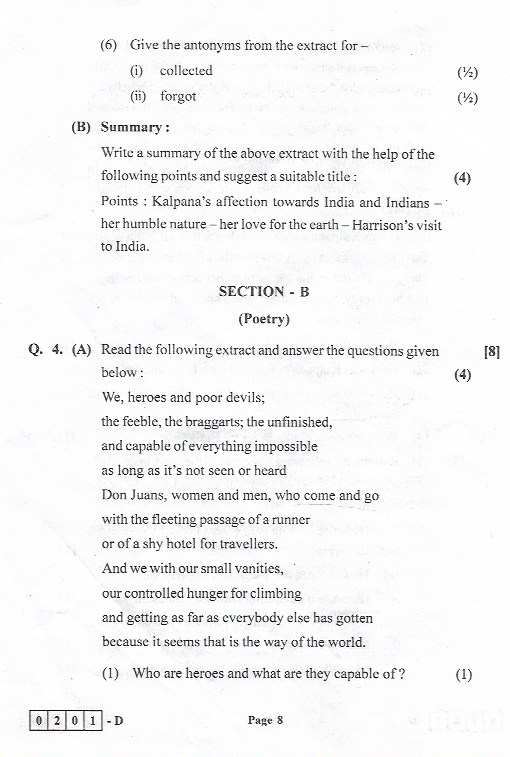
Q. 1. B. Answers
Q. 1. C. Answers
Secretarial Practice Board Papers
- S.P. - March 2025 - English Medium View Answer Key
- S.P. - March 2025 - Marathi Medium View Answer Key
- S.P. - March 2025 - HIndi Medium View Answer Key
- S.P. - March 2024 - English Medium View Answer Key
- S.P. - March 2024 - Marathi Medium Download QP Answer Key Answer Key
- S.P. - March 2024 - Hindi Medium View Answer Key
- S.P. - March 2022 View
- S.P. - March 2014 View
- S.P. - October 2014 View
- S.P. - March 2015 View
- S.P. - July 2015 View
- S.P. - March 2016 View
- S.P. - July 2016 View
- S.P. - March 2017 View
- S.P. - July 2017 View
- S.P. - March 2018 View
- S.P. - July 2018 View
- S.P. - February 2019 View
Q. 2. Distinguish between the following (Any Three)
Q. 3. Write notes on the following.
Q. 4. State with reasons, whether the following statements are True or False.
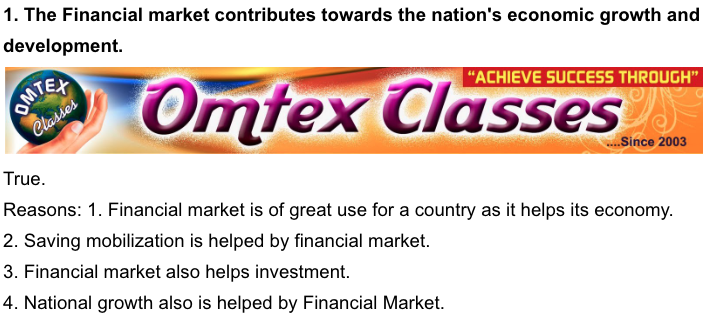


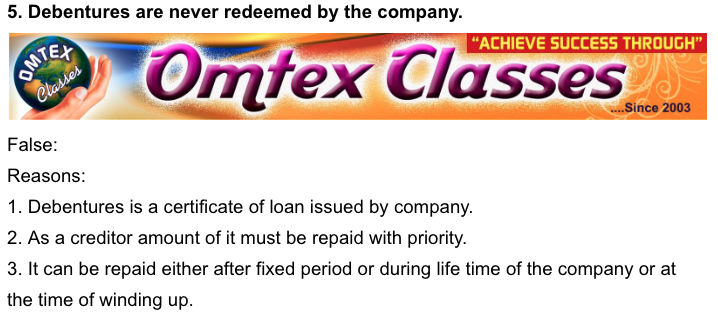
Q. 5. Attempt the following. (Any Two)


Sunday, February 25, 2018
HSC ENGLISH MARCH 2018 SET D BOARD QUESTION PAPER

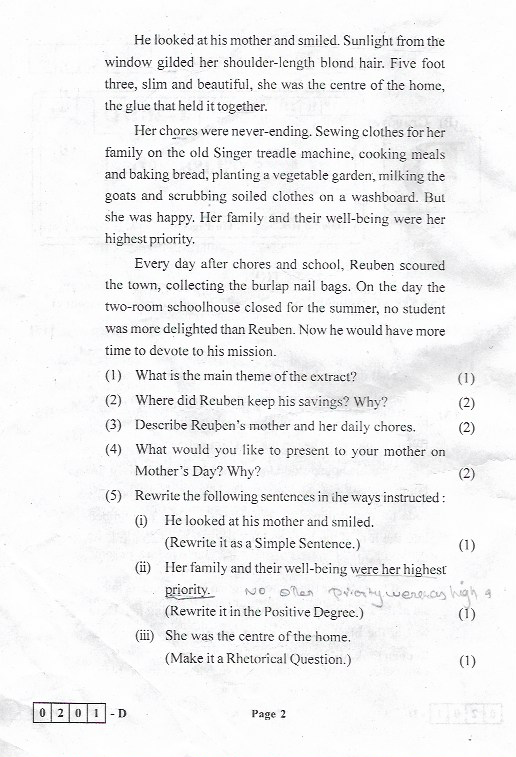

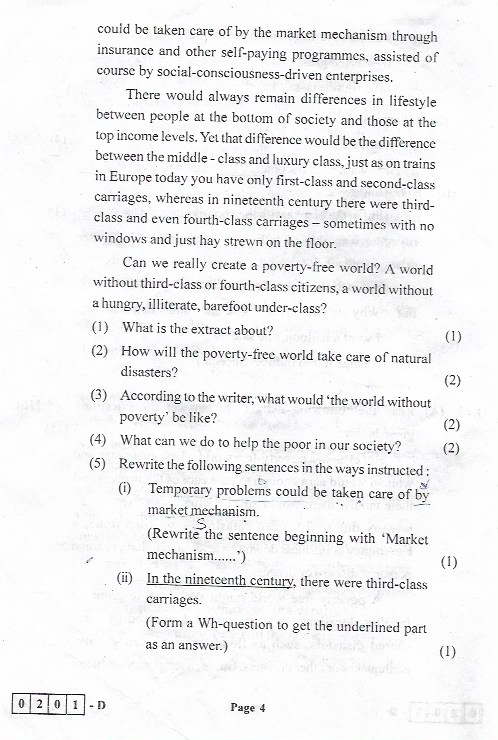






HSC English (01) Question Paper Solution - 2018 Set D
SECTION - A
(Reading Skill, Grammar, Vocabulary, Note-making and Summary)
Q. 1. (A) Read the following extract and answer the questions given below:
12th English Board Papers
- English - February 2025 View Answer Key
- English - July 2025 View Answer Key
- English - February 2024 View Answer Key
- English - July 2024 View Answer Key
- English - February 2023 View Answer Key
- English - July 2023 View Answer Key
- English - February 2022 View Answer Key
- English - February 2022 View Answer Key
- English - July 2022 View Answer Key
- English - September 2021 View Answer Key
- English - March 2020 Set A View
- English - March 2020 Set B View
- English - March 2020 Set C View
- English - March 2020 Set D View
- English - March 2014 View
- English - October 2014 View
- English - March 2015 View
- English - July 2015 View
- English - March 2016 Set A View
- English - March 2016 Set B View
- English - March 2016 Set C View
- English - March 2016 Set D View
- English - July 2016 Set A View
- English - July 2016 Set B View
- English - July 2016 Set C View
- English - July 2016 Set D View
- English - March 2017 Set A View
- English - March 2017 Set B View
- English - March 2017 Set C View
- English - March 2017 Set D View
- English - July 2017 Set A View
- English - March 2018 Set A View
- English - March 2018 Set B View
- English - March 2018 Set C View
- English - March 2018 Set D View
- English - March 2019 Set A View
- English - March 2019 Set B View
- English - March 2019 Set C View
- English - March 2019 Set D View
(B) Grammar: Do as directed
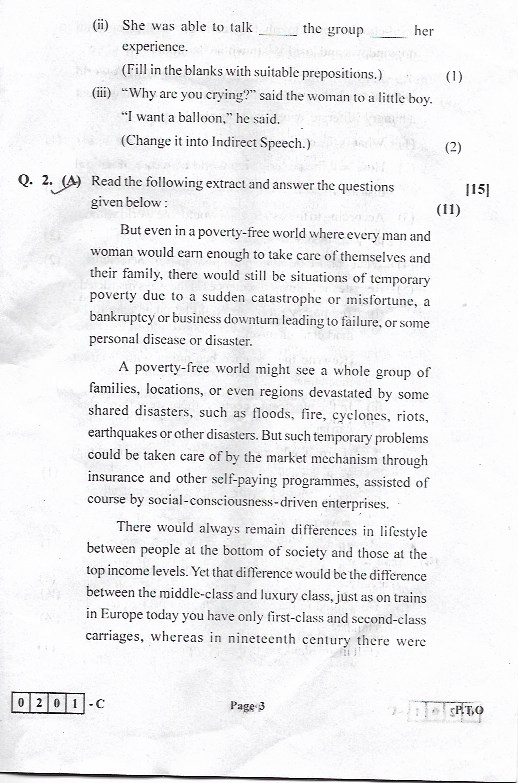
Q. 2. (A) Read the following extract and answer the questions given below:
(B) Note-making:
| Title | Sarvepalli Radhakrishnan |
|---|---|
| Birth | 5th September, 1888 |
| Qualifications | B.A., M.A. |
| Introduced thinking of | Western idealist philosophers, and translated it into Indian thought. |
| Work | Translated Indian Philosophy into standard academic jargon |
| Ambassador | to the Soviet Union |
| Honours | National: Bharat Ratna International: Templeton Prize Order of Merit |
Q. 3. (A) Read the following extract and answer the questions given below:
(B) Summary:
Kalpana’s Eternal Bond with Earth and India
Kalpana Chawla, despite her celebrity status as an astronaut, remained humble and deeply connected to her Indian roots. She took pride in her birthplace, staying in touch with old friends and teachers. Beyond her patriotism, she harbored a deep concern for the Earth's well-being, urging youth to protect the fragile planet. Although she could not return to India alive, her husband, Harrison, fulfilled her cherished desire by visiting her alma maters and scattering her ashes over the Himalayas, forever uniting her with the land she loved.
SECTION - B
(Poetry)
Q. 4. (A) Read the following extract and answer the questions given below:
(B) Read the following extract and answer the questions given below:
SECTION - C
(Rapid Reading and Composition)
Q. 5. (A) Read the following extract and rewrite it from the point of view of Roma:
Herman and I shared the backseat of Sid’s car. As European Jews who had survived the war, we were aware that much had been left unsaid between us. I broached the subject, "Where were you during the war?" I asked softly.
"The camps," he said, the terrible memories still vivid, the irreparable loss, he had tried to forget. But you can never forget.
I nodded, "My family was hiding on a farm in Germany, not far from Berlin," I told him. "My father knew a priest, and he got us Aryan papers."
I imagined how he must have suffered too, fear, a constant companion. And yet here we were both survivors, in a new world.
"There was a camp next to the farm," I continued. "I saw a boy there and I would throw him apples every day."
What an amazing coincidence that I had helped some other boy. "What did he look like?" he asked.
"He was tall, skinny and hungry. I must have seen him every day for six months."
(B) Read the following extract and convert it into a continuous write-up in about 120 words:
Mrs Green was asking to come in. My mother welcomed her warmly, asking her to sit down and inquiring if she required a room. Mrs Green politely declined the room for the day, explaining that she was staying with Padre Dutt who had insisted on putting her up. However, she mentioned she might want a room for a day or two later, just for old times' sake.
The narrator remarked that she had stayed there before. Mrs Green confirmed it was a long time ago and revealed that she was the "missing Mrs Green"—the very one for whom the narrator's mother had put up a handsome tombstone in the cemetery. She expressed how touched she was by the gesture and was glad the inscription didn't say 'Beloved Wife of Henry Green,' as she confessed she didn't love him any more than he loved her.
SECTION - D
(Written Communication)
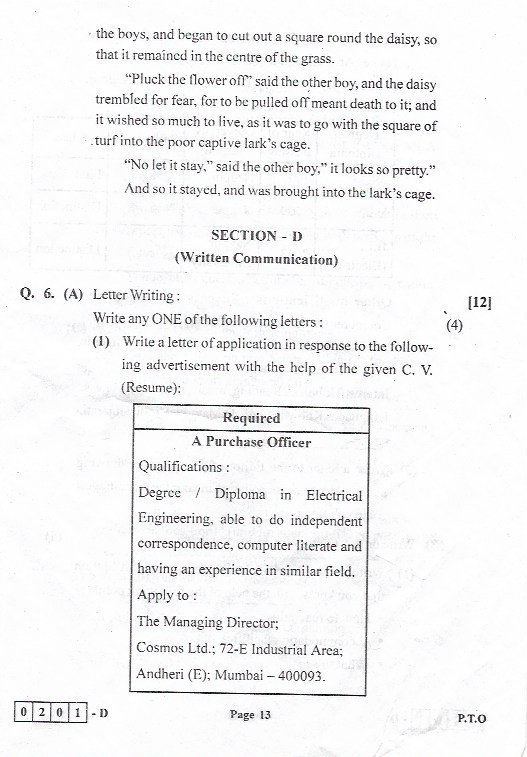
Q. 6. (A) Letter Writing:
Aruna Anil Shinde
B1-104, Rose Parade,
S. B. Road, Nagpur.
Date: 26th February 2018
To,
The Managing Director,
Cosmos Ltd.,
72-E Industrial Area,
Andheri (E), Mumbai – 400093.
Subject: Application for the post of Purchase Officer.
Reference: Your advertisement in 'The Daily Times' dated 25th February 2018.
Respected Sir/Madam,
With reference to the advertisement mentioned above, I wish to apply for the post of Purchase Officer in your esteemed organization. I have the necessary qualifications and experience required for this position.
I have completed my B.E. (Electrical) from Nagpur University with distinction (78%) in 2013. Additionally, I have successfully completed a Computer Diploma from NIIT, Nagpur in 2014, making me proficient in computer operations necessary for independent correspondence and inventory management.
I possess relevant work experience, having worked as a Purchase Officer at Login Private Ltd., Nagpur for the past three years. I am looking for better career prospects and a challenging environment to grow, which I believe Cosmos Ltd. can provide.
I have enclosed my C.V. for your kind perusal. I hope for a positive response and an opportunity to be interviewed.
Thanking you,
Yours faithfully,
(Signature)
Aruna Anil Shinde
Encl: Curriculum Vitae
Name: Aruna Anil Shinde
Address: B1-104, Rose Parade, S. B. Road, Nagpur.
Date of Birth: 15th August 1991
Email: aruna.shinde@email.com
Educational Qualifications:
| Degree/Diploma | Year | University/Board | Percentage | Class |
|---|---|---|---|---|
| B.E. (Electrical) | 2013 | Nagpur University | 78% | Distinction |
| HSC | 2009 | Nagpur Board | 76% | Distinction |
| SSC | 2007 | Nagpur Board | 72% | First |
Other Qualifications: Computer Diploma from NIIT, Nagpur (2014).
Work Experience: 3 Years as Purchase Officer at Login Private Ltd., Nagpur.
Languages Known: English, Marathi, Hindi, Gujarati.
Hobbies: Reading, music, swimming, chess.
(B) Write on any ONE of the following items:
VISIT MAJESTIC MATHERAN
The Pollution-Free Paradise
How to Reach There:
- By Rail: Nearest railhead is Neral Junction on the Central Railway. From Neral, take the famous Toy Train or a taxi to Dasturi Naka.
- By Road: Well connected by road from Mumbai (100 km) and Pune (120 km). Vehicles must be parked at Dasturi Naka.
Accommodation Facilities:
- Luxury Heritage Hotels like The Verandah in the Forest.
- Budget-friendly lodges and MTDC resorts are available.
- Homestays for a local experience.
What to See:
- Panorama Point: For a 360-degree view of the surrounding hills.
- Charlotte Lake: The main water source and a serene picnic spot.
- Echo Point: Shout and hear the mountains answer back!
- Louisa Point: Offers majestic views of the Prabal Fort.
Shopping Attractions:
- Famous for leather goods (Kolhapuri chappals, bags).
- Chikki (sweet peanut brittle) and honey.
- Handicrafts and cane items.
Anything Special:
Matheran is Asia's only automobile-free hill station! Enjoy horse riding and hand-pulled rickshaws in the fresh, unpolluted air.
(C) Write on any ONE of the following items:
Classification of Morphemes
Morphemes are defined as the smallest linguistic units within a word that can carry a meaning. They are broadly classified into two main categories: Free Morphemes and Bound Morphemes. Bound Morphemes are further subdivided based on their position and function. Based on position, they are classified into Prefixes (initial position), Infixes (middle position), and Suffixes (final position). Based on function, Suffixes can be categorized into Derivational, which are class-changing (changing the grammatical category of the word), and Inflexional, which are class-maintaining (keeping the word in the same grammatical category) and attached to a Bound base.
Q. 7. Answer the following questions as per instructions:
Interview Questions for Ms. P.V. Sindhu (Badminton Player)
- Welcome to our college, Ma'am. How does it feel to be back in a college atmosphere?
- At what young age did you decide that badminton was your true calling?
- Who has been your biggest inspiration and support system throughout your journey?
- Could you share some of the biggest challenges you faced during your early training years?
- You have won numerous medals. Which specific match or victory is closest to your heart and why?
- How do you handle the immense pressure and expectations before a major international tournament like the Olympics?
- What is your daily fitness regimen and diet plan that keeps you in such great shape?
- How do you balance your personal life with the demanding schedule of a professional athlete?
- What changes would you like to see in the sports infrastructure in India to support upcoming talent?
- Finally, what message would you like to give to the aspiring young athletes of our college?
Save Trees, Trees Save
Respected Principal, teachers, and my dear friends,
A very good morning to all of you. Today, I stand before you to speak on a topic that is not just a slogan, but a lifeline for our survival: "Save Trees, Trees Save."
Since the dawn of civilization, trees have been the silent providers of human needs. They give us the very air we breathe, the food we eat, the wood for our shelter, and medicines to heal our bodies. Yet, in our greed for urbanization, we are ruthlessly cutting them down.
We must realize that trees are the guardians of our ecological balance. They hold the soil together, preventing erosion, and play a crucial role in the water cycle, bringing timely rainshowers that feed our agriculture. Without trees, we invite droughts, floods, and global warming. A world without trees is a world without a future.
Friends, it is time to act. Let us pledge today not to cut trees but to plant more of them. Let us protect our green cover to ensure a healthy environment for ourselves and generations to come. Remember, if we save trees, trees will save us.
Thank you.
HSC ENGLISH MARCH 2018 SET C BOARD QUESTION PAPER
HSC English Question Paper Solution 2018
Maharashtra State Board - Std 12 - English (01) - Set C








(i) I rushed to the site. (Rewrite the sentence using 'used to'.)
Answer: I used to rush to the site.
(ii) The tree was being cut. (Rewrite it beginning with 'They ...'.)
Answer: They were cutting the tree.
(iii) I looked into all the nests and saw smashed eggs in two of them. (Rewrite the sentence using the word 'when'.)
Answer: When I looked into all the nests, I saw smashed eggs in two of them.
(i) neatly: carefully
(ii) stay for longer: linger
12th English Board Papers
- English - February 2025 View Answer Key
- English - July 2025 View Answer Key
- English - February 2024 View Answer Key
- English - July 2024 View Answer Key
- English - February 2023 View Answer Key
- English - July 2023 View Answer Key
- English - February 2022 View Answer Key
- English - February 2022 View Answer Key
- English - July 2022 View Answer Key
- English - September 2021 View Answer Key
- English - March 2020 Set A View
- English - March 2020 Set B View
- English - March 2020 Set C View
- English - March 2020 Set D View
- English - March 2014 View
- English - October 2014 View
- English - March 2015 View
- English - July 2015 View
- English - March 2016 Set A View
- English - March 2016 Set B View
- English - March 2016 Set C View
- English - March 2016 Set D View
- English - July 2016 Set A View
- English - July 2016 Set B View
- English - July 2016 Set C View
- English - July 2016 Set D View
- English - March 2017 Set A View
- English - March 2017 Set B View
- English - March 2017 Set C View
- English - March 2017 Set D View
- English - July 2017 Set A View
- English - March 2018 Set A View
- English - March 2018 Set B View
- English - March 2018 Set C View
- English - March 2018 Set D View
- English - March 2019 Set A View
- English - March 2019 Set B View
- English - March 2019 Set C View
- English - March 2019 Set D View
(i) Temporary problems could be taken care of by market mechanism. (Rewrite the sentence beginning with 'Market mechanism...')
Answer: Market mechanism could take care of temporary problems.
(ii) In the nineteenth century, there were third-class carriages. (Form a Wh-question to get the underlined part as an answer.)
Answer: When were there third-class carriages?
(iii) There would still be situations of temporary poverty. (Rewrite it using 'can'.)
Answer: There can still be situations of temporary poverty.
(i) devastated: destroyed or ruined
(ii) hay: dried grass
Birth: 5th September, 1888
Qualifications: B.A., M.A.
Introduced thinking of: Western idealist philosophers like Plato, Plotinus, and Bergson into Indian thought.
Work: Translated Indian Philosophy into standard academic jargon.
Ambassador: to the Soviet Union.
Honours:
: National Bharat Ratna
: International Templeton Prize
: Peace Prize of German Book Trade
: Order of Merit
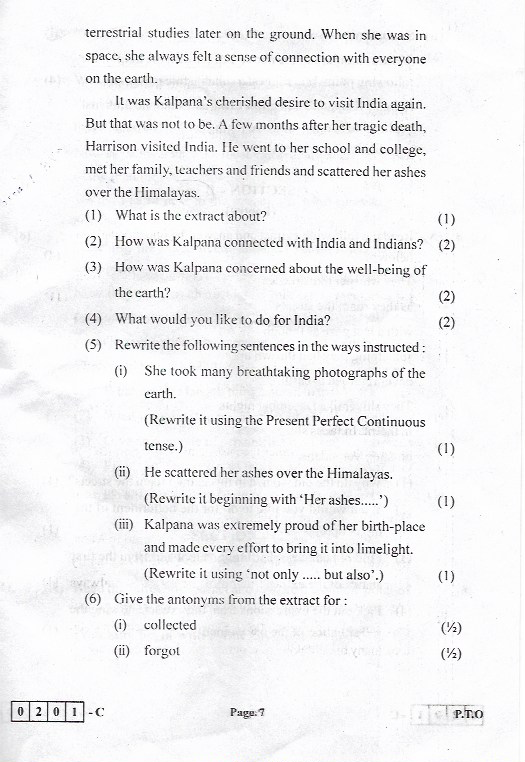
(i) She took many breathtaking photographs of the earth. (Rewrite it using the Present Perfect Continuous tense.)
Answer: She has been taking many breathtaking photographs of the earth.
(ii) He scattered her ashes over the Himalayas. (Rewrite it beginning with 'Her ashes...')
Answer: Her ashes were scattered over the Himalayas by him.
(iii) Kalpana was extremely proud of her birth-place and made every effort to bring it into limelight. (Rewrite it using 'not only ... but also'.)
Answer: Kalpana was not only extremely proud of her birth-place but also made every effort to bring it into limelight.
(i) collected: scattered
(ii) forgot: remembered
Kalpana Chawla: A Down-to-Earth Star
Kalpana Chawla, despite her fame as an astronaut, maintained a humble nature and deep affection for India and Indians. She took great pains to stay connected with her roots, tracking down old teachers and friends. She had a profound love for the Earth, urging youth to protect the fragile planet. Although her cherished desire to visit India again was left unfulfilled due to her tragic death, her husband, Harrison, honoured her wish by visiting India and scattering her ashes over the Himalayas.
One day Rosalind and Celia met me. I did not recognize them because of their stained faces and simple clothes. I thought they were a shepherd boy and his sister. I made friends with them and often came to see them in their cottage.
Rosalind, still dressed as Ganymede, one day made fun of my poetry. 'I'll cure you of your love for this girl Rosalind!' she said. 'I will pretend to be Rosalind and you shall make love to me.'
And there followed an amusing scene with me calling Ganymede "Rosalind" and swearing that I would die of love for her, and Ganymede refusing to believe it. 'Men have died from time to time, and worms have eaten them, but not for love!' said Rosalind, laughing at the earnest Orlando (me).
At last I said I would have to go. 'I must attend the Duke at dinner', I explained, 'but I shall be with you again at two O'clock.'
So Rosalind said goodbye to me, and waited impatiently for my return. Two O'clock came, however, but I did not come, and Rosalind began to feel angry and disappointed. Just then Oliver, my elder brother, came running through the forest to their cottage. He held a blood-stained handkerchief in his hand, which he gave to Rosalind, saying that I had sent it to her.
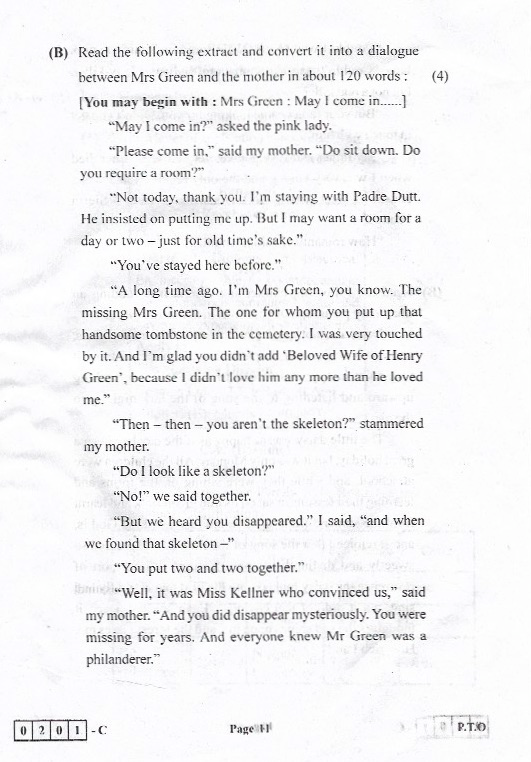
Mrs Green: May I come in?
Mother: Please come in. Do sit down. Do you require a room?
Mrs Green: Not today, thank you. I'm staying with Padre Dutt. He insisted on putting me up. But I may want a room for a day or two – just for old time's sake.
Mother: You've stayed here before.
Mrs Green: A long time ago. I'm Mrs Green, you know. The missing Mrs Green. The one for whom you put up that handsome tombstone in the cemetery. I was very touched by it. And I'm glad you didn't add 'Beloved Wife of Henry Green', because I didn't love him any more than he loved me.
Mother: (stammering) Then – then – you aren't the skeleton?
Mrs Green: Do I look like a skeleton?
Mother: No!
Mrs Green: But we heard you disappeared, and when we found that skeleton — you put two and two together.
Mother: Well, it was Miss Kellner who convinced us. And you did disappear mysteriously. You were missing for years. And everyone knew Mr Green was a philanderer.
Mrs Green: Couldn't wait to get away from him. Couldn't stand him anymore. He was a lady-killer, but not a real killer.
(1) Letter of Application
Aruna Anil Shinde
B1-104, Rose Parade,
S. B. Road, Nagpur.
Date: 21st February 2018
To,
The Managing Director,
Cosmos Ltd.,
72-E Industrial Area,
Andheri (E), Mumbai - 400093.
Subject: Application for the post of Purchase Officer.
Reference: Your advertisement in 'The Times of India' dated 20th February 2018.
Respected Sir/Madam,
With reference to your advertisement mentioned above, I wish to apply for the post of Purchase Officer in your reputed company. I possess the requisite qualifications and experience mentioned in the advertisement.
I have completed my B.E. (Electrical) with distinction and have also successfully completed a Computer Diploma. I have good command over English, Hindi, and Marathi. I have previous work experience as a Purchase Officer which has given me the necessary skills for independent correspondence and management.
I am enclosing my resume herewith for your kind perusal. I assure you that if selected, I shall work with utmost sincerity and dedication.
Thanking you,
Yours faithfully,
(Signature)
Aruna Anil Shinde
Encl: Resume
Name: Aruna Anil Shinde
DOB: 15th August 1985
Education:
- B.E. (Electrical), Nagpur University (2013) - 78% (Distinction)
- H.S.C, Nagpur Board (2009) - 76% (Distinction)
- S.S.C, Nagpur Board (2007) - 72% (First Class)
- Computer Diploma from NIIT, Nagpur (2014)
Experience: Worked as Purchase Officer in Login Private Ltd., Nagpur (3 Years)
Hobbies: Reading, Music, Swimming, Chess
Languages: English, Marathi, Hindi, Gujarati
Visit Majestic Mahabaleshwar
The Queen of Hill Stations
How to Reach There:
Mahabaleshwar is well connected by road. It is approx 120km from Pune and 285km from Mumbai. State transport buses and private taxis are available frequently.
Accommodation Facilities:
A wide range of accommodation is available, from MTDC resorts and budget hotels to luxury 5-star heritage hotels and charming homestays.
What to See:
- Arthur's Seat: For a view of the deep valley.
- Venna Lake: For boating and horse riding.
- Pratapgad Fort: A historical marvel nearby.
- Mapro Garden: For fresh strawberry products.
Shopping Attractions:
Famous for leather footwear (Kolhapuri chappals), wooden artifacts, fresh strawberries, honey, and jams.
Specialty:
The cool, pleasant climate year-round and the stunning strawberry farms make it a unique getaway.
Facebook: A Trap in Disguise
While many argue that Facebook is an excellent networking site that allows people to connect successfully, the reality is often quite different. Far from being purely user-friendly, Facebook poses significant risks. While it allows information sharing with people far and wide, this lack of privacy often leads to data theft and cyberstalking. Users create profile pages that are meant to interrelate with friends, but this often fosters a superficial culture where people obsess over 'likes' rather than genuine connection. Furthermore, addiction to the endless scroll affects productivity and mental health. The platform is also rampant with fake news and misinformation. Therefore, one must view the "friendliness" of this device with caution.
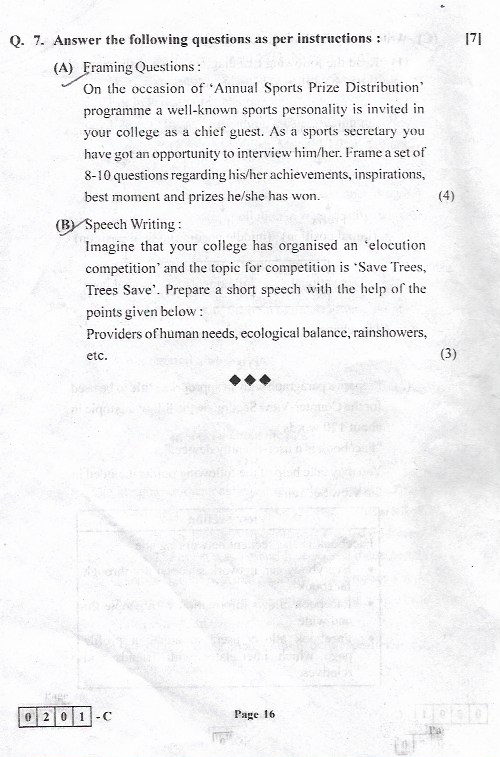
1. Welcome to our college! How does it feel to be here with us today?
2. At what age did you start playing this sport, and who was your biggest inspiration?
3. What do you consider to be your greatest achievement so far?
4. Could you share a memorable moment from your career that you cherish the most?
5. What kind of training schedule do you follow to stay fit and competitive?
6. How do you handle pressure and failures during crucial matches?
7. You have won many prizes and medals; which one is closest to your heart?
8. Who has been your strongest support system throughout your journey?
9. What are your future goals in the field of sports?
10. What message would you like to give to the aspiring sportspersons in our college?
Save Trees, Trees Save
Respected Principal, teachers, and my dear friends,
Today, I stand before you to speak on a topic that is crucial for our very survival: "Save Trees, Trees Save." We often take nature for granted, forgetting that trees are the primary providers of human needs. From the food we eat to the wood for our furniture, and most importantly, the oxygen we breathe, we owe it all to trees.
Trees are the guardians of our ecological balance. They regulate the climate, absorb harmful carbon dioxide, and provide habitats for countless birds and animals. Without them, the delicate balance of our ecosystem would collapse. Furthermore, trees play a vital role in bringing rainshowers and maintaining the water cycle. They bind the soil with their roots, preventing soil erosion and floods.
However, mindless deforestation is threatening our planet. If we do not act now, we face a bleak future. Let us pledge today to plant more trees and protect the existing ones. Remember, if we save trees, trees will save us.
Thank you.