Chapter 15: Biodiversity, Conservation and Environmental Issues
Balbharati Solutions for Biology 12th Standard HSC Maharashtra State Board
Choose the correct option
Observe the graph and select the correct option.
Line A represents, \(S = CA^2\)
Line B represents, \(\log C = \log A + Z \log S\)
Line A represents, \(S = CA^Z\)
Line B represents, \(\log S= \log Z + C \log A\)
Select the odd one out on the basis of Ex-situ conservation.
Zoological park
Tissue culture
Sacred groves
Cryopreservation
Which of the following factors will favour species diversity?
Invasive species
Glaciation
Forest canopy
co extinction
The term “terror of Bengal’ is used for ___________.
algal bloom
water hyacinth
increased BOD
eutrophication
CFC are air polluting agents which are produced by ___________.
Diesel trucks
Jet planes
Rice fields
Industries
Very short answer type question
Give two examples of biodegradable materials released from the sugar industry.
Solution:
Bagasse (dry pulpy residue left after extraction of juice from sugarcane), molasses (the liquid left after the first extraction of sugar) and press mud (organic waste) are biodegradable materials released from the sugar industry.
Name any 2 modern techniques of protection of endangered species.
Solution:
i.Tissue culture
ii.In vitro fertilization
Where was the ozone hole discovered?
Solution:
The ozone hole was discovered over the Antarctic region, wherein a depletion of the ozone layer has resulted in the formation of a large area of the thinned ozone layer, commonly called the ozone hole.
Give one example of natural pollutants.
Solution:
Natural pollutants: Dust (fine particles from sand), fog, mist. fungi, bacteria, moulds, algae, viruses, etc.
What do you understand by the EW category of a living being?
Solution:
Extinct in the Wild (EW): A category containing those species whose members survive only in captivity.
i.During dandiya raas, the use of amplifiers or loudspeakers create lots of noise.
ii.Noise pollution may have many ill effects on human health:
a. Noise causes psychological and physiological changes in human beings.
b. Exposure to extremely high sound level (150 decibels or more) like that generated during a jet plane or rocket take off, may damage eardrums and cause permanent hearing loss.
c. Noise also can cause sleeplessness, increased heartbeat, altered breathing pattern, and psychological stress.
d. Noise may negatively interfere with a child’s learning and behaviour pattern.
iii.There is a need for creating awareness about noise pollution caused during festivals and processions in our society. Thus the Govt. of India has rules and regulations against firecrackers and loudspeakers.
iv.The Supreme court of India banned loudspeakers at public gatherings after 10:00 pm.
v.Also, playing loudspeakers or having public gatherings like dandiya raas after 10 p.m. violates the supreme court orders. Hence, dandiya raas is not allowed after 10.00 pm.
Tropical regions exhibit species richness as compared to polar regions. Justify.
Solution:
i.Factors like overall stability of tropical regions for millions of years, lesser climatic changes throughout the year, and availability of plenty of sunlight have favoured speciation.
ii.Tropical areas have less often experienced drastic disturbances like periodic glaciations observed at poles. Such stability over millions of years might have favoured speciation.
iii.Lesser migrations in tropics might have reduced gene flow between geographically isolated regions and favoured speciation.
iv.Scientists also have considered the availability of more intense sunlight, warmer temperatures and higher annual rainfall in tropics, as factors responsible for the bountifulness of these regions.
v.Some animals enjoy food preferences under climatic conditions and abundance of resources. e.g. Fruits being available throughout the year in rainforests, a variety of frugivorous organisms is obviously more as compared to the temperate regions.
vi.In short, species richness or diversity for plants and animals decreases as we move away from the equator to the poles. It is maximum in tropical rainforests.
Hence, tropical regions exhibit species richness as compared to polar regions.
How does genetic diversity affect the sustenance of a species?
Solution:
Genetic diversity includes variation within a population and diversity between populations that are associated with adaptation to local conditions.
Genetic variations (e.g. allelic genes) lead to individual differences within species. Such variations eventually lead to evolution. They also improve the chances of continuation of species in the changing environmental conditions or allow the best adapted to survive.
The greater the genetic diversity, the better would be the sustenance of a species.
e.g.
a.Existence of subspecies or races
b.There are about 1000 varieties of mangoes and 50,000 varieties of rice or wheat in India.
c.A medicinal plant Rauwolfia vomitoria which secretes active component reserpine is found in different Himalayan ranges. This plant shows variations in terms of potency and concentration of the active chemical, from location to location.
The greenhouse effect is boon or bane? Give your opinion.
Solution:
i.Greenhouse effect is responsible for the heating of the earth’s surface and atmosphere. Without the greenhouse effect, the average temperature of Earth would have been -18°C rather than the current average of 15°C. Hence, the greenhouse effect can be considered a boon for keeping Earth warm.
ii.However, increasing concentrations of greenhouse gases result in global warming which causes unfavourable climatic changes i.e., melting of polar ice caps. Hence, the greenhouse effect is also a bane. Thus, it can be said that the greenhouse effect is a boon only until the emission of greenhouse gases is kept under control.
How does CO cause giddiness and exhaustion?
Solution:
Carbon monoxide is a poisonous gas which binds with haemoglobin of the blood more readily than oxygen to form carboxyhemoglobin. The presence of CO, therefore, reduces the amount of haemoglobin available in the blood for the transport of oxygen to the body cells. The harmful effects of inhaling increased amounts of CO include giddiness, exhaustion, weak eyesight, headache, nervousness and cardiovascular disorders.
Name two types of particulate pollutants found in the air. Add a note on ill effects of the same on human health.
Solution:
i. Two types of particulate pollutants:
a.Natural pollutants: Dust (fine particles from sand), fog, mist. fungi, bacteria, moulds, algae, viruses, etc.
b.Manmade pollutants: Smoke, smog, pesticides, heavy metals, radioactive elements, etc.
ii. Adverse effects of particulate pollutants:
a.Particulates of about 1.0 µm in size enter lungs easily and those greater than 5 µm get lodged in nasal passage causing irritation in the respiratory tract. Viable particulate matters such as fungi, bacteria, moulds, and algae cause various air-borne diseases.
b.Heavy metal - mercury (Hg) particulate causes heaviness, headache, fatigue and nervousness along with a number of other problems. Prolonged exposure may cause CNS (Central Nervous System) breakdown. Accumulation of heavy metal - lead (Pb) in human tissue may disrupt normal functioning of RBC (Red Blood Corpuscles), which leads to anaemia. It also damages organs like liver, kidneys, intestines and also affects the CNS.
c.Women exposed to fine particulate matter (having a diameter less than 10 µm) give birth to children with small heads and bodies. These children also suffer from learning disability and have an increased risk of cancer. Polynuclear hydrocarbon coated particulates cause irreversible damage to DNA of the growing foetus.
Long answer type question
Montreal protocol is an essential step. Why is it so?
Solution:
i.Recognising the harmful effects of ozone depletion, an international treaty, known as the Montreal Protocol was signed at Montreal (Canada) in 1987 to control the emission of ozone-depleting substances.
ii.Later, many more efforts have been made and protocols have laid down definite roadmaps separately for developing and developed countries for reducing the emission of CFCs and other ozone-depleting chemicals.
iii.Montreal Protocol primarily focuses on chloro or Bromo derivates of hydrocarbons which are the main reasons for the depletion of the ozone layer.
iv.Montreal Protocol has provided a mechanism to reduce and phase-out the global production and consumption of substances that deplete the ozone layer.
v.Montreal Protocol has helped in successfully reducing the global production, consumption, and emissions of substances that deplete the ozone layer.
vi.Encouraging evidence for recovery of stratospheric ozone has been found. If the Montreal Protocol was not brought in, ozone depletion likely would be much greater than observed today. Hence, the Montreal Protocol is an essential step.
Name any 2 personalities who have contributed to control deforestation in our country. Elaborate on the importance of their work.
Solution:
Saalumarada Thimmakka, an Indian environmentalist from the state of Karnataka, and Moirangthem Loiya from Manipur have contributed to control deforestation in our country.
i.Saalumarada Thimmakka, an Indian environmentalist from the state of Karnataka noted for her work in planting and tending to 385 banyan trees along a 4 km stretch of highway between Hulikal and Kudur. She has also planted nearly 8000 other trees. Her work has been honoured with the National Citizens Award of India. She was also conferred with Padma Shri in 2019.
ii.Moirangthem Loiya from Manipur dedicated 17 years of his life to restore the Punshilok forest. He left his job and took over the task of bringing back the lost glory of 300 acres of forest land. He planted a variety of trees like, bamboo, oak, Ficus, teak, jackfruit, and Magnolia. Today the forest has over 250 varieties of plants including 25 varieties of bamboo. It is now selected as home by the great diversity of animals too.
How BS emission standards changed over time? Why is it essential?
Solution:
i.According to the new fuel policy, the norms are set to reduce sulphur and aromatic content of petrol and diesel. Another provision is the up-gradation of engines. For this, Bharat stage emission standards (BS) are set. These standards are equivalent to Euro norms and have evolved on similar lines as Bharat Stage II (BS-II) to BS-VI from 2001 to 2017.
ii.It is essential to change BS emission standards in order to limit the release of air pollutants from the internal combustion engine.
iii.In 2001, Bharat stage II emission norms were set for CNG and LPG vehicles. As per Bharat Stage II, the emission of sulphur should be controlled at 50 ppm in diesel and 150 ppm in petrol. Aromatic hydrocarbons should be just 42% in concerned fuel.
iv.The aim was to reduce sulphur emission to 50 ppm in petrol and diesel along with aromatic hydrocarbons to 35%. Hence, the Government of India directly adapted BS-VI in the year 2018, skipping BS V. These efforts decreased the levels of CO2 and SO2 in Delhi.
v.BS emission standards in cities of India:
Vehicle
Norms
Cities of Implementation
4 wheelers
Bharat Stage II
All metro cities
4 wheelers
Bharat Stage III
Throughout the country since October 2010
4 wheelers
Bharat Stage IV
13 megacities (Delhi and NCR, Mumbai, Kolkata, Chennai, Bengaluru, Surat, Kanpur, Agra, Lucknow, Solapur) since April 2010.
2 wheelers
Bharat Stage III
Throughout the country since October 2010
3 wheelers
Bharat Stage III
Throughout the country since October 2010
During large public gatherings like Pandharpur vari mobile toilets are deployed by the government. Explain how this organic waste is disposed of.
Solution:
i.During large public gatherings like Pandharpur vari mobile toilets are deployed by the Government. These mobile toilets are an example of ecological sanitation.
ii.This is a practical, efficient, and cost-effective solution for human waste disposal.
iii.In order to conserve water and prevent the creation of sewage, ecological sanitation (ecosan) is a sustainable system for handling human excreta using dry composting toilets.
iv.Organic waste disposal:
Ecological sanitation (Ecosan) is an approach to sanitation provision which safely reuses excreta in agriculture. This reduces the need for chemical fertilizers.
Ecosan toilet is a closed system that does not need water. It is an alternative to leach pit toilets in a place where water is scarce or where there is a risk of groundwater contamination. It is based on the principle of recovery and recycling of nutrients from excreta to create a valuable resource for agriculture. When the pit of an ecosan toilet fills up, it is closed and sealed.
After about 8-9 months, the faeces are completely composted to organic manure.
How Indian culture and traditions helped in biodiversity conservation?
Solution:
i.Indian culture and traditions are always connected with nature, and rituals are laid down to protect biodiversity.
ii.In many cultures, stretches of forests were set aside and protected in the name of Almighty, which is called sacred groves.
iii.Such sacred groves are found in Khasi and Jaintia hills in Meghalaya, Western ghat regions of Maharashtra and Karnataka, Aravalli hills of Rajasthan and Bastar, and Chanda and Sarguja areas of Madhya Pradesh.
iv.Sacred groves serve the only chance of survival for some endangered varieties of animal and plant species. Tribals do not allow to cut even a single branch of a tree from a sacred grove.
Give the importance of conservation in terms of utilitarian reasons.
Solution:
The reasons for the conservation of biodiversity can be classified into three categories:
i. Narrowly utilitarian reasons:
a.Since ancient times, humans are reaping material benefits from biodiversity.
b.This includes, deriving resources for basic needs such as food, clothes, shelter, or industrial products like resins, tannins, perfume base, etc. or aesthetic use like ornaments and artifacts.
c.The medicinal use of plants and animals is another major factor. It shares 25% of the global medicine market. Around 25000 species are put to use by tribals worldwide as traditional medicines. Several are yet to be explored for their potential as medicinal plants.
d.Nowadays, bioprospecting of economically important species is carried out. Bioprospecting is a systematic search for the development of new sources of chemical compounds, genes, micro-organisms, macro-organisms, and other valuable products from nature.
ii. Broadly utilitarian reasons:
a.Animals play a crucial role in pollination and seed dispersal.
b.Amazon forest is estimated to produce 20% of the total oxygen of Earth’s atmosphere. We need to consider the recreational use of biodiversity.
c.Devastating fires in the amazon rainforest were reported in August 2019. Such fires are mainly caused in Brazil and are more manmade than natural. The slash and burn policy of locals to reclaim forestland has caused a towering 906000 hectares of forest devastation, only in the year 2019.
Give an example of an ecosystem that shows an inverted pyramid of numbers.
Solution:
A tree ecosystem is an example of an inverted pyramid of numbers.
Give an example of an ecosystem that shows an inverted pyramid of biomass.
Solution:
The oceanic ecosystem is an example of an inverted pyramid of biomass.
Which mineral acts as a limiting factor for productivity in an aquatic ecosystem.
Solution:
Phosphorus.
Name the reservoir and sink of carbon in the carbon cycle.
Solution:
i. Reservoir of carbon in the carbon cycle in the atmosphere and ocean.
ii. Carbon which is present in the rock and fossil fuels like oil, coal and natural gas are the sink of the carbon cycle.
Distinguish between the upright and inverted pyramid of biomass.
No.
Upright Pyramid of Biomass
Inverted Pyramid of Biomass
i.
It is the type of ecological pyramid where the producers have maximum biomass and occupy a broad base and the consumers decrease in terms of biomass.
It is the type of ecological pyramid where the producers have less biomass and form a narrow base, while the consumers are more in terms of biomass.
ii.
E.g. Upright pyramid of biomass in the grassland ecosystem.
E.g. The inverted pyramid of biomass in the oceanic ecosystem.
Distinguish between Food chain and food web
No.
Food Chain
Food Web
i.
The food chain is a definite sequence of interaction between producers, consumers, and decomposers (saprophytes).
The Food web is a network of food chains that are interconnected at various levels forming an intricate web instead of a linear chain.
ii.
If any of the intermediate organisms are removed from the chain it affects the whole food chain.
In the food web, there is more than one alternative of food to most of the organisms; hence the removal of an organism does not affect the food web directly.
Long answer question
Define ecological pyramids.
Solution:
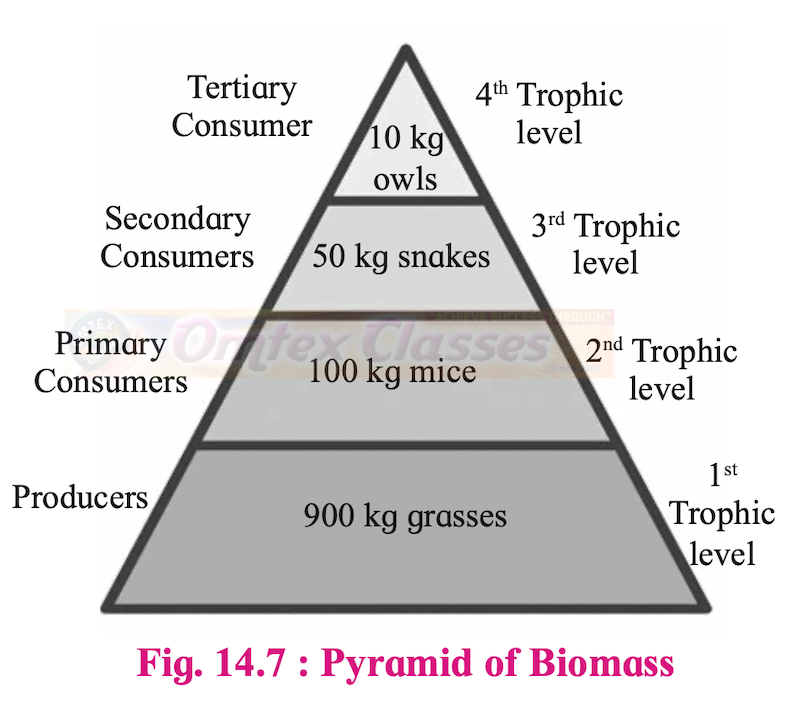
An ecological pyramid is a graphical representation of various environmental parameters such as the number of individuals present at each trophic level, the amount of energy, or the biomass present at each trophic level. Ecological pyramids represent producers at the base, while the apex represents the top-level consumers present in the ecosystem.
Describe with examples of Pyramids of number, and biomass.
Solution 1:
Pyramid of numbers:
It is a graphical representation of the number of individuals present at each trophic level in a food chain of an ecosystem. The pyramid of numbers can be upright or inverted depending on the number of producers. For example, in a grassland ecosystem, the pyramid of numbers is upright. In this type of a food chain, the number of producers (plants) is followed by the number of herbivores (mice), which in turn is followed by the number of secondary consumers (snakes) and tertiary carnivores (eagles). Hence, the number of individuals at the producer level will be the maximum, while the number of individuals present at top carnivores will be least.
On the other hand, in a parasitic food chain, the pyramid of numbers is inverted. In this type of a food chain, a single tree (producer) provides food to several fruit eating birds, which in turn support several insect species.
Pyramid of biomass
A pyramid of biomass is a graphical representation of the total amount of living matter present at each trophic level of an ecosystem. It can be upright or inverted. It is upright in grasslands and forest ecosystems as the amount of biomass present at the producer level is higher than at the top carnivore level. The pyramid of biomass is inverted in a pond ecosystem as the biomass of fishes far exceeds the biomass of zooplankton (upon which they feed).
What is primary productivity?
Solution:
Primary productivity:
Primary productivity is the rate of generation of biomass in an ecosystem that is expressed in units of mass per unit surface (or volume) per unit time i.e. g/m2/day.
The mass unit may relate to dry matter or to the mass of carbon generated.
Give a brief description of the factors that affect primary productivity.
Solution:
Factors that affect primary productivity are as follows:
a. It depends on the plant species inhabiting a particular area.
b. It depends upon environmental factors such as light, temperature, water, precipitation, etc.
c. It depends upon the availability of nutrients.
d. It also depends upon the photosynthetic capacity of plants. The greater the photosynthetic activity, the higher will be the primary productivity.
Define decomposition.
Solution:
i. Decomposition is the process of breakdown of complex organic matter into inorganic substances like carbon dioxide, water, and nutrients by the decomposers.
ii. Raw materials for decomposition are dead remains of plants and animals, fecal matter, detritus.
iii. This process requires oxygen. Temperature and soil moisture are important factors that indirectly help soil microbes for decomposition.
iv. Warm and the moist environment favours decomposition whereas, low temperature and anaerobic conditions inhibit the process.
Describe the processes and products of decomposition.
Solution:
The steps of decomposition are fragmentation, leaching, catabolism, humification, and mineralization.
a. Fragmentation: Detritivores like earthworm breakdown detritus into smaller fragments or particles.
b. Leaching: In this process, water-soluble inorganic nutrients percolate into the soil horizon and get precipitated as unavailable salts.
c. Catabolism: The bacterial and fungal enzymes degrade detritus into simpler inorganic substances. All of the above steps occur simultaneously.
d. Humification: It leads to the accumulation of particularly decomposed, a dark coloured, amorphous, colloidal organic substance called humus. Humus serves as a reservoir of nutrients. It is resistant to microbial action and undergoes decomposition at an extremely slow rate. Humus changes the soil texture and increases the capacity of water holding in the soil.
e. Mineralization: Some microorganisms degrade humus and release inorganic nutrients by the process of mineralization.
Decomposition cycle
Write important features of a sedimentary cycle in an ecosystem.
Solution 1:
Sedimentary cycles have their reservoirs in the Earth’s crust or rocks. Nutrient elements are found in the sediments of the Earth. Elements such as sulphur, phosphorus, potassium, and calcium have sedimentary cycles.
Sedimentary cycles are very slow. They take a long time to complete their circulation and are considered as less perfect cycles. This is because during recycling, nutrient elements may get locked in the reservoir pool, thereby taking a very long time to come out and continue circulation. Thus, it usually goes out of circulation for a long time.
Solution:
Features of a sedimentary cycle in an ecosystem are as follows:
a. Earth’s crust is the main reservoir of phosphorus and other minerals, such as calcium and potassium that undergo sedimentary cycles.
b. The rate of release of minerals that take part in the sedimentary cycle is regulated by various environmental factors temperature, moisture, and nature of the soil.
c. Sedimentary cycles are slower than the gaseous cycles therefore they take more time to complete.
d. Sedimentary cycles are considered as less perfect cycles as, during recycling, nutrient elements may get locked in the reservoir pool, thereby taking a very long time to come out and continue circulation
Describe the carbon cycle and add a note on the impact of human activities on the carbon cycle.
Solution:
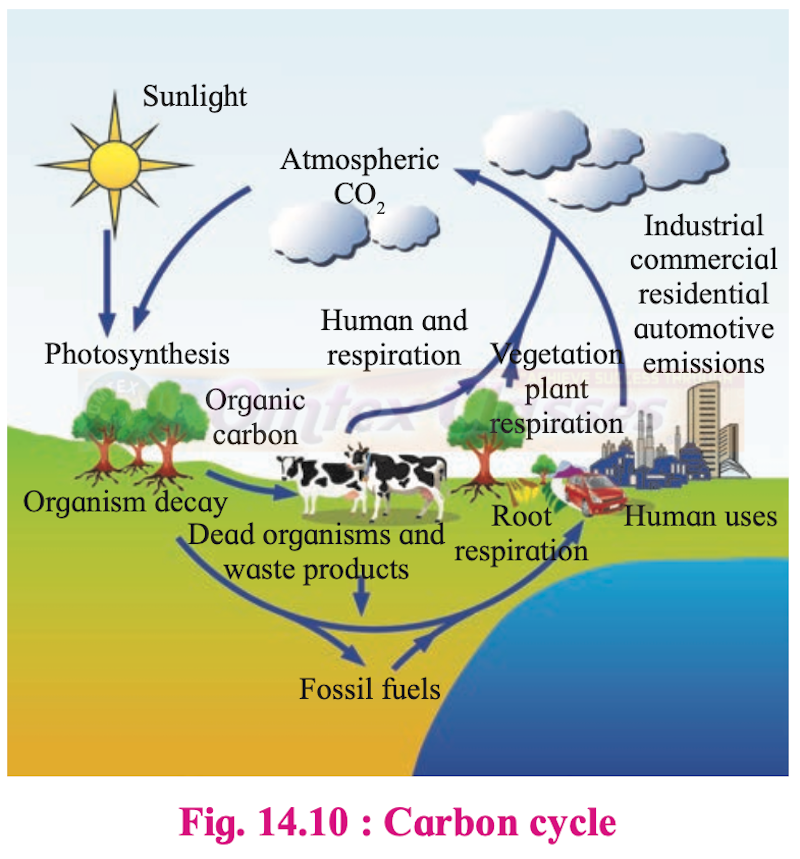
i. Reservoir of carbon:
a. All life forms on earth are carbon-based because carbon is the main component of all the organic compounds of protoplasm. It constitutes 49% of the dry weight of organisms.
b. 71% of carbon is found dissolved in oceans. The oceanic reservoir regulates the amount of carbon dioxide in the atmosphere.
c. Carbon present in the rock and fossil fuels like oil, coal, and natural gas has been away from the rest of the carbon cycle for a long time. These long term storage places are known as the sink.
d. The element carbon is a part of seawater, the atmosphere, rocks such as limestone and coal, soils, as well as all living things.
ii. Cyclic pathway of carbon:
a. Carbon as CO2 moves from the atmosphere to plants during the process of photosynthesis to produce food.
b. Carbon moves from plants to animals, through food chains.
c. At the time of exhalation, the CO2 gas is released into the atmosphere. Thus, carbon moves from living things to the atmosphere.
d. Decomposers also contribute substantially to CO2 in the atmosphere, by their processing of waste materials and dead organic matter of land and oceans.
e. When fossil fuels burn to power factories, power plants, motor vehicles, most of the carbon quickly enters the atmosphere as carbon dioxide gas.
f. Most of the remainder is dissolved in seawater and deposited as calcium or magnesium carbonate compounds that make up shells of marine animals.
g. The additional sources for releasing CO2 in the atmosphere are the burning of wood, forest fire and combustion of organic matter, fossil fuel, and volcanic activity.
h. The ocean absorbs some carbon in the form of CO2 from the atmosphere. This carbon gets dissolved in the ocean water. Some amount of the carbon which is fixed is lost to sediments and removed from circulation.
iii. The impact of human activities on the carbon cycle
a. Carbon cycle is significantly influenced by human activities.
b. Rapid deforestation and the massive burning of fossil fuel for energy and transport have significantly increased the rate of release of carbon dioxide into the atmosphere.
Define the following term and give one example for each:
Commensalism
Solution 1:
Commensalism:
Commensalism is an interaction between two species in which one species gets benefited while the other remains unaffected. An orchid growing on the branches of a mango tree and barnacles attached to the body of whales are examples of commensalisms.
Solution 2:
Commensalism is the interaction in which one species gets benefited and the other is neither harmed nor benefited.
Parasitism
Solution 1:
Parasitism:
Parasitism is the interaction in which only one species (parasite) is benefited and the interaction is detrimental to other species (host).
Solution 2:
Parasitism is a kind of relationship between two species in which one species which is termed as parasite, derives its food from the other species which is termed as host. Parasitism also involves shelter, in addition to food obtained by a parasite. Parasites may be ectoparasites or endoparasites. Ectoparasites live on the surface of their host while endoparasites live inside the body of the host.
Examples of Parasitism
(i) Cuscuta growing on shoe flower plant: Cucuta grows on the stem of shoe and derive nutrition from the plant.
(ii) Head lice is an ectoparasite and suck human blood
(iii) Ascaris, Taenia, Plasmodium causing diseases in humans
(iv) Koel laying its eggs in crow’s nest is an example of Brood parasitism. Birds lay egg in the nest of its host and host incubate it.
Very short answer question
Define the following term: Camouflage
Camouflage:
Camouflage is the cryptic coloration or patterns adopted by prey species to blend with the surroundings or background so as to escape their predators.
Give one example for Interspecific competition
Interspecific competition:
E.g. Competition between leopards and lion, resident fish competing with migratory birds Flamingos for common food i.e. zooplankton
Give one example for Mutualism
Mutualism:
E.g. Lichens represent an intimate, mutualistic relationship between a fungus and photosynthetic algae or cyanobacteria.
Name the type of association: Clownfish and sea anemone
Clown fish and sea anemone: Commensalism
Name the type of association: Crow feeding the hatchling of Koel
Crow feeding the hatchling of Koel: Brood parasitism
Name the type of association: Humming birds and host flowering plants
Humming birds and host flowering plants: Mutualism
What is the ecological process behind the biological control method of managing with pest insects?
The ecological process behind the biological control method of managing with pest insects is Predation. Predators regulate the population of prey in a habitat, thus helping in the management of pest insects.
Short answer question
How is the dormancy of seeds different from hibernation in animals?
i. Seed dormancy is the inability of viable seeds to germinate even under suitable environmental conditions, whereas hibernation in animals is a state of reduced activities to escape cold winter conditions.
ii. During seed dormancy, growth and development of an embryo are arrested temporarily, whereas in hibernation animals enter a state of inactivity by slowing their metabolism.
If a marine fish is placed in a freshwater aquarium, will it be able to survive? Give reason.
i. If a marine fish is placed in a freshwater aquarium, fish would not be able to survive because marine fishes are adapted to high salt concentrations of the marine environment.
ii. Marine fishes have more osmotic concentration (more salt concentration) than marine water which prevents marine water to enter into the body.
iii. When marine fish is placed in a freshwater aquarium, water enters into the body of marine fish due to osmosis, as freshwater creates a hypotonic environment outside the fish’s body.
iv. Entry of water into the body causes its body to swell leading to the death of the marine fish.
Name important defense mechanisms in plants against herbivores.
Defense mechanisms in plants against herbivores can be morphological like thorns (in Acacia, Cactus) or chemicals like poisonous cardiac glycosides (produced by Calotropis), secondary metabolites (for e.g.nicotine, caffeine, quinine, strychnine, opium, etc.)
An orchid plant is growing on the branch of the mango tree. How do you describe this interaction between the orchid and the mango tree?
Solution 1:
An orchid growing on the branch of a mango tree is an epiphyte. Epiphytes are plants growing on other plants which however, do not derive nutrition from them. Therefore, the relationship between a mango tree and an orchid is an example of commensalisms, where one species gets benefited while the other remains unaffected. In the above interaction, the orchid is benefited as it gets support while the mango tree remains unaffected.
Solution 2:
i. An orchid plant growing on the branch of a mango tree represents Commensalism.
ii. In this interaction, one species gets benefited and the other is neither harmed nor benefited.
iii. Orchid is an epiphytic plant. While growing on mango tree it gets support but does not derive any nutrition from the mango tree.
iv. Thus, the orchid plant is benefited, while the mango tree is neither benefited nor harmed.
Distinguish between the following: Hibernation and Aestivation
Hibernation
Aestivation
i.
It is also called as winter sleep.
It is also called as summer sleep.
ii.
It is a state of reduced activities in some organisms to escape cold winter conditions.
It is a state of reduced activities in some organisms to escape desiccation due to heat in summer.
iii.
Animals rest in warm places.
Animals rest in cool, shady, and moist places.
iv.
It is shown by bears inhabiting cold regions.
It is shown by some fishes and snails.
Distinguish between the following: Ectotherms and Endotherms
Ectotherms
Endotherms
i.
These are cold-blooded animals.
These are warm-blooded animals.
ii.
Ectotherms do not possess the ability to generate sufficient heat to keep them warm, thus their body temperature varies with surroundings
Endotherms do possess the ability to generate heat and keep them warm, thus they can maintain constant body temperature.
iii.
They are also known as poikilothermic.
They are also known as homeothermic.
iv.
They are affected by changes in environmental temperature
They remain unaffected by changes in environmental temperature.
E.g. Most of the fishes, amphibians, reptiles
E.g. Birds, mammals
Distinguish between the following: Parasitism and Mutualism
Parasitism
Mutualism
i.
In parasitism, only one species (parasite) is benefited and the interaction is detrimental to other species (host).
In mutualism, both species are benefited.
ii.
The parasite needs a host, but the host does not need the parasite.
Both species need the presence of each other.
E.g.
Cuscuta, a parasitic plant commonly found growing on hedge plants.
Lichen represents the mutualistic relationship between a fungus and photosynthetic algae or cyanobacteria.
Write a short note on Adaptations of plants to water scarcity
Adaptations of plants to water scarcity:
Plants found in deserts are well adapted to cope with water scarcity and scorching heat of the desert. Plants have an extensive root system to tap underground water. They bear thick cuticles and sunken stomata on the surface of their leaves to reduce transpiration. In Opuntia, the leaves are modified into spines and the process of photosynthesis is carried out by green stems. Desert plants have special pathways to synthesize food, called CAM (\(C_4\) pathway). It enables their stomata to remain closed during the day to reduce water loss by transpiration.
Adaptations of plants for desert habitats:
1. Many desert plants have a thick cuticle on their leaf surfaces and have their stomata in deep pits to minimize loss of water through transpiration.
2. They show a special photosynthetic pathway (CAM - Crassulacean Acid Metabolism) that enables their stomata to remain closed during the daytime.
3. Some desert plants like Opuntia have their leaves reduced (modified) to spines and the photosynthetic function is taken over by the flattened stems.
[Image of desert plants and animals adaptations]
Write a short note on Behavioural adaptations in animals
Solution 1:
Behavioural adaptations in animals
Certain organisms are affected by temperature variations. These organisms undergo adaptations such as hibernation, aestivation, migration, etc. to escape environmental stress to suit their natural habitat. These adaptations in the behaviour of an organism are called behavioural adaptations. For example, ectothermal animals and certain endotherms exhibit behavioral adaptations. Ectotherms are cold blooded animals such as fish, amphibians, reptiles, etc. Their temperature varies with their surroundings. For example, the desert lizard basks in the sun during early hours when the temperature is quite low. However, as the temperature begins to rise, the lizard burrows itself inside the sand to escape the scorching sun. Similar burrowing strategies are exhibited by other desert animals. Certain endotherms (warm-blooded animals) such as birds and mammals escape cold and hot weather conditions by hibernating during winters and aestivating during summers. They hide themselves in shelters such as caves, burrows, etc. to protect against temperature variations.
Solution 2:
Behavioural adaptations in animals.
a. To cope up with extreme variations in their environment, some organisms respond through behaviourally (like migration, hibernation, and aestivation).
b. For e.g. Desert lizards manage to keep their body temperature fairly constant by behavioural adaptations.
c. They bask in the sun and absorb heat when their body temperature drops below the comfort zone. But when the ambient temperature starts increasing, they move into the shade.
d. Some species burrow into the sand to hide and escape from the heat.
Write a short note on Adaptations of desert animals
Adaptations of animals for desert habitats:
1. Desert animal-like Kangaroo rat inhabiting the Arizona deserts has the potential to concentrate its urine to conserve water. This animal never drinks water in its life.
2. Snakes and desert lizards bask in the sun early in the morning and burrow themselves in the sand in the afternoons to escape the heat of the day, to prevent water loss.
3. Camels can store fat in the hump which can be metabolised for energy. A camel can survive for many days without water. Long eyelashes, ears lined with hair, and slit-like nostrils help to keep out sand.
Define Population.
Population: Organisms of the same kind inhabiting a geographical area constitute the population.
OR
Individuals live in groups in a well-defined geographical area, share or compete for similar resources, potentially interbreed and thus form a population.
OR
The population is defined as a group of individuals of a species occupying a definite geographic area at a given time.
Define Community.
Community: Several populations of different species in a particular area constitute a community that interacts with one another in several ways.
Long answer question
With the help of a suitable diagram describe the logistic population growth curve.
Logistic growth curve of population
i. Resources like food and space are not always unlimited. They may be plenty in the beginning; but as the population density increases, competition for those resources starts, resulting in a slowdown in the rate at which the original population was growing. This results in a logistic or sigmoid growth curve.
ii. Competition between individuals for limited resources will weed out the ‘weaker’ ones. Only the ‘fittest’ individuals will survive and reproduce.
iii. A given habitat has enough resources to support a maximum possible number, beyond which no further growth is possible. This limit can be called nature’s carrying capacity (K) for that species in that habitat.
iv. A population growing in a habitat with limited resources shows initially a lag phase, followed by phases of acceleration and deceleration and finally an asymptote when the population density reaches the carrying capacity.
v. A plot of population density (N) in relation to time (t) results in a sigmoid curve. This type of population growth is called VerhulstPearl Logistic Growth.
vi. Since resources for the growth of most animal populations are finite and become limiting sooner or later, the logistic growth model is considered a more realistic one.
Enlist and explain the important characteristics of a population.
i. The important characteristics of a population are population size, population density, natality, mortality, sex ratio, immigration, emigration, age pyramids, expanding population, population growth forms, and biotic potential.
ii. Some important characteristics of the population are:
a. Population density: Population density tells us the number of individuals present per unit space, in a given time.
OR
The density of a population is the total number of individuals in that population present per unit area at a specific time.
b. Natality: Natality is the birth rate of a population.
c. Mortality: Mortality is the death rate of a population.
d. Age distribution and Age pyramids:
1. A population consists of individuals of different ages. The entire population is divided into three age groups – pre-reproductive (0-14 years), reproductive (age 15-44 years), post-reproductive (45-85+years)The relative proportion of individuals of various age groups in the population is referred to as the age structure of the population.
2. If the age distribution (percent individuals of a given age or age group) is plotted for the population, the resulting structure is called as age pyramid.
e. Sex Ratio:
Sex ratio is the ratio of the number of individuals of one sex to that of the other sex.