HSC ECONOMICS JULY 2016 BOARD PAPER
Original Economics July 2016 QP



Q1. A. Fill in the blanks with proper alternatives given in the brackets:
12th Economics
Economics Board Questions with Solution
- Economics - March 2025 - English Medium View Answer Key
- Economics - March 2025 - Marathi Medium View Answer Key
- Economics - March 2025 - Hindi Medium View Answer Key
- Economics - July 2025 - English Medium View Answer Key
- Economics - July 2025 - Marathi Medium View Answer Key
- Economics - March 2024 - English Medium View Answer Key
- Economics - March 2024 - Marathi Medium Download QP Answer Key
- Economics - March 2024 - Hindi Medium View Answer Key
- Economics - July 2024 - English Medium View Answer Key
- Economics - March 2023 - English Medium View Answer Key
- Economics - March 2023 - Marathi Medium View Answer Key
- Economics - July 2023 - English Medium View Answer Key
- Economics - March 2022 - English Medium View Answer Key
- Economics - March 2022 - Marathi Medium View Answer Key
- Economics - July 2022 - English Medium View Answer Key
- Economics - October 2021 - English Medium View Answer Key
- Economics - March 2020 View
- Economics - March 2014 View
- Economics - October 2014 View
- Economics - March 2015 View
- Economics - July 2015 View
- Economics - March 2016 View
- Economics - July 2016 View
- Economics - March 2017 View
- Economics - July 2017 View
- Economics - March 2018 View
- Economics - July 2018 View
- Economics - March 2019 View
(B) Match the following Group ‘A’ with Group ‘B’
Analyze the columns below and try to match them before checking the solution.
| Group A | Group B |
|---|---|
| (a) Electricity | (1) Inelastic demand |
| (b) Complementary goods | (2) Share brokers |
| (c) Pension | (3) Elastic demand |
| (d) D - mat account | (4) Composite demand |
| (e) Central Bank | (5) Transfer income |
| (6) Primary function of Commercial Banks | |
| (7) ATM facility | |
| (8) Apex banking institution |
Click to Reveal Correct Matches
Correct Matches:
(a) Electricity — (4) Composite demand
(b) Complementary goods — (3) Elastic demand
(c) Pension — (5) Transfer income
(d) D - mat account — (2) Share brokers
(e) Central Bank — (8) Apex banking institution
(C) State whether the following statements are true or false. (6)
Q2. (A) Define or Explain the following concepts (Any Three) (6)
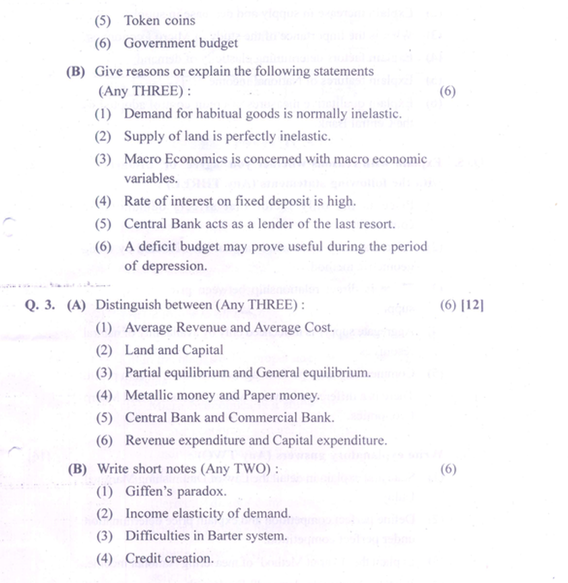
(B) Give reasons or Explain the following statements (Any Three) (6)
Q3. (A) Distinguish between the following. (Any Three) (6)
(B) Write short notes on (Any Two) (6)
Q4. Write short answers for the following questions. (Any Three) (12)
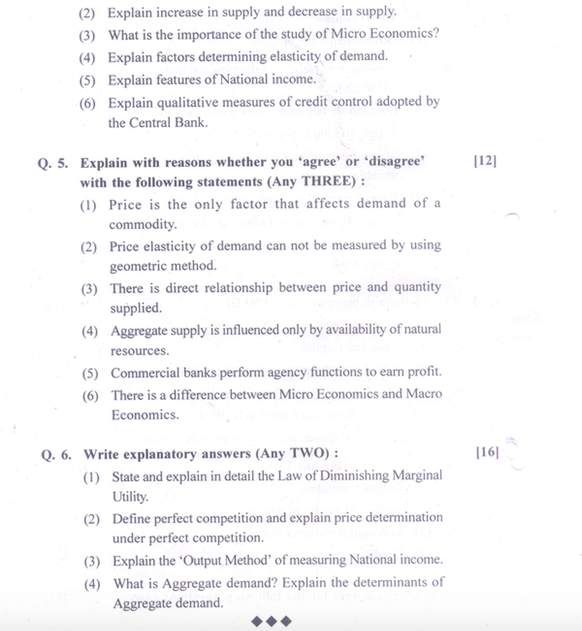
Q5. Explain, with reasons, whether you Agree or Disagree with the following statements. (Any Three) (12)
Q6. Write explanatory answers. (Any Two) [16]
ECONOMICS HSC IMPORTANT QUESTIONS FOR BOARD EXAM
ALMOST 99.99% SURE QUESTIONS.
Define / Explain the following concepts. (Any Three)
Induced Consumption Expenditure
Give reasons or explain the following (Any Three) (6)
A deficit budget may prove useful during the period of depression.
Agricultural goods are exceptions to the law of supply.
An entrepreneur is called a leader of the organization.
Autonomous investment is not directly linked with profit.
Cash reserve ratio (CRR) affects the lending capacity of banks.
Central Bank has the sole power of issuing currency notes.
Central bank acts as a lender of the last resort of commercial banks.
Change in the price of substitute goods affects the demand for another goods.
Demand for habitual goods is normally inelastic.
Demand for the commodity having multiple uses has elastic demand.
Effective demand is also called macroeconomics equilibrium.
In order to avoid double counting, value added approach is used.
Macroeconomic is also known as income and employment theory.
Macroeconomics is concerned with macro economic variables.
Macroeconomics is the study of aggregates.
Micro economic theories are based on certain assumptions.
Microeconomics deals with allocation of resources.
Microeconomics is useful to the government.
Microeconomics studies behaviours of individual economic unit.
Microeconomics studies individual economic unit.
Old age pension is transfer income.
Paid services are included in national income.
Perfectly inelastic demand curve is parallel to OY axis.
Price discrimination is possible under monopoly.
Rate of Interest on fixed deposits is high.
Rate of interest on fixed deposit is high.
Services of housewives are excluded from national income.
Supply is directly related to price.
Supply of land is perfectly inelastic.
The Central Bank may take direct action against the defaulting commercial banks.
The propensity to save depends upon the level of income.
Theories of micro economics are based on certain assumptions.
There are many subjective factors that determine consumption function.
Unpaid services are not included in national income.
Utility has no ethical consideration.
Utility is a relative concept.
With the increase in income, both consumption and savings increase.
Distinguish between (Any Three) (6)
Average Revenue and Average cost
Central Bank and Commercial Bank.
Convertible paper money and Inconvertible paper money.
Direct demand and Indirect demand.
Expansion of demand and Increase in demand.
Extension of supply and contraction of supply.
Form Utility and Time Utility.
Gross National Product and Net National Product
Gross domestic products at market price and Gross domestic product at factor cost.
Increase in demand and Decrease in Demand.
Increase in supply and Decrease in supply.
Individual demand and Market demand
Individual supply and Market supply
Legal tender money and Non – legal tender money.
Metallic money and paper money
Microeconomics and Macroeconomics.
Paper Money and Metallic Coins.
Partial equilibrium and General equilibrium.
Personal income and National Income
Place utility and Time utility.
Relatively more elastic demand and relatively less elastic demand.
Revenue budget and Capital budget.
Revenue expenditure and Capital Expenditure.
Slicing method and Lumping method.
Standard coins and Token Coins.
Surplus Budget and Deficit Budget.
Write short notes (Any Two) (6)
Determination of equilibrium price under perfect competition.
Difficulties in Barter system.
Factors determining elasticity of demand.
Features of Monopolistic Competition.
Historical review of microeconomics.
Importance of micro economics.
Importance of the law of diminishing marginal utility.
Price determination under perfect competition.
Proportional method of measuring elasticity of demand.
Ratio method of measuring price elasticity of demand.
Risk and uncertainty bearing function of an entrepreneur.
Significance of price elasticity of demand.
Subject matter of microeconomics.
Total expenditure method of measuring Elasticity of Demand.
Types of loans of commercial bank.
Write short answers for the following questions (Any Three) (12)
Explain different types of loans and advances provided by commercial banks.
Explain features of National Income.
Explain qualitative measures of credit control adopted by the Central Bank.
Explain the agency function of Commercial Bank.
Explain the budget expenditure of the government.
Explain the circular flow of National Income
Explain the components of government budget.
Explain the determinants of aggregate demand.
Explain the features of monopolistic competition.
Explain the features of monopoly.
Explain the features of perfect competition.
Explain the importance of elasticity of demand.
Explain the importance of the law of Diminishing Marginal Utility.
Explain the increase in supply and decrease in supply.
Explain the law of diminishing marginal utility.
Explain the relationship between Total utility and Marginal utility.
Explain the secondary function of money.
Explain the subject matter of Microeconomics.
Explain the subject matter of macroeconomics.
Explain the types of government budget.
Explain the various types of deposits.
Explain various types of Bank Deposits.
Explain various types of investment expenditure.
State the determinants of aggregate demand.
What are the characteristics of utility?
What are the determinants of aggregate supply?
What are the features of Macro Economics?
What are the features of ‘microeconomics’?
What are the features of ‘pure competition’?
What are the main components of budget?
What are the primary functions of commercial bank?
What is the importance of the study of Microeconomics?
Q5. Explain with reasons whether you ‘agree’ or ‘disagree’ with the following statements (Any Three) (12)
Aggregate demand depends only on the consumption expenditure.
Aggregate supply is influenced only by availability of natural resources.
Barter system did not have any difficulty.
Bank rate is a quantitative measure of credit control.
Cash reserve ratio is a quantitative measure of credit control.
Central Bank do not adopt quantitative measures of credit control.
Central Bank does not work as a banker to the government.
Central Bank is a profit making institution.
Central bank is called the bankers’ bank
Commercial Bank provides many general utility services.
Commercial bank can create credit on the basis of primary deposits.
Commercial banks cannot create credit money.
Commercial banks perform agency functions to earn profit.
Commercial banks provide many general utility services.
During the period of inflation surplus budget is advisable.
General acceptability is the only quality of good money.
Good money has many qualities.
Law of Diminishing Marginal utility is important in practice
Money also performs certain contingent functions.
Money performs various functions.
Population is the only determinant factor of demand.
Price elasticity of demand can not be measured by using geometric method.
Price is the only determinant of demand.
Price is the only determinant of supply.
Price is the only factor that affects demand of a commodity
Providing safe deposits vault facility is the only general functions of commercial banks.
Supply curve of labour bends backwards.
Supply curve slopes upward from left to right.
The law of diminishing marginal utility can be explained with the help of schedule and diagram.
The law of equi – marginal utility is based on certain assumptions.
The law of ‘diminishing marginal utility’ is important in practice.
There are many features of labour.
There are no exceptions to the law of demand.
There are no exceptions to the law of supply.
There is difference between Micro Economics and Macro Economics.
There is difference between stock and supply.
There is direct relationship between price and quantity supplied.
There is no difference between the Central bank and a commercial bank.
There is no relationship between marginal utility and total utility.
Various factors influence Elasticity of Demand.
Various factors influence the demand for a commodity.
Q6. Write explanatory answers. (Any Two): (16)
Explain any ‘two methods’ of measuring price elasticity of demand.
Explain the practical difficulties involved in the measurement of national income.
State and explain the law of demand with assumptions.
What is elasticity of demand? Explain the types of price elasticity of demand.
Explain Keynesian psychological law of consumption.
Explain in detail ‘saving function’ with schedule and diagram.
What is ‘elasticity of demand’? Explain the factors determining elasticity of demand.
Explain the various methods of measuring national income.
What is aggregate supply? Explain the determinants of aggregate supply.
State and explain in detail the Law of Diminishing Marginal Utility.
Assumption to the Law of Diminishing Marginal Utility.
Exception to the Law of Diminishing Marginal Utility.
Define perfect competition and explain price determination under perfect competition.
What is Aggregate demand? Explain the determinants of Aggregate demand.
Exception to the Law of Demand
What is perfect competition? Explain price determination under perfect competition.
What is national income. Explain how national income is measured by output method.
Explain Ratio method and Geometric method of measuring price elasticity of demand.
Explain the subjective and objective factors determining consumption function.
Labels: HSC Economics, Board Paper Solution, July 2016, Important Questions, Maharashtra Board
Permanent Link: hsc-economics-july-2016-board-paper-solution-important-questions
Search Description: Complete solution for HSC Economics July 2016 Board Paper with important questions for Board exam.