


Economics Board Questions with Solution
- Economics - March 2025 - English Medium View Answer Key
- Economics - March 2025 - Marathi Medium View Answer Key
- Economics - March 2025 - Hindi Medium View Answer Key
- Economics - July 2025 - English Medium View Answer Key
- Economics - July 2025 - Marathi Medium View Answer Key
- Economics - March 2024 - English Medium View Answer Key
- Economics - March 2024 - Marathi Medium Download QP Answer Key
- Economics - March 2024 - Hindi Medium View Answer Key
- Economics - July 2024 - English Medium View Answer Key
- Economics - March 2023 - English Medium View Answer Key
- Economics - March 2023 - Marathi Medium View Answer Key
- Economics - July 2023 - English Medium View Answer Key
- Economics - March 2022 - English Medium View Answer Key
- Economics - March 2022 - Marathi Medium View Answer Key
- Economics - July 2022 - English Medium View Answer Key
- Economics - October 2021 - English Medium View Answer Key
- Economics - March 2020 View
- Economics - March 2014 View
- Economics - October 2014 View
- Economics - March 2015 View
- Economics - July 2015 View
- Economics - March 2016 View
- Economics - July 2016 View
- Economics - March 2017 View
- Economics - July 2017 View
- Economics - March 2018 View
- Economics - July 2018 View
- Economics - March 2019 View
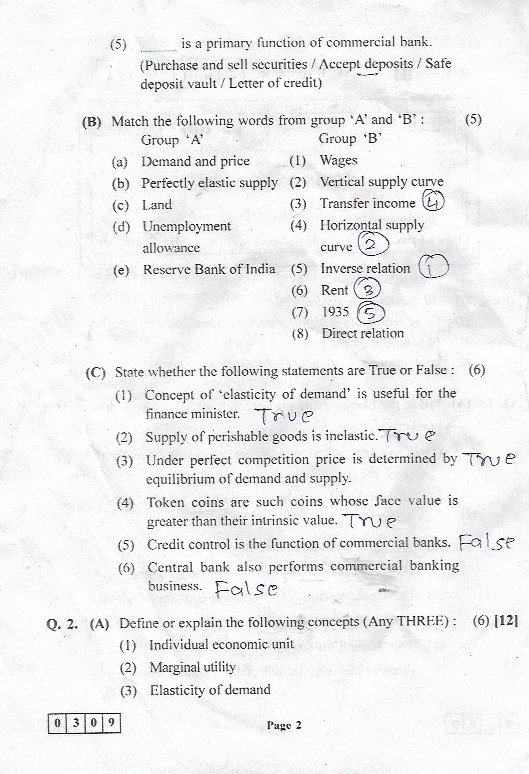
| Group ‘A’ | Group ‘B’ |
|---|---|
| (a) Demand and Price | (5) Inverse relation |
| (b) Perfectly elastic supply | (4) Horizontal supply |
| (c) Land | (6) Rent |
| (d) Unemployment allowance | (3) Transfer income |
| (e) Reserve Bank of India | (7) 1935 |
Ans. It is the smallest part of an economy such as individual household, firm etc. Micro Economics studies individual unit.
(2) Marginal utility:Ans. Marginal utility refers to the addition made to total utility by the consumption of one more unit of a commodity.
$$ Marginal\ Utility = TU_n \text{ units} - TU_{n - 1} \text{ units} $$
For eg. \( 10 = 110 - 100 \)
3. Elasticity of Demand:It refers to the degree of responsiveness of change in quantity demanded with given change in the price of a commodity assuming that except price all other conditions of demand remain same.
 4. National income:
Ans. National income is the money value of all final goods and service produced in a country during a year counted without duplication.
It is the aggregate income of a nation for the period of a year.
5. Effective Demand:Ans. The concept of effective demand is given by J.M. Keynes. In Economics, effective demand is determined at the point where aggregate demand is equal to aggregate supply.
$$ Effective\ demand = ADD = ASS $$
6. BudgetAns. The word Budget is derived from the French word 'Baguette' which means bad or wallet containing the financial proposals.
"A Budget is a statement of the state's estimated income and expenditure for the next financial year.
1. The supply of agriculture commodities is relatively inelastic:
Ans. It is because supply of agriculture commodities depends up on monsoon, weather and natural conditions therefore it cannot be increased or decreased with human efforts. Thus, supply of agriculture commodities is relatively inelastic.
2. A monopolist can control the supply of goods.
Ans. It is because in monopoly there is single seller in the market, so he has complete control on supply of goods. He does not face any competition.
3. The supply of land is inelastic:
Ans. It is because land is a free gift of nature. Its total supply on the globe is fixed and it cannot be increased or decreased with human efforts.
4. Macroeconomics is different from micro economics:
Ans. It is because, Macroeconomics studies aggregate economy as a whole while Microeconomics studies individual Economics unit. Macroeconomics uses general equilibrium approach while Microeconomics uses partial equilibrium approach.
5. As banker for the government the central bank transfers government fund:
Ans. It is because central bank is banker of the government therefore it accept money on behalf of the government as well as helps to transfer government fund from central to state and local government and also among different departments of the government.
6. Microeconomics is also known as price theory.
Ans. It is because Microeconomics, is primarily concerned with price determination of goods and services as well as rewards of factors of productions i.e. land, labour, capital and entrepreneur in the form of rent, wages, interest and profit respectively.