Showing posts with label English Study Material. Show all posts

Fun with Music: Term 2 Unit 1 Questions & Answers for 2nd English

Fun with Music | Term 2 Chapter 1 | 2nd English

Chapter: 2nd English : Term 2 Unit 1 : Fun with Music

Questions with Answers (Part 1)

Let us understand

1. Tick (✓) the correct word.

Tick the correct word exercise

2. Listen and number the sequence.

Mom, can you buy me a drum? 2

Everyone claps. 5

I only have the sticks. 3

The teacher loved the sound. 4

We are going to play in the concert. 1

3. Listen, think and write.

boxes   sticks   concert   violin

a. Mani’s mother gave him sticks.

b. Abu played the violin.

c. Mani used boxes as drums.

d. Class 2 was ready for the concert.

e. I am Mahendra Varman. (your name)

I like to play violin.

Let us know

Valli and Chittu are looking at some pictures.

Pictures of Nila, Raju, and a belt

That is Nila. She is my sister.

That is Raju. He is my brother.

That is a belt. It is my belt.

Yes. It is your belt.

What do you say for two girls?

When we see more than one, we say, ‘They are girls’.

Note to the teacher: Explain to children that we use he for a ‘boy’, she for a ‘girl’ , it for an ‘object’ and they for ‘more than one’.

Let us practice

1. Read aloud.

Read aloud pronoun examples

2. Fill in the blanks with He / She / It.

Fill in the blanks pronoun exercise

Spell check

Fill in the missing letters.

Spell check exercise with answers

Stick box drums

Let us do

Word wall

live last colour friend eat want year got play both
Word wall activity illustration

* Display the words on the word wall.

* Drill the words.

* Divide the class into two groups.

* Let them stand with their back to the word wall except for the first child in each group.

* Point to a word on the word wall.

* The child facing the wall reads it.

* Then moves to the last place.

* The next child in each group continues and so on.

Read aloud and circle the words you see in the word wall.

1. Crows live on trees.

2. What colour do you like?

3. I eat with my friend.

4. We want to run.

5. This year I will win.

6. I got a pen as a gift.

7. We both play with our friends.

Colour the words in yellow.

live  last  colour  friend  eat  want  year  got  play  both

Color the words exercise

Circle time - Let us talk

A. Display number cards from two to ten. Introduce the number names, Let children repeat the names of the numbers. Ask children to give you two pencils. Say, “These are/ We have two pencils.” Practise with more objects and more numbers. (2 to10) Let children repeat ofter you.

B. Now hold three pens and ask. “How many pens are there? Enourage them to answer using. “There are ____. “ Divide the class into group A and B. Ask group A to question and group B to answer. Practise with all the children.

Let us practice

Practice sentences with 'There is' and 'There are'

Complete the sentences.

1. There are four pencils in my bag.

2. There are two pens in my bag.

3. There are three erasers in my bag.

4. There are five books in my bag.

Let us say

Listen to the sound and repeat.

Long i sound examples: y, ie, i_e

Read aloud.

Read aloud words with long i sound

Listen and circle the words with the long ‘i’ sound.

1. The kite flies in the sky.

2. I ride my bike by the side.

3. Mike and Nike like pineapples.

4. The mice try to bite the pie.

5. I like lime rice.

6. Draw a fine line.

Try to read these!

g + l = gl- glass

g + r = gr- grass

s + k = -sk desk

Note to the teacher: First teach the sound /aI/ to children. Then, introduce the three different letter clusters for the same sound. Help children relate the sound to the letter cluster.

Let us do

Word wall

my by try dry fry lie die tried tied dried wide cite file lime pine
Word wall activity illustration

* Display the words on the word wall.

* Distribute the word cards to all the children.

* Say a word.

* The child with the word should read the word and point it in the word wall.

* Practise with all the words.

Add ‘e’ and write the words. Example: sit – site

Add 'e' exercise

Fill in the missing letters.

Fill missing letters exercise

Match and tick (✓) the correct one.

Matching and ticking exercise

Know Your Feelings | 2nd English Term 1 Unit 3 Study Material

UNIT 3: Know Your Feelings

2nd English - Term 1

Introduction to Know Your Feelings Unit

Let us recall

1. Tick (✓) the correct word for the picture.

Activity: Tick the correct word for the picture. The word 'jug' is ticked for the image of a jug.

2. Make one into many.

Activity: Make one into many. Examples show 'one bat' becoming 'many bats' and 'one ball' becoming 'many balls'.

3. Fill a / an.

This is a bun.

This is a kite.

This is an axe.

Look and say

Feelings Chart 1: Happy, Sad, Angry, Surprised Feelings Chart 2: Sleepy, Tired, Hungry, Thirsty

Note to the teacher: Practise vocabulary using the pictures. Ask children to name the feelings in the pictures.

Healthy Food: Questions & Answers (Part 2) | Class 1 English Term 2 Unit 1

1st English: Term 2 Unit 1: Healthy Food

Questions with Answers (Part 2)

Let us follow

Circle the healthy food and cross the junk food.

Activity: Circle healthy food, cross junk food. Solution shown.

Do you eat healthy food? Yes ✔ No

Does your friend eat junk food? Yes No ✔

Discuss with your friend about junk food.

Note to the teacher: Encourage children to eat healthy foods. Explain the dangers of junk food.

Let us do

Word wall

Word wall with various words for practice.

Say a word and clap your hands.

Let children repeat it.

Say the word again and stamp your feet. Let children repeat it.

Practise the actions for all the words.

I can do

I. Write the names.

Images of mango, carrot, potato, and papaya with space to write their names.

mango carrot potato papaya

II. Read aloud

pup, cup, cub, tub, mud, bug, mug, jug, hut, cut, nut, bud

III. Circle the correct one.

A papaya is shown nearby. This / That is a papaya.

A mango is shown in the distance. This / That is a mango.

IV. Draw a fruit and a vegetable you like.

Drawing spaces filled with grapes (fruit) and a pumpkin (vegetable).

This is a grapes

This is a pumpkin

V. Recite the poem ‘To the market‛.

Learning outcomes

Now I can...

Learning outcomes checklist: Name fruits and vegetables, use 'this/that', read 'u' sound words, recite 'To the market' poem.

Note to the teacher: Ask children to colour the apple when they achieve the learning outcome.

The Three Questions Section II by Leo Tolstoy | 8th English Unit 3 Supplementary Solutions

The Three Questions: Section II

by Leo Tolstoy | 8th English : Unit 3 : Supplementary

Section II

The king turned round and saw a bearded man come running out of the wood. The man held his hands pressed against his stomach, and blood was flowing from under them. When he reached the king, he fell fainting on the ground, moaning feebly. The king and the hermit unfastened the man’s clothing. There was a large wound in his stomach. The king washed it as best he could, and bandaged it with his handkerchief and with a towel the hermit had. But the blood would not stop flowing, and the king again and again removed the bandage soaked with warm blood, and washed and re-bandaged the wound. When at last the blood ceased flowing, the man revived and asked for something to drink. The king brought fresh water and gave it to him. Meanwhile the sun had set, and it had become cool. So the king, with the hermit’s help, carried the wounded man into the hut and laid him on the bed. Lying on the bed, the man closed his eyes and was quiet; but the king was so tired from his walk and from the work he had done that he crouched down on the threshold, and also fell asleep – so soundly that he slept all through the short summer night.

The king and the hermit tending to the wounded man

When he awoke in the morning, it was long before he could remember where he was, or who was the strange bearded man lying on the bed and gazing intently at him with shining eyes.

“Forgive me!” said the bearded man in a weak voice, when he saw that the king was awake and was looking at him.

“I do not know you, and have nothing to forgive you for,” said the king.

“You do not know me, but I know you. I am that enemy of yours who swore to revenge himself on you, because you executed his brother and seized his property. I knew you had gone alone to see the hermit, and I resolved to kill you on your way back. But the day passed and you did not return. So I came out from my ambush to find you, and came upon your bodyguard, and they recognized me, and wounded me. I escaped from them, but should have bled to death had you not dressed my wound. I wished to kill you, and you have saved my life. Now, if I live, and if you wish it, I will serve you as your most faithful slave, and will bid my sons do the same. Forgive me!”

The king was very glad to have made peace with his enemy so easily, and to have gained him for a friend, and he not only forgave him, but said he would send his servants and his own physician to attend him, and promised to restore his property.

Having taken leave of the wounded man, the king went out into the porch and looked around for the hermit. Before going away he wished once more to beg an answer to the questions he had put. The hermit was outside, on his knees, sowing seeds in the beds that had been dug the day before.

The king approached him and said, “For the last time, I pray you to answer my questions, wise man.”

“You have already been answered!” said the hermit, still crouching on his thin legs, and looking up at the king, who stood before him.

“How answered? What do you mean?” asked the king.

“Do you not see?” replied the hermit. “If you had not pitied my weakness yesterday, and had not dug these beds for me, but had gone your way, that man would have attacked you, and you would have repented of not having stayed with me. So the most important time was when you were digging the beds; and I was the most important man; and to do me good was your most important business. Afterwards, when that man ran to us, the most important time was when you were attending to him, for if you had not bound up his wounds he would have died without having made peace with you. So he was the most important man, and what you did for him was your most important business. Remember then: there is only one time that is important – now! It is the most important time because it is the only time when we have any power. The most necessary person is the one with whom you are, for no man knows whether he will ever have dealings with anyone else: and the most important affair is to do that person good, because for that purpose alone was man sent into this life.”

About the Author

Portrait of Leo Tolstoy

Leo Tolstoy (1828 – 1910) was a Russian writer who is regarded as one of the greatest authors of all time. He is best known for the novels War and Peace (1869) and Anna Karenina (1877).

Glossary

moaning (v) - sob, cry
unfasten (v) - undo, disconnect, untie, disjoin
revived (v) - restored to life or consciousness
crouched (v) - bent, stopped (down)
threshold (n) - doorstep , entrance
seized (v) - snatched , grabbed, held of suddenly and forcibly
ambush (n) - surprise attack, trap, entrap, pounce on

Read and Understand

A. Write ‘True or False’ for the following statement.

1. The bearded man was an enemy of the king.

[Answer: True]

2. The king and the hermit refused to help the wounded man.

[Answer: False]

3. The wounded man asked for the king’s forgiveness.

[Answer: True]

4. The king promised to restore the property of the bearded man.

[Answer: True]

B. Match the words in column ‘A’ with their meanings in column ‘B’

Column A

1. physician

2. restore

3. repent

4. ambush

Column B

(a) bring back

(b) surprise attack

(c) medical practitioner

(d) regret

Answers

1. physician - (c) medical practitioner

2. restore - (a) bring back

3. repent - (d) regret

4. ambush - (b) surprise attack

C. Answers the following questions.

1. Who came running out of the wood? What happened to him?

Answer: A bearded man came running out of the wood. Blood was flowing from the wound in his stomach. The king’s bodyguard attacked him.

2. How did the king and the hermit restore the life of a wounded man?

Answer: The king and the hermit unfastened the man’s clothing. The king washed the wound in his stomach and bandaged it with his handkerchief and with a towel the hermit had. When the blood stopped flowing, the king gave fresh water for him to drink. Then the king, with the hermit’s help, carried the wounded man into the hut and laid him on the bed.

3. Why did the king sleep through the night?

Answer: The king was so tired from his walk, from the digging work with the spade and from putting all his effort to save the bearded man. So he slept soundly through the night.

4. What were the changes in the behaviour of the wounded man at the end?

Answer: The wounded man was the enemy of the king. He wanted to kill the king but the king saved his life. The wounded man asked the king’s forgiveness and wanted to serve the king as a very faithful slave.

D. Answer the following in 100 words.

1. What were the answers to the three questions? What is the message of the hermit?

Answer: For the first question of the king, “What was the right time for every action?”, the answer was, “The most important time was when the king was digging the beds”. The answer for the second question, “Who were the most necessary people?” was the hermit was the most important man.

The final question was, “What was the most important thing to do?” The answer was to do good for the hermit was the most important business of the king.

2. Why did the bearded man ask for the king’s forgiveness? What did the king do to show his forgiveness?

Answer: The bearded man actually came to kill the king. But when he was badly wounded and bled to death, the king saved his life by treating his wound. The man whom he wanted to kill, saved his life. This act of the king made the bearded man feel guilty of his sin.

So the bearded man asked for the king’s forgiveness. The king was happy to make peace with his enemy and make his friend. He not only forgave him but also sent his servants and his own physician to attend on him. The king promised to restore his property too.

Sir Isaac Newton The Ingenious Scientist: Section II | Prose by Nathaniel Hawthorne | 8th English Unit 3

Sir Issac Newton - The Ingenious Scientist: Section II

Sir Issac Newton - The Ingenious Scientist

Nathaniel Hawthorne

Section –II

Reading

Take turns and read this section aloud.

Isaac's playmates were enchanted with his new windmill. They thought that nothing so pretty, and so wonderful, had ever been seen in the whole world.

"But, Isaac," said one of them, "you have forgotten one thing that belongs to a mill."

"What is that?" asked Isaac; for he supposed, that, from the roof of the mill to its foundation, he had forgotten nothing.

"Why, where is the miller?" said his friend.

Illustration related to Sir Issac Newton - The Ingenious Scientist

"That is true!—I must look out for one," said Isaac; and he set himself to consider how the deficiency should be supplied.

He might easily have made the miniature figure of a man; but then it would not have been able to move about, and perform the duties of a miller. But perhaps some two-legged millers are quite as dishonest as this small quadruped.

As Isaac grew older, it was found that he had far more important matters in his mind than the manufacture of toys, like the little windmill. All day long, if left to himself, he was either absorbed in thought, or engaged in some book of mathematics, or natural philosophy. At night, I think it probable, he looked up with reverential curiosity to the stars, and wondered whether they were worlds, like our own,—and how great was their distance from the earth,—and what was the power that kept them in their courses. Perhaps, even so early in life, Isaac Newton felt a presentiment that he should be able, hereafter, to answer all these questions.

When Isaac was fourteen years old, his mother's second husband being now dead, she wished her son leave school, and assist her in managing the farm at Woolsthorpe. For a year or two, therefore, he tried to turn his attention to farming. But his mind was so bent on becoming a scholar, that his mother sent him back to school, and afterwards to the University of Cambridge.

He was the first that found out the nature of Light; for, before his day, nobody could tell what the sunshine was composed of until then. You remember, I suppose, the story of an apple's falling on his head, which lead him to discover the force of gravitation and which keeps the heavenly bodies in their courses. When he had once got hold of this idea, he never permitted his mind to rest, until he had searched out all the laws, by which the planets are guided through the sky. This he did as thoroughly as if he had gone up among the stars, and tracked them in their orbits. As a boy, he had found out the mechanism of a windmill; and as a man he explained to his fellow-men the mechanism of the universe.

While researching he was accustomed to spend night after night in a lofty tower, gazing at the heavenly bodies through a telescope. His mind was lifted far above the things of this world. He may be said, indeed, to have spent the greater part of his life in worlds that lie thousands and millions of miles away; for where the thoughts and the heart are, there is our true existence.

Newton lived to be a very old man, renowned thinker and was made a Member of Parliament, and received the honor of knighthood from the king. But he cared little for earthly fame and honors, and felt no pride in the vastness of his knowledge. All that he had learned only made him feel how little he knew in comparison to what remained to be known.

"I seem to myself like a child," he observed, "playing on the sea-shore, and picking up here and there a curious shell or a pretty pebble, while the boundless ocean of Truth lies undiscovered before me."

At last, in 1727, when he was 85 years old, Sir Isaac Newton died,—or rather he ceased to live on earth. We may be permitted to believe that he is still searching out the infinite wisdom and goodness of the Creator, as earnestly, and with even more success, than while his spirit animated a mortal body. He has left a fame behind him, which will be as endurable as if his name were written in letters of light, formed by the stars upon the midnight sky.

Wheels, our greatest invention…Man’s greatest invention wheel is fundamental to transport, agriculture, industry and the world in which welive today.

"I love to hear about mechanical contrivances—such as the water-clock and the little windmill," remarked George. "I suppose if Sir Isaac Newton had only thought of it, he might have found out the steam-engine, and railroads, and all the other famous inventions that have come into use since his day."

"Very possibly he might," replied Mr. Temple; "and, no doubt, a great many people would think it more useful to manufacture steam-engines, than to search out the system of the universe. Other great astronomers, besides Newton, have been endowed with mechanical genius. There was David Rittenhouse, an American,—he made a perfect little water-mill, when he was only seven or eight years old. But this sort of ingenuity is but a mere trifle in comparison with the other talents of such men."

About the Author

Nathaniel Hawthorne

Nathaniel Hawthorne (July 4, 1804 – May 19, 1864) was an American novelist, dark romantic, and short story writer. His works often focus on history, morality, and religion. He was born in 1804 in Salem, Massachusetts, to Nathaniel Hathorne and the former Elizabeth Clarke Manning. The biography of Sir Isaac Newton was published in Nathaniel Hawthorne's, True Stories from History and Biography (1851) .

Glossary

enchanted (v) – delighted

miniature (adj) – very small model

curiosity (n) – eagerness

accustomed (v) – something familiar with

gazing (v) – looking steadily and intently

ceased (v) – stopped

Read and Understand

A. Choose the correct antonym for the italicized word

1. His Grandmother was very kind to him.

(i) affectionate

(ii) loving

(iii) disrespectful

(iv) cruel

[Answer: (iv) cruel]

2. The boy seemed to have a taste for mathematics.

(i) delicious

(ii) sweet

(iii) distaste

(iv) against

[Answer: (iii) distaste]

3. Isaac possessed a wonderful faculty of acquiring knowledge.

(i) owned

(ii) controlled

(iii) lacks

(iv) have

[Answer: (iii) lacks]

4. He was observed to be usually busy with his tools.

(i) common

(ii) rarely

(iii) unwontedly

(iv) usually

[Answer: (ii) rarely]

B. Answer the following questions in one or two sentences

1. Who was taking care of Newton after his father's death?

Answer: His grandmother was taking care of Newton after his father’s death.

2. What did Isaac manufacture at his young age?

Answer: Isaac manufactured a set of little tools and saws of various sizes.

3. How did the young boy find the strength of the wind?

Answer: The young boy found the strength of the wind by first jumping against the wind. According to the length of his jump, he could calculate the force of a gentle breeze, a brisk gale or a tempest.

4. Why were his friends attracted by the windmill?

Answer: His friends were attracted by the windmill because they thought that they had not seen anything so pretty and wonderful in the whole world.

5. How was Newton honoured by the king?

Answer: Newton was made a Member of the Parliament and received the honour of knighthood from the king.

C. Answer the following in about 100 words

1. Why did Newton's friends advice his grand mother to apprentice him to a clockmaker?

Answer: In his early years, Newton was chiefly remarkable in his ability to invent things.

He had manufactured a set of little tools and saws of various sizes. With the help of these things, he invented curious articles, at which he worked with so much skill. His friends and neighbours admired at the things manufactured by him. Some of his friends advised his grandmother to apprentice him to a clockmaker because, besides his mechanical skill, Newton seemed to have a taste for mathematics, which would be very useful to him in that profession. After sometimes he could set up one for himself.

2. How did Newton learn about the way a windmill operated?

Answer: Newton frequently went to the windmill that operated on a new plan. He spent hours in examining the various parts of the windmill. When the mill was not working, he examined its internal machinery. When the windmill’s broad sails were in motion by the wind, Newton examined the process by which the mill-stones revolved and crushed the grains, put into its hopper. Thus Newton gained a thorough knowledge of the construction and operation of the windmill.

3. Mention some of Newton's inventions.

Answer: Sir Isaac Newton is best known for his laws of motion. In mathematics, his inventions included laying the groundwork for differential and integral calculus. His inventions in mechanics and gravitation were summarised in ‘The Principia’.

The reflecting telescope and Binomial Theorem were also some of his best inventions. He was the first to find out the nature of light. He invented the reflecting telescope which was used to view and map out the orbits of the planets. He also used his theory of gravity to calculate the elliptical orbits of planets around the sun accurately.

Hobby Turns into a Successful Career | Prose Unit 2 | 8th English Section III Q&A

Hobby Turns into a Successful Career

8th English | Prose: Unit 2 | Section III: Questions & Answers

Read and Understand

A. Fill in the blanks.

1. Mani's grandfather noticed it and helped him by reading bedtime stories.

2. Ajay mastered the techniques of Preparing colours and brushes.

3. Ilavazhagi won her first match against her father.

B. Choose correct synonyms for the italic word.

1. Writing is a unique hobby

  • a) common
  • b) beneficial
  • c) uncommon
  • d) separate
Answer: (c) uncommon

2. Ajay started to paint happily.

  • a) depressed
  • b) joyfully
  • c) unhappily
  • d) sadly
Answer: (b) joyfully

3. Miniature paintings depict Indian culture.

  • a) warp
  • b) portray
  • c) twist
  • d) falsify
Answer: (b) portray

C. Choose correct antonyms for the italic word.

1. Ajay suffered an injury.

  • a) sorrow
  • b) endure
  • c) hurt
  • d) mourn
Answer: (b) endure

2. Ajay mastered the techniques of painting.

  • a) skilled
  • b) proficient
  • c) unskilled
  • d) experienced
Answer: (c) unskilled

3. Ilavazhagi won world championship in 2008.

  • a) win
  • b) succeed
  • c) lost
  • d) well-skilled
Answer: (c) lost

Short & Long Answer Questions

D. Answer the following questions in one or two sentences.

1. What happened to Ajay at the age of three?

Answer: Ajay suffered an injury at the age of three. He was treated, but that treatment left him permanently deaf.

2. What did Asha Devi teach Ajay?

Answer: Asha Devi taught Ajay the old and dying technique of ‘Traditional Indian Miniature Painting’.

3. Why writing is beneficial according to Mani?

Answer: According to Mani, writing opens his mind to think beyond the little things with a broader mind. It makes him more passionate about his life, and learn new things.

E. Answer the following questions in 100 words.

1. How did Ajay’s father find his son’s talent?

Answer: Ajay Kumar Garg’s childhood was going well, until he suffered an injury at the age of three. Ajay was treated, but that treatment left him permanently deaf. His parents tried many hospitals to cure his disability but it was useless. One day, his father bought him a paint set to play. Ajay started painting happily on the walls and floors. He looked happy, while using the paint set. Soon Ajay father realised that Ajay was talented in painting. When Ajay was five years, a court artist of Dholpur, Shri Sua Lal was impressed with Ajay’s work. He took Ajay with him and started training him.

2. Write a note on Ilavazhagi.

Answer: Ilavazhagi was one among the many to achieve their dream amidst all odds. Her father was a district-level champion in carom. He used to put her on the Carom board to listen to the sound of strikers and coins. Her father took her to the local clubs frequently. When llavazhagi won her first match against her father, she gained confidence. This confidence led her to win the Asia Cup, SAARC Cup and the world championship. She won a lot of trophies. She won the 2008 Indian National Carom Championship and became a world champion in the women’s singles. Her passion for Carom made her succeed in life.

Hobby Turns into a Successful Career: Warm Up Exercise for 8th English Unit 2 Prose

Hobby Turns into a Successful Career

Unit 2: Prose - 8th English

Warm up

Banner for Hobby Turns into a Successful Career

Look at the pictures. Discuss in pairs and share your answers with your friends.

Pictures showing various hobbies like painting, cooking, gardening, cycling and listening to music.

1. What is the girl doing?

Painting

2. What is the man doing?

Cooking.

3. Will you like doing it? Why?

Yes. I like cooking. I can prepare for my taste and so i like.

4. Do you like gardening? Why?

Yes. It is a good hobby done during our spare time.

5. What are the benefits of listening to music?

Cycling is mainly an aerobic activity. Our heart, blood vessels and lungs all get a workout. Regular cycling increases the strength of our muscles and bones. It keeps you fit always.

The Nose-Jewel by C. Rajagopalachari | Unit 1 Prose | 8th English

8th English | Unit 1 | Prose

The Nose-Jewel

by C. Rajagopalachari

The Nose-Jewel by C. Rajagopalachari Banner

Reading

Ramayya was a simple man living in the town. He lived with his wife in a nice house made of tiled roofs. He was not rich but he could take care of his family.

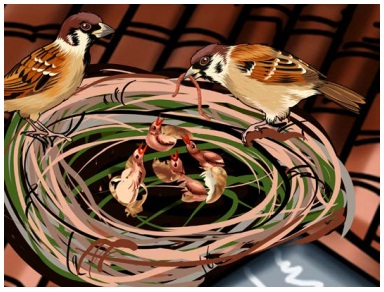
Two sparrows built a nest in a nice spot in the roof of Ramayya's house and the mother-bird laid her eggs in it.

“My dear," began the male sparrow.

“And what do you want now?" asked his wife.

"Why does the lady of this house always quarrel with her husband?"

Sparrows in conversation

"How am I to know?" said the female bird. “Let us mind our own business."

"You are always self-centred," said the male sparrow and added, "Should we not help this poor Ramayya?"

Female sparrow looks on disdainfully

The female sparrow said with disdain, "Let me see what help you can do for him. Please do not talk about what does not concern us. See that the cat does not come near our nest. That would be enough for you and me."

Somewhere in the muck- heap lay a diamond nose- jewel. The male bird picked it up and came to the nest with the shining stud in his beak and said to his wife: "Look! Do you like this?

The wife-bird replied, "What am I to do with diamond nose studs or with ear-rings?

Find some grub; the young ones are hungry."

Ramayya's wife finding the nose jewel while sweeping

The bird dropped the diamond stud on the floor and went out in search of little worms for the young ones.

Ramayya's wife noticed the jewel as she was sweeping the floor. She picked it up with delight and wore it.

Ramayya questioned her angrily, "How did you get this diamond-stud?" "I found it lying here yesterday and took it. That is all."

"We should go and handover it to the village magistrate. If tomorrow the police should come and search our house, it will be disgrace to us?"

In Meenakshi Ammal's house nearby, the talk went thus: "I forgot and left it in the bathroom. Kuppayi, the servant woman must have swept it out. She is very careless and ignorant."

The mother, Meenakshi Ammal, consoled her little girl saying, "Let us search and find it. Don't tell father yet. He would go into a rage if he knew that you had lost the diamond nose stud."

A bird’s eye takes up about 50 percent of its head; our eyes take up about 5 percent of our head. To be comparable to a bird’s eyes, our eyes would have to be the size of baseballs.

What is the secret you are whispering?" asked Ramanatham.

The loss of the jewel had to be admitted. Soon the whole village knew about it. The maid-servant Kuppayi was suspected by everyone to have stolen it.

The maid-servant Kuppayi was suspected by everyone

The police came and searched her hut, but could find nothing.

Ramayya's heart was in a flutter. Ramayya's wife put the stud away in her box. She soon developed a severe fever and was confined to her bed. No one thought of searching their house.

The he-sparrow said, "Look at the fun, my dear, the lady of this house is scared and is down with fever."

"Nice fun indeed!" said the she- sparrow. "The poor woman is in a panic. The fever may be the end of her."

"And a good thing too," said the cruel male sparrow.

"It is all your doing you brought and threw it here and tempted her," said the female bird.

Sparrows discussing the situation

The male bird answered gravely, "Did I tell her to steal the thing? This is bound to happen when human are being greedy.”

“Rightly said, we should never be greedy for what belongs to others". "Come, let us go now and bring some worms for the young ones.” And the two flew out.

Ramayya and his wife spend the rest of life in fear of being caught. The diamond Nose Jewel may still be with them, but the fear of getting caught was even more.

About the Author

Chakravarti Rajagopalachari

Chakravarti Rajagopalachari (1878-1972) informally called Rajaji, was an Indian politician, independence activist, lawyer, writer, historian and statesman. Rajagopalachari was born in the village of Thorapalli in the Krishnagiri district. Rajagopalachari was the last Governor-General of India, as India soon became a Republic in 1950. Furthermore, he was the first Indian-born governor-general, since before him the posts were held by British nationals. He also served as leader of the Indian National Congress, Premier of the Madras Presidency, Governor of West Bengal, Minister for Home Affairs of the Indian Union and Chief Minister of Madras state. He was one of the first recipients of India's highest civilian award, the Bharat Ratna.

A Dilemma by Silas Weir Mitchell | Story Questions and Answers | 10th English Supplementary

Answer the questions - A Dilemma

by Silas Weir Mitchell | Supplementary Story

A. Identify the Character / Speaker

1. I suppose you think me queer. I will explain.

Uncle Philip to Tom

2. Don't come back. It won't hasten things.

Uncle Philip

3. He thought it simply a cruel jest.

Tom’s father confessor

4. He did not desire to do so.

Professor Clinch

5. He would think it over and come back later.

The Collector

B. Short Answer Questions

1. What did the uncle do as soon as he bought a stone?

When the uncle bought a new stone, he carried it in his pocket for a month. He took it out now and then and looked at it. Then, he kept it safe at the trust company.

2. What did the uncle bequeath to the narrator?

Uncle Philip bequeathed all his precious stones to the narrator.

3. What was the condition laid by the uncle to inherit his property?

The condition laid by the uncle to inherit his property was that Tom would have to pay for his funeral.

4. Why do you think Tom happily looked forward to the expenditure for his uncle’s funeral?

Tom’s uncle declared Tom as his only heir. He gave an iron box containing valuable stones. So, Tom looked forward to the expenditure for his uncle’s funeral.

5. Write a few words about the mechanism used in the iron box.

If Tom opened the box with fear, the box would explode. If he opened the box without fear, it would not explode and he could lead a rich life. This was the mechanism used in the iron box.

6. What was the counsel offered to the narrator?

As a considerate man, Tom’s uncle counselled him to open the box without fear.

7. Why and when was the narrator shocked?

The narrator was shocked when he read the letter that the box contained sensitive dynamite.

8. What was the doctor’s warning to Tom?

The doctor warned Tom that he was in danger of losing his mind with too much thought about precious stones.

9. Why didn’t Tom dare to assign the task of unlocking the box to someone?

Tom deeply thought of the risk of unlocking the box. He did not want someone else to risk his life. So, Tom didn’t dare to assign the task of unlocking the box to someone.

C. Paragraph Questions

1. Describe briefly the contents of the letter written by Tom’s uncle.

Lesson: A DILEMMA

Author: Silas Weir Mitchell

Theme: Life is a dilemma - “To be or not to be”

Characters: Tom, Philip, Susan, Dr.Schaff, Professor Clinch

Outlook: Uncle Philip - interested - collecting gems - declared Tom - heir - Leaving iron box - contained gems - take extreme - handling - interesting mechanism - open - explode - wished him

Uncle Philip was a bachelor, cunning and malicious, living alone. He was much interested in collecting valuable gems and pearls. On his death bed, he called Tom and declared Tom as his only heir. Leaving an iron box for Tom, his uncle instructed him to carefully read a letter which lay on top of it. He told that the box contained a large number of pigeon-blood rubies, a lot of diamonds, hundreds of pearls. Tom’s uncle counselled Tom that he should take extreme care in handling the box. He mentioned that the box contained an interesting mechanism. So Tom should open the box with confidence to obtain the precious stones. If Tom opened the box with fear, the box would explode. If he opened without fear, the box would not explode. Hence, Uncle Philip asked Tom to believe him and then unlock the iron box. Uncle Philip wished him to be rich and asked him to remember his uncle.

ESSAY

  • Introduction
  • Uncle Philip’s Last wish
  • Mechanism used in the iron box
  • Details in the letter
  • Conclusion

Introduction:

“A Dilemma” is a very interesting and mysterious story written by Silas Weir Mitchell. Tom was the protagonist of this story. Tom narrated how he was in a dilemma to open a box given by his uncle.

Uncle Philip’s Last wish:

Uncle Philip was a bachelor, cunning and malicious, living alone. He was much interested in collecting valuable gems and pearls. On his death bed, he called Tom and declared Tom as his only heir.

Mechanism used in the iron box

Leaving an iron box for Tom, his uncle instructed him to carefully read a letter which lay on top of it. He told that the box contained a large number of pigeon-blood rubies, a lot of diamonds, hundreds of pearls.

Details in the letter

Tom’s uncle counselled Tom that he should take extreme care in handling the box. He mentioned that the box contained an interesting mechanism. So Tom should open the box with confidence to obtain the precious stones. If Tom opened the box with fear, the box would explode. If he opened without fear, the box would not explode. Hence, Uncle Philip asked Tom to believe him and then unlock the iron box.

Conclusion

Though Uncle Philip wished Tom to be rich and asked him to remember his uncle, he made Tom mad and remember him in his whole life.

“Thinking without awareness is the main dilemma of human existence”.

2. Explain the efforts taken by Tom to open the iron box? Did he succeed? Why?

Lesson: A DILEMMA

Author: Silas Weir Mitchell

Theme: Life is a dilemma - “To be or not to be”

Characters: Tom, Philip, Susan, Dr.Schaff, Professor Clinch

Outlook: Uncle Philip - leaving iron box - contained gems - mechanism- explode - tried - First - planned to explode - Secondly - Professor Clinch - Then Dr. Schaff - referred books - father confessor collector - None understand

Uncle Philip was a bachelor, living alone. On his death bed he called Tom. Leaving an iron box, he instructed Tom that the box contained precious gems but the box contained an interesting mechanism. If he opened it with fear, it would explode. Tom was curious and tried all possible ways to open the box. First of all, He planned to explode the box at a safe distance but dropped the plan in fear of losing the rubies. Secondly he consulted Professor Clinch. But he was turned down by the Professor stating the dubious nature of his uncle. Then he met Dr. Schaff whereas who was indifferent to Tom’s request. Tom referred to books on dynamite at libraries. After that, he sought the help of father confessor. The father replied that it was a cruel jest of his uncle. Finally Tom took the matter to the collector. But he avoided Tom. Definitely, he made a lot of efforts to open the box but he could not succeed. None of them could understand the absurdity of his uncle’s condition.

ESSAY

  • Introduction
  • Tom - sole heir of uncle Philip
  • Mechanism used in the iron box
  • Efforts taken by Tom
  • Conclusion

Introduction:

“A Dilemma” is a very interesting and mysterious story written by Silas Weir Mitchell. Tom was the protagonist of this story. Tom narrated how he was in a dilemma to open a box given by his uncle.

Tom - Sole heir of uncle Philip:

Uncle Philip was a bachelor, cunning and malicious, living alone. On his death bed he called Tom and declared Tom as his only heir. Leaving an iron box for Tom, his uncle instructed him to carefully read a letter which lay on top of it. He told Tom that the box contained a large number of pigeon-blood rubies, diamonds, and pearls.

Mechanism used in the iron box:

Tom’s uncle counselled Tom that he should take extreme care in handling the box. He mentioned that the box contained an interesting mechanism. If he opened it with fear, it would explode. Tom read the letter which stated that the box contained sensitive dynamite. Tom was curious to see the contents in the iron box and tried all possible ways to open the box.

Efforts taken by Tom:

First of all, he planned to explode the box at a safe distance but dropped the plan in fear of losing the rubies. Secondly he consulted Professor Clinch. But he was turned down by the Professor stating the dubious nature of his uncle. Then he met Dr.Schaff, but he was indifferent to Tom’s request. He referred to books on dynamite at libraries. After that he sought the help of father confessor. He replied that it was a cruel jest of his uncle. Finally he took the matter to the collector. But he avoided Tom.

Conclusion:

None of them could understand the absurdity of his uncle’s condition. At last, Tom bequeathed the box to the Society. The protagonist Tom is a true representation of human curiosity and how the iron box can drive him to anxiety and mental instability.

“Life is a dilemma that must be solved by the person living in it”.

D. Summary - Fill in the Blanks

  1. The narrator was sent for, by his uncle when he was on his deathbed.
    (on his deathbed / on his travels / in his workplace)
  2. The uncle had collected precious stones.
    (jewels / stones / articles)
  3. His uncle announced Tom as his heir and wanted him to pay for his funeral.
    (rented house / marriage / funeral)
  4. Leaving an iron box for Tom, his uncle instructed him not to shake the box.
    (throw / carry / shake)
  5. The letter read that the box contained a sensitive dynamite.
    (a sensitive dynamite / jewels / money)
  6. He started thinking of all possible ways to open the box without being killed.
    (wounded / killed / maimed)
  7. He planned to explode the box at a safe distance but dropped the plan in fear of losing the rubies.
    (home / a safe distance / a waste land)
  8. His consultation with Professor Clinch did not yield him any fruitful solution.
    (Uncle Philip / Professor Clinch / Susan)
  9. He failed in his attempts to open the box. His efforts to read about explosives led to confusions (hopes / confusions / suspicions) and he had to change his name and occupation.
    (name and occupation / lodgings / appearance)
  10. At last, he bequeathed the box to the Society.
    (his offspring / his friends / the Society)

The Dying Detective Prose: Reading Comprehension Exercise

Reading - The Dying Detective | by Arthur Conan Doyle | Prose

Read the story carefully and answer the questions asked below

A Mystery Case

For a man of ease, John Mathew kept an arduous schedule. On Wednesdays, for example, he was awakened at 9.00 and served breakfast in bed by Emanuel, his chef. Next came a quick fitness session with Basky, his personal trainer. Then, at 10.30, John Mathew answered his mail, returned phone calls and rearranged his social calendar helped by Louise, his secretary. At noon, John Mathew drove his Jaguar to the station and took a commuter train into Guindy for his weekly lunch with Lalli and Lolly, his two oldest and dearest friends. Then, on to a little shopping. The 4:05 nonstop would bring him back to Tambaram. As John Mathew drove up to the house at 5:00, Basky would have already set up the massage table and warmed the scented oils for a soothing herbal wrap. It was a gruelling life but John seemed to thrive on it. On this Wednesday, however, there was an unexpected change of plans. Today John’s shopping errand involved taking his diamond bracelet into the jeweller’s for cleaning. He threw the expensive jewel into his purse and proceeded on to lunch.

As John waved his friends good- bye and exited the restaurant, he sensed he was being followed. The feeling continued until he reached Tenth Avenue. Then, as he joined the throng of shoppers, John felt a hug. Within a split-second, a man riding pillion on a bike rode past him, grabbing his purse. He couldn’t guess who the culprit was?

G. Match the following.

1. A man of ease – Emanuel
2. John’s trainer – Lalli and Lolly
3. Mathew’s secretary – John Mathew
4. John’s chef – Louise
5. Mathew’s friends – Basky

Answer:

  • 1. A man of ease - John Mathew
  • 2. John’s trainer - Basky
  • 3. Mathew’s secretary - Louise
  • 4. John’s chef - Emanuel
  • 5. Mathew’s friends - Lalli and Lolly

H. State whether the given statements are true or false. If false correct the statements.

  1. Mathew is a very busy man. True
  2. He woke up very late in the morning. True
  3. He always had lunch with his family. False Correct Statement: He had his weekly lunch with his dearest friends Lalli and Lolly.
  4. He exercised with Louise every day. False Correct Statement: He exercised with Basky, his personal trainer.
  5. He preferred handling mail by himself. False Correct Statement: He answered his mail with the help of Louise, his secretary.

The Last Lesson by Alphonse Daudet: Poem Reading Comprehension Exercise

Reading - The Last Lesson | by Alphonse Daudet | Prose

H. Read the poem carefully and answer the questions that follow:

Festival of harvest

Celebrations at its best

Festival of Light

To our heart’s delight

Festival of Dance

Leaves us in a trance

Festival of Music

Where they sing the joyous lyric

Festival of flowers

That brightens up with colours

Festival of decorated cars

That twinkle like the stars

Festival of Love

That spreads treasures on a tree,

To share the word from above

That makes us happy and free.

Festival of sacrifice

To unfurl the joy of giving,

Celebrate them well and nice

To make life worth living.

Fill in the blanks.

1.

(a) festival of Light is the festival which fills our hearts with delight.
(b) The joy of giving is referred to as a festival of sacrifice.

2. What kind of joy is unfurled during the festival of sacrifice?

The Joy of giving is unfurled during the festival of sacrifice.

3. How can we make our life worth living?

We can celebrate the festivals well and nice and make our life worth living.

4. What does the poet mean by ‘Festival of flowers’?

Since it is decorated with colourful flowers, it is called as festival of flowers.

5. When are we in a state of trance?

We are in a state of trance, during festival of dance.

6. What do the people do when the festival of Music is celebrated?

The people sing the joyous lyric, when the festival of music is celebrated.

7. What makes us happy and free, according to the poet?

According to the poet, festival of love makes us happy and free.

8. Find out the rhyme scheme employed in the fourth stanza.

a b a b

9. Pick out the rhyming words from the first stanza of the poem.

harvest-best, light-delight, dance-trance, music - lyric, flowers- colours

10. Write down the words that alliterate in the poetic lines below.

(a) Festival of Flowers - Festival Flowers (Sound is alliterated)
(b) That spreads treasures on a tree - Treasures, tree (T sound is alliterate)

Glossary - A day in 2889 of an American Journalist | by Jules Verne | Supplementary/Story

Glossary: A Day in 2889 of an American Journalist

by Jules Verne | 10th English Supplementary Story (Unit 5)

Key Terms and Definitions

phonotelephote(n)
A means of transmitting and receiving both voice and picture for a personal conversation
Champs-Elysees(n)
a prestigious avenue in Paris, famous for the Cafes, cinemas and shops
phototelegrams (n)
A telegraphic transmission including images
jovians(n)
inhabitants of planet Jupiter
inhabitants(n)
a person or animal that lives in or occupies a place.
Centropolis (n)
(in this story) the new name of New York in 2889
valet(n)
a man's personal male attendant, who is responsible for his clothes and appearance