Maharashtra Board HSC Chemistry Question Paper Solution: February 2020
Time: 3 Hours | Total Marks: 70
Section-A
Q.1. Select and write correct answer of the following questions: [10 Marks]
i. Identify synthetic polymer amongst the following:
- (A) Linen
- (B) Jute
- (C) Silk
- (D) Terylene
Answer: (D) Terylene
Explanation: Linen, Jute, and Silk are natural fibers. Terylene (Dacron) is a synthetic polyester.
ii. Which among the following hydrides is NOT a reducing agent?
- (A) H₂O
- (B) H₂S
- (C) H₂Te
- (D) H₂Se
Answer: (A) H₂O
Explanation: Thermal stability decreases down group 16. Water is thermally stable and does not release hydrogen easily to act as a reducing agent.
iii. During oxidation of ferrous sulphate using mixture of dil. H₂SO₄ and potassium dichromate; oxidation state of chromium changes from _______.
- (A) + 6 to + 2
- (B) + 6 to + 3
- (C) + 6 to + 1
- (D) + 6 to + 4
Answer: (B) + 6 to + 3
Explanation: Dichromate ion (\(Cr_2O_7^{2-}\)) reduces to Chromium ion (\(Cr^{3+}\)).
iv. Identify complex ion in which effective atomic number of the central metal ion is 35.
- (A) [Zn(NH₃)₄]²⁺
- (B) [Fe(CN)₆]⁴⁻
- (C) [Fe(CN)₆]³⁻
- (D) [Co(NH₃)₆]³⁺
Answer: (C) [Fe(CN)₆]³⁻
Calculation: EAN = Z - OS + 2(CN). For (C), Fe(Z=26), OS=+3. EAN = 26 - 3 + 12 = 35.
v. Conversion of methyl chloride into methyl fluoride is known as _______.
- (A) Finkelstein reaction
- (B) Swarts reaction
- (C) Williamson’s synthesis
- (D) Wurtz reaction
Answer: (B) Swarts reaction
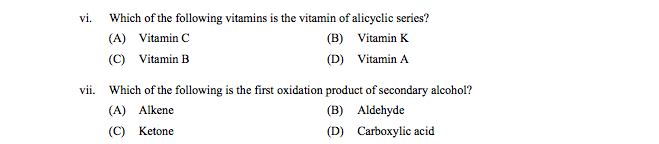
vi. The number of moles of methyl iodide required to prepare tetramethyl ammonium iodide from 1 mole of methyl amine is/are:
Answer: (C) 3
Explanation: \(CH_3NH_2 \xrightarrow{CH_3I} (CH_3)_2NH \xrightarrow{CH_3I} (CH_3)_3N \xrightarrow{CH_3I} (CH_3)_4N^+I^-\). Total 3 moles.
vii. Name the reagent which on reaction with glucose confirms the presence of five hydroxyl groups in glucose:
- (A) Hydroxyl amine
- (B) Bromine water
- (C) Dilute nitric acid
- (D) Acetic anhydride
Answer: (D) Acetic anhydride
viii. Identify antibiotic drug amongst the following:
- (A) Codeine
- (B) Equanil
- (C) Penicillin
- (D) Valium
Answer: (C) Penicillin
ix. The number of atoms per unit cell of body centred cube is:
Answer: (B) 2
x. Calculate the work done during the reactions represented by the following thermochemical equation at 300 K:
\(CH_{4(g)} + 2O_{2(g)} \rightarrow CO_{2(g)} + 2H_2O_{(l)}\)
- (A) + 4.988 kJ
- (B) – 4.988 kJ
- (C) – 49.88 kJ
- (D) + 49.88 kJ
Answer: (A) + 4.988 kJ
Calculation: \(\Delta n_g = 1 - (1+2) = -2\). \(W = -\Delta n_g RT = -(-2)(8.314)(300) = +4988.4 J \approx +4.99 kJ\).
Q.2. Answer the following questions: [8 Marks]
i. What is the concentration of dissolved oxygen at 50°C under pressure of one atmosphere if partial pressure of oxygen at 50°C is 0.14 atm. (Henry’s law constant for oxygen = 1.3 × 10⁻³ mol dm⁻³ atm⁻¹)
Solution:
According to Henry's Law: \(S = K_H \times P\)
Given: \(K_H = 1.3 \times 10^{-3} \text{ mol dm}^{-3}\text{atm}^{-1}\), \(P = 0.14 \text{ atm}\)
\(S = 1.3 \times 10^{-3} \times 0.14 = 0.182 \times 10^{-3} = 1.82 \times 10^{-4} \text{ mol dm}^{-3}\)
ii. Write structural formula of the alcohol that results when acetaldehyde is reacted with CH₃MgBr in the presence of dry ether and the product is hydrolysed.
Solution: The product is Propan-2-ol (Isopropyl alcohol).
Structural Formula: \(CH_3-CH(OH)-CH_3\)
iii. Write balanced chemical reaction for preparation of acetic anhydride using acetic acid.
Reaction:
\[ 2CH_3COOH \xrightarrow{P_2O_5, \Delta} (CH_3CO)_2O + H_2O \]
iv. Write the chemical reaction involved in the formation of ethylamine using acetaldoxime.
Reaction: Reduction of acetaldoxime.
\[ CH_3-CH=N-OH + 4[H] \xrightarrow{Na/C_2H_5OH} CH_3-CH_2-NH_2 + H_2O \]
v. What is electrometallurgy?
Answer: Electrometallurgy is the process of extraction of metals from their ores using electricity (electrolysis), typically used for highly reactive metals like sodium, aluminum, etc.
vi. For the reaction: \(N_2O_{4(g)} \rightarrow 2NO_{2(g)}\) (\(\Delta H^\circ = + 57.24 kJ, \Delta S^\circ = 175.8 Jk^{-1}\)). At what temperature the reaction will be spontaneous?
Solution:
For spontaneity, \(\Delta G < 0\). At equilibrium, \(T = \Delta H / \Delta S\).
\(\Delta H = 57240 J\), \(\Delta S = 175.8 J/K\)
\(T = \frac{57240}{175.8} = 325.6 K\)
Since both \(\Delta H\) and \(\Delta S\) are positive, the reaction is spontaneous at temperatures above 325.6 K.
vii. The standard e.m.f. of the following cell is 0.463 V: \(Cu|Cu^{2+}(1M)||Ag^+(1M)|Ag\). If the standard potential of Ag electrode is 0.800 V, what is the standard potential of Cu electrode?
Solution:
\(E^\circ_{cell} = E^\circ_{cathode} (Ag) - E^\circ_{anode} (Cu)\)
\(0.463 = 0.800 - E^\circ_{Cu}\)
\(E^\circ_{Cu} = 0.800 - 0.463 = 0.337 V\)
viii. Write the mathematical relation between half life of zero order reaction and its rate constant.
Answer:
\[ t_{1/2} = \frac{[A]_0}{2k} \]
Where \([A]_0\) is initial concentration and \(k\) is the rate constant.
Section-B
Attempt any EIGHT of the following questions [16 Marks]
Q.3. State and explain Hess’s law of constant heat summation.
Statement: Hess's Law states that the enthalpy change for a chemical reaction is the same regardless of the path by which the reaction occurs, provided the initial and final states are the same.
Explanation: If a reaction \(A \rightarrow B\) has enthalpy change \(\Delta H\), and the same reaction occurs in steps \(A \rightarrow C \rightarrow D \rightarrow B\) with enthalpy changes \(\Delta H_1, \Delta H_2, \Delta H_3\) respectively, then \(\Delta H = \Delta H_1 + \Delta H_2 + \Delta H_3\). It is a consequence of the law of conservation of energy.
Q.4. Write the cell reaction and calculate E° cell of the following electrochemical cell:
\(Al|Al^{3+}(1M)||Zn^{2+}(1M)|Zn\)
Given: \(E^\circ_{Al} = - 1.66 V, E^\circ_{Zn} = - 0.76 V\)
Cell Reactions:
Anode (Oxidation): \(2Al_{(s)} \rightarrow 2Al^{3+}_{(aq)} + 6e^-\)
Cathode (Reduction): \(3Zn^{2+}_{(aq)} + 6e^- \rightarrow 3Zn_{(s)}\)
Overall Reaction: \(2Al_{(s)} + 3Zn^{2+}_{(aq)} \rightarrow 2Al^{3+}_{(aq)} + 3Zn_{(s)}\)
Calculation:
\(E^\circ_{cell} = E^\circ_{cathode} - E^\circ_{anode}\)
\(E^\circ_{cell} = -0.76 - (-1.66) = -0.76 + 1.66 = +0.90 V\)
Q.5. Distinguish between order and molecularity of a reaction.
| Order of Reaction |
Molecularity of Reaction |
| It is an experimentally determined quantity. |
It is a theoretical concept. |
| It can be zero, fractional, or an integer. |
It is always a positive integer (1, 2, 3). |
| It is the sum of powers of concentration terms in the rate law expression. |
It is the number of reacting species taking part in an elementary step. |
Q.6. Write two uses of each of the following: a. Helium b. Neon
a. Helium:
1. Used in filling balloons for meteorological observations.
2. Used in breathing mixture by deep sea divers (mixed with oxygen).
b. Neon:
1. Used in neon discharge lamps and signs for advertising.
2. Used in beacon lights for air navigation.
Q.7. Write the name and chemical formula of one ore of zinc. Define: Quaternary ammonium salt.
Ore of Zinc: Zinc Blende (ZnS) or Calamine (ZnCO₃).
Quaternary ammonium salt: It is a salt in which all four hydrogen atoms of the ammonium ion (\(NH_4^+\)) are replaced by alkyl or aryl groups. General formula: \([R_4N]^+X^-\).
Q.8. What is the action of acidified potassium dichromate on the following: a. KI b. H₂S
a. Action on KI: It oxidizes potassium iodide to iodine.
\(Cr_2O_7^{2-} + 14H^+ + 6I^- \rightarrow 2Cr^{3+} + 3I_2 + 7H_2O\)
b. Action on H₂S: It oxidizes hydrogen sulphide to sulphur.
\(Cr_2O_7^{2-} + 8H^+ + 3H_2S \rightarrow 2Cr^{3+} + 3S \downarrow + 7H_2O\)
Q.9. Define optical activity. How many optical isomers are possible for glucose?
Optical Activity: The property of certain organic substances to rotate the plane of plane-polarized light towards the right (dextrorotatory) or left (levorotatory) is called optical activity.
Optical Isomers of Glucose: Glucose has 4 chiral carbon atoms. The number of optical isomers = \(2^n = 2^4 = 16\).
Q.10. Explain continuous etherification process for the preparation of diethyl ether.
Explanation: Excess ethyl alcohol is heated with concentrated sulphuric acid at 413 K (140°C).
\(2C_2H_5OH \xrightarrow{H_2SO_4, 413K} C_2H_5-O-C_2H_5 + H_2O\)
This method is called continuous etherification because ether is continuously distilled off and fresh alcohol is added to the reaction mixture.
Q.11. Identify ‘A’ and ‘B’ in the following reaction:
\(C_6H_6 + CH_3COCl \xrightarrow{Anhydrous AlCl_3} A \xrightarrow{Zn-Hg, Conc. HCl, \Delta} B + H_2O\)
Step 1: Friedel-Crafts Acylation forms Acetophenone.
A = Acetophenone (\(C_6H_5COCH_3\))
Step 2: Clemmensen Reduction reduces carbonyl group to methylene group.
B = Ethylbenzene (\(C_6H_5CH_2CH_3\))
Q.12. Write Haworth projection formula of \(\alpha – D – (+) –\) glucopyranose. Define hormones.
Haworth Formula: It is a six-membered ring structure where the OH group at C1 is below the plane (alpha form).
Hormones: Hormones are chemical messengers produced by ductless (endocrine) glands and secreted directly into the blood stream to regulate physiological and metabolic processes.
Q.13. Classify the following solids into different types: (A) Silver (B) P₄ (C) Diamond (D) NaCl
(A) Silver: Metallic solid
(B) P₄: Molecular solid
(C) Diamond: Covalent (Network) solid
(D) NaCl: Ionic solid
Q.14. Define: a. Molality b. Osmotic pressure
a. Molality (m): It is defined as the number of moles of solute dissolved in one kilogram (1 kg) of solvent.
b. Osmotic Pressure (\(\pi\)): It is the excess hydrostatic pressure that must be applied to the solution side to just prevent the flow of solvent into the solution through a semipermeable membrane.
Section-C
Attempt any EIGHT of the following questions [24 Marks]
Q.15. Define flux. Write a note on leaching process.
Flux: A substance added to molten ore during smelting to remove impurities (gangue) by forming a fusible slag is called flux.
Leaching Process: It is a chemical method of concentration of ores. The powdered ore is treated with a suitable reagent that can selectively dissolve the ore but not the impurities. The impurities are filtered off, and the ore is regenerated from the solution. Example: Leaching of Bauxite (Al ore) using NaOH (Bayer's process).
Q.16. Draw the structure of sulphurous acid. Explain why nitrogen does not form pentahalides.
Structure of Sulphurous Acid (\(H_2SO_3\)): Sulphur is bonded to one oxygen via double bond, two -OH groups, and has one lone pair. It has a pyramidal shape.
Nitrogen Pentahalides: Nitrogen belongs to the second period and has valence shell electronic configuration \(2s^2 2p^3\). It does not have vacant d-orbitals in its valence shell to expand its octet. Hence, it can form a maximum of 4 bonds and cannot form pentahalides like \(NCl_5\).
Q.17. Write the general electronic configuration of lanthanoids. Why are most of the compounds of transition metals coloured?
Configuration: \([Xe] 4f^{1-14} 5d^{0-1} 6s^2\)
Colour in Transition Metals: The colour is due to the presence of unpaired electrons in the (n-1)d orbitals. When white light falls on the compound, electrons absorb a specific wavelength of visible light for d-d transition (excitation from lower energy d-orbital to higher energy d-orbital). The transmitted light is the complementary colour which we observe.
Q.18. Calculate the effective atomic number (e.a.n) of copper in \([Cu(NH_3)_4]^{2+}\). Explain ionisation isomerism in coordination compounds with a suitable example.
EAN Calculation:
Z of Cu = 29. Oxidation State = +2. Coordination Number = 4.
EAN = Z - O.S. + 2(C.N.) = 29 - 2 + 2(4) = 27 + 8 = 35.
Ionisation Isomerism: This type of isomerism arises when the counter ion in a complex salt is itself a potential ligand and can displace a ligand which can then become the counter ion. They give different ions in solution.
Example: \([Co(NH_3)_5SO_4]Br\) (gives \(Br^-\) ions) and \([Co(NH_3)_5Br]SO_4\) (gives \(SO_4^{2-}\) ions).
Q.19. Write the chemical reactions of chlorobenzene with respect to: a. Sulphonation b. Acetylation c. Nitration
a. Sulphonation: Chlorobenzene + Conc. \(H_2SO_4\) \(\rightarrow\) 2-chlorobenzenesulphonic acid (minor) + 4-chlorobenzenesulphonic acid (major).
b. Acetylation: Chlorobenzene + \(CH_3COCl\) (+ Anhydrous \(AlCl_3\)) \(\rightarrow\) 2-chloroacetophenone + 4-chloroacetophenone.
c. Nitration: Chlorobenzene + Conc. \(HNO_3\) / Conc. \(H_2SO_4\) \(\rightarrow\) 1-chloro-2-nitrobenzene + 1-chloro-4-nitrobenzene.
Q.20. How is ethanol prepared from the following compounds? a. Ethanal b. Ethene c. Bromoethane
a. From Ethanal: By reduction using \(H_2/Ni\) or \(LiAlH_4\).
\(CH_3CHO + H_2 \rightarrow CH_3CH_2OH\)
b. From Ethene: By acid-catalysed hydration.
\(CH_2=CH_2 + H_2O \xrightarrow{H^+} CH_3CH_2OH\)
c. From Bromoethane: By hydrolysis with aqueous KOH.
\(C_2H_5Br + KOH_{(aq)} \rightarrow C_2H_5OH + KBr\)
Q.21. How are primary, secondary and tertiary nitroalkanes distinguished using HNO₂?
Primary Nitroalkanes: React with nitrous acid (\(HNO_2\)) to form nitrolic acid, which dissolves in alkali to give a red solution.
Secondary Nitroalkanes: React with \(HNO_2\) to form pseudonitrol, which gives a blue colour and is insoluble in alkali.
Tertiary Nitroalkanes: Do not react with nitrous acid as they lack alpha-hydrogen.
Q.22. What are monosaccharides? Explain denaturation of proteins.
Monosaccharides: These are the simplest carbohydrates that cannot be hydrolyzed into smaller units. Examples: Glucose, Fructose.
Denaturation of Proteins: It is a process where a protein loses its biological activity and native structure (secondary, tertiary, quaternary) due to changes in physical (heat) or chemical (pH) environment. The hydrogen bonds are disturbed, globules unfold and helix gets uncoiled. Primary structure remains intact. Example: Coagulation of egg white on boiling.
Q.23. Define non-biodegradable polymer. Write the preparation of terylene.
Non-biodegradable polymer: Polymers which are not decomposed by natural processes (microorganisms) over a period of time are called non-biodegradable polymers. Example: Polythene.
Preparation of Terylene: It is prepared by the condensation polymerization of Ethylene glycol and Terephthalic acid at 420-460 K in the presence of Zinc acetate-Antimony trioxide catalyst. Water molecules are eliminated.
Q.24. What are soaps? How are soaps prepared? Define antiseptic.
Soaps: Soaps are sodium or potassium salts of long-chain fatty acids (like stearic, oleic, palmitic acid).
Preparation: By Saponification. Heating fat or oil (triglycerides) with aqueous sodium hydroxide (NaOH).
Fat + NaOH \(\rightarrow\) Soap + Glycerol.
Antiseptic: Chemical substances used to kill or prevent the growth of microorganisms on living tissues (e.g., wounds, cuts) without harming the tissue. Example: Dettol, Tincture of iodine.
Q.25. Unit cell of a metal has edge length of 288 pm and density of 7.86 g cm⁻³. Determine the type of crystal lattice. [Atomic mass of metal = 56 g mol⁻¹]
Solution:
Formula: \(\rho = \frac{Z \cdot M}{a^3 \cdot N_A}\)
Given: \(\rho = 7.86 g/cm^3\), \(a = 288 pm = 2.88 \times 10^{-8} cm\), \(M = 56 g/mol\).
\(Z = \frac{\rho \cdot a^3 \cdot N_A}{M}\)
\(a^3 = (2.88)^3 \times 10^{-24} \approx 23.88 \times 10^{-24} cm^3\)
\(Z = \frac{7.86 \times 23.88 \times 10^{-24} \times 6.022 \times 10^{23}}{56}\)
\(Z = \frac{7.86 \times 23.88 \times 0.6022}{56} \approx \frac{113.04}{56} \approx 2.01\)
Since Z is approximately 2, the type of crystal lattice is Body Centred Cubic (BCC).
Q.26. Define instantaneous rate of reaction. Explain pseudo first order reaction with suitable example.
Instantaneous Rate: The rate of a chemical reaction at a specific instant of time is called instantaneous rate of reaction. It is given by \(dx/dt\).
Pseudo First Order Reaction: A reaction which has higher order true rate law but behaves as a first order reaction because one of the reactants is present in large excess.
Example: Acid catalyzed hydrolysis of ethyl acetate.
\(CH_3COOC_2H_5 + H_2O \xrightarrow{H^+} CH_3COOH + C_2H_5OH\)
Rate = \(k'[Ester][H_2O]\). Since water is in excess, \([H_2O]\) is constant. Rate = \(k[Ester]\).
Section-D
Attempt any THREE of the following questions [12 Marks]
Q.27. Define the terms: a. Electrochemical series b. Corrosion. Write two applications of electrochemical series.
a. Electrochemical Series: The arrangement of elements or ions in the increasing or decreasing order of their standard electrode potentials is called electrochemical series.
b. Corrosion: The process of slow destruction of metals due to the attack of atmospheric gases and moisture resulting in the formation of compounds like oxides, sulphides, carbonates, etc., on the surface.
Applications of Electrochemical Series:
1. To compare the relative oxidizing and reducing powers of substances.
2. To predict the spontaneity of a redox reaction (if \(E^\circ_{cell}\) is positive, reaction is spontaneous).
Q.28. Explain interhalogen compounds. How is oxygen prepared from the following compounds? a. KClO₄ b. PbO₂
Interhalogen Compounds: Compounds formed by the combination of two different halogen atoms are called interhalogen compounds. General formula \(XX'_n\) where X is larger halogen and X' is smaller halogen.
Preparation of Oxygen:
a. From \(KClO_4\): By thermal decomposition.
\(KClO_4 \xrightarrow{\Delta} KCl + 2O_2\)
b. From \(PbO_2\): By thermal decomposition.
\(2PbO_2 \xrightarrow{\Delta} 2PbO + O_2\)
Q.29. Explain the mechanism of aldol addition reaction. Mention two uses of carboxylic acids.
Mechanism of Aldol Addition:
1. Formation of enolate ion: Base removes an acidic alpha-hydrogen from aldehyde/ketone to form a resonance stabilized enolate ion.
2. Nucleophilic attack: The enolate ion attacks the carbonyl carbon of another aldehyde molecule to form an alkoxide ion.
3. Protonation: The alkoxide ion accepts a proton from water to form Aldol (beta-hydroxy aldehyde).
Uses of Carboxylic Acids:
1. Acetic acid is used as vinegar in food preservation.
2. Benzoic acid is used as a food preservative (sodium benzoate).
Q.30. Derive the mathematical expression between molar mass of a non-volatile solute and elevation of boiling point. State and explain van’t Hoff-Avogardo’s law.
Derivation:
Elevation in boiling point \(\Delta T_b\) is proportional to molality \(m\).
\(\Delta T_b = K_b \times m\)
Molality \(m = \frac{W_2 / M_2}{W_1 / 1000} = \frac{1000 W_2}{W_1 M_2}\)
Substituting m: \(\Delta T_b = K_b \frac{1000 W_2}{W_1 M_2}\)
Rearranging for molar mass \(M_2\): \(M_2 = \frac{1000 K_b W_2}{W_1 \Delta T_b}\)
van't Hoff-Avogadro's Law:
Statement: At constant temperature, equal volumes of isotonic solutions contain an equal number of solute particles. Or, osmotic pressure is directly proportional to molar concentration at constant temperature (\(\pi \propto C\) when T is constant).
Q.31. Define: a. Reversible process b. Standard enthalpy of combustion. Calculate the enthalpy change for the reaction: \(N_{2(g)} + 3H_{2(g)} \rightarrow 2NH_{3(g)}\). The bond enthalpies are: N≡N: 946, H–H: 435, N–H: 389 kJ/mol.
a. Reversible Process: A process conducted in such a way that at every stage the driving force is only infinitesimally greater than the opposing force, and which can be reversed by a slight change in the external conditions.
b. Standard Enthalpy of Combustion: The enthalpy change when one mole of a substance is completely burnt in excess of oxygen under standard conditions (298 K, 1 bar).
Calculation:
\(\Delta H = \Sigma \text{Bond Enthalpies (Reactants)} - \Sigma \text{Bond Enthalpies (Products)}\)
Reactants: \(1 \times (N \equiv N) + 3 \times (H-H) = 946 + 3(435) = 946 + 1305 = 2251 kJ\)
Products: \(2 \times 3 \times (N-H) = 6(389) = 2334 kJ\)
\(\Delta H = 2251 - 2334 = -83 kJ\)