HSC ACCOUNTS MARCH 2018 BOARD QUESTION PAPER

Q 1. A. Answer:
- Trial Balance is a list of all debit and credit balances of ledger accounts.
- Entrance fees is the fees paid by the person who intends to become members of ‘not for profit concern’.
- Qualified acceptance is a type of acceptance in which drawee makes changes in the conditions mentioned in the bill.
- Gain ratio is required to be calculated in case of retirement of partner, when goodwill is raised equal to share of retiring partner and written off.
-

Q 1. B. Answers:
- (1) Unrecorded assets
- (2) Capital
- (3) Endorsee
- (4) Gain ratio
- (5) Single Entry System
Q 1. C. Answers:
- (1) Debited
- (2) 25th January, 2017
- (3) Statement of Affairs.
- (4) Realization Account.
- (5) Purchases.
Q 1. D. Answers.
- (1) False.
- (2) True
- (3) True
- (4) True
- (5) True

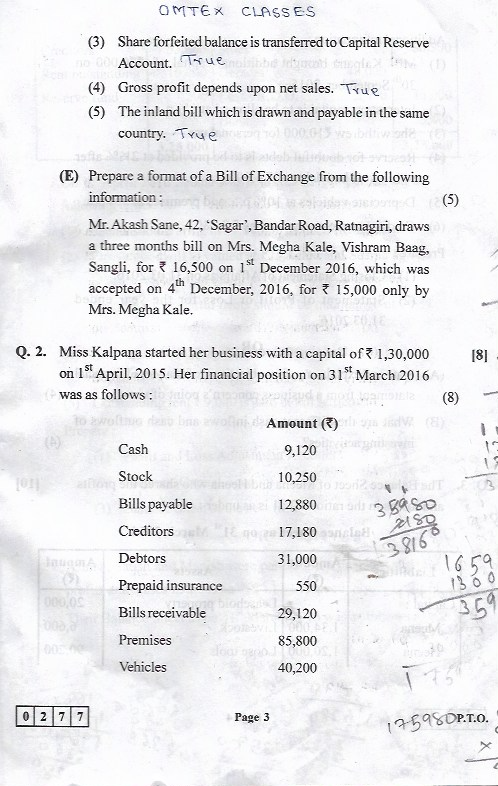
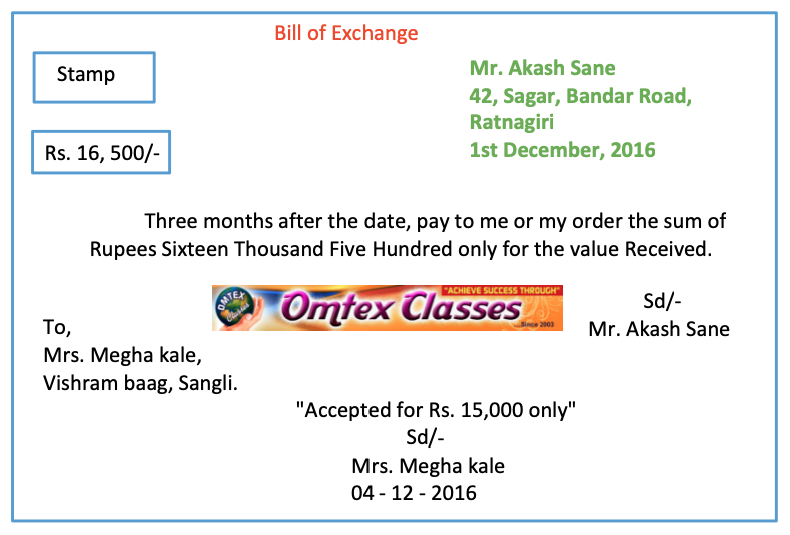
Q. 2. Single Entry Solution:

Q. 3. Admission of Partner Solution:


Q. 3. Death of a partner Solution:

Q. 4. Bills of Exchange Solution:

Q. 5. Dissolution Solution:
OR
Q. 5. Issue of Equity Shares Solution:

Q. 6. NPO Solution:


Q. 7. FINAL ACCOUNT SOLUTION:
Book-keeping and Accountancy 12th Standard
HSC Maharashtra State Board. Latest Syllabus.
- Chapter 1: Introduction to Partnership and Partnership Final Accounts
- Chapter 2: Accounts of ‘Not for Profit’ Concerns
- Chapter 3: Reconstitution of Partnership (Admission of Partner)
- Chapter 4: Reconstitution of Partnership (Retirement of Partner)
- Chapter 5: Reconstitution of Partnership (Death of Partner)
- Chapter 6: Dissolution of Partnership Firm
- Chapter 7: Bills of Exchange
- Chapter 8: Company Accounts - Issue of Shares
- Chapter 9: Analysis of Financial Statements
- Chapter 10: Computer In Accounting
ACCOUNTS BOARD PAPERS
- HSC Accounts March 2020 Board Paper With Solution
- MARCH 2014 : View | PDF Download
- OCTOBER 2014 : View | PDF Download
- MARCH 2015 : View | PDF Download
- JULY 2015 : View | PDF Download
- MARCH 2016 : View | PDF Download
- JULY 2016 : View | PDF Download
- JULY 2017 : View | PDF Download
- MARCH 2017 : View | PDF Download
- MARCH 2018 : View | PDF Download
- JULY 2018 : View | PDF Download
- MARCH 2019 : View | PDF Download
- MARCH 2020 : View | PDF Download
Difficult Words & Meanings:
Trial Balance: A statement showing the balances of all ledger accounts to check arithmetic accuracy.
Ledger Accounts: The main book of accounts where transactions are recorded under specific headings.
Debit: An entry on the left side of an account, typically representing an increase in assets/expenses or a decrease in liability/equity/income.
Credit: An entry on the right side of an account, typically representing a decrease in assets/expenses or an increase in liability/equity/income.
Entrance Fees: A fee paid by new members to join an organization, especially a 'not-for-profit concern'.
Not for Profit Concern (NPO): An organization that operates for a social cause, not to make profit (e.g., charities, clubs).
Qualified Acceptance: When the drawee (person asked to pay a bill) agrees to pay but with some changes to the bill's original terms.
Drawee: The person or entity directed by a drawer (writer of the bill) to pay a specified sum of money on a bill of exchange.
Gain Ratio: A ratio used in partnership accounting, especially during a partner's retirement or death, to determine how remaining partners will share the outgoing partner's portion of profits or goodwill.
Goodwill: The intangible value of a business based on its reputation, customer base, etc., beyond its tangible assets.
Endorsee: The person to whom a bill of exchange or promissory note is transferred (endorsed).
Single Entry System: A simple bookkeeping method that records only cash and personal accounts, not using the double-entry principle.
Statement of Affairs: A summary of assets and liabilities, similar to a balance sheet, often prepared in single entry systems or insolvency cases.
Realization Account: An account prepared during the dissolution (closing down) of a partnership firm to record the sale of assets and payment of liabilities.
Reconstitution of Partnership: Any change in the existing agreement between partners, such as admission, retirement, or death of a partner.
Dissolution of Partnership Firm: The process of closing down a partnership business entirely.
Equity Shares: Shares that represent ownership in a company and give shareholders voting rights.