Andhra Pradesh SSC Class 10th Maths Question Paper 1 With Solution 2019 QUESTION PAPER CODE 15E(A) (B)
Andhra Pradesh SSC Class 10th Maths
Question Paper 1 Solutions | Year: 2019 | Code: 15E(A)
SECTION – I
(4 Marks)
1. Write A = {2, 4, 8, 16} in set-builder form.
Step 1 Observe the pattern: $2=2^1, 4=2^2, 8=2^3, 16=2^4$.
Answer $A = \{x : x = 2^n, n \in \mathbb{N}, n \le 4\}$
Answer $A = \{x : x = 2^n, n \in \mathbb{N}, n \le 4\}$
2. Find the value of $\log_5 \sqrt{625}$.
Solution
$\log_5 (625)^{1/2} = \log_5 (5^4)^{1/2}$
$= \log_5 5^2 = 2 \log_5 5$
$= 2(1) = 2$
$= \log_5 5^2 = 2 \log_5 5$
$= 2(1) = 2$
3. The larger of two supplementary angles exceeds the smaller by 58°, find the angles.
Solution
$x + y = 180^\circ$ (Supplementary)
$x - y = 58^\circ$ (Given)
Adding: $2x = 238^\circ \implies x = 119^\circ$.
$y = 180^\circ - 119^\circ = 61^\circ$.
Angles: 119° and 61°.
$x - y = 58^\circ$ (Given)
Adding: $2x = 238^\circ \implies x = 119^\circ$.
$y = 180^\circ - 119^\circ = 61^\circ$.
Angles: 119° and 61°.
4. Find the curved surface area of the cylinder, whose radius is 7cm and height is 10cm.
Solution
$CSA = 2\pi rh = 2 \times \frac{22}{7} \times 7 \times 10 = 440 \text{ cm}^2$
SECTION – II
(10 Marks)
5. Rohan’s mother is 26 years older than him. The product of their ages after 3 years will be 360. Write the quadratic equation.
Solution
Rohan = $x$. Mother = $x + 26$.
After 3 years: $(x + 3)$ and $(x + 29)$.
Product: $(x + 3)(x + 29) = 360$
$x^2 + 32x + 87 = 360 \implies x^2 + 32x - 273 = 0$.
After 3 years: $(x + 3)$ and $(x + 29)$.
Product: $(x + 3)(x + 29) = 360$
$x^2 + 32x + 87 = 360 \implies x^2 + 32x - 273 = 0$.
6. Find the zeroes of $x^2 – x – 30$ and verify the relation between zeroes and coefficients.
Solution
$x^2 - 6x + 5x - 30 = 0 \implies (x - 6)(x + 5) = 0$
Zeroes: $\alpha = 6, \beta = -5$.
Sum: $6 + (-5) = 1$ (Verified with $-b/a$).
Product: $6(-5) = -30$ (Verified with $c/a$).
Zeroes: $\alpha = 6, \beta = -5$.
Sum: $6 + (-5) = 1$ (Verified with $-b/a$).
Product: $6(-5) = -30$ (Verified with $c/a$).
7. A joker’s cap is in the form of a right circular cone (r=7cm, h=24cm). Find the area of sheet for 10 caps.
Solution
$l = \sqrt{7^2 + 24^2} = 25\text{ cm}$.
Area (1 cap) = $\pi rl = \frac{22}{7} \times 7 \times 25 = 550 \text{ cm}^2$.
Area (10 caps) = $5500 \text{ cm}^2$.
Area (1 cap) = $\pi rl = \frac{22}{7} \times 7 \times 25 = 550 \text{ cm}^2$.
Area (10 caps) = $5500 \text{ cm}^2$.
8. Find the HCF of 1260 and 1440 by using Euclid’s division lemma.
Solution
$1440 = 1260(1) + 180$
$1260 = 180(7) + 0$
HCF is the last divisor: 180.
$1260 = 180(7) + 0$
HCF is the last divisor: 180.
9. If the sum of the first 15 terms of an AP is 675 and its first term is 10, then find the 25th term.
Solution
$S_{15} = \frac{15}{2}[2(10) + 14d] = 675 \implies 20 + 14d = 90 \implies d = 5$.
$a_{25} = 10 + 24(5) = 130$.
$a_{25} = 10 + 24(5) = 130$.
SECTION – III
(16 Marks)
10. Internal Choice Question
[A] Show that $2 + 5\sqrt{3}$ is irrational.
Assume it is rational: $2 + 5\sqrt{3} = \frac{a}{b}$.
$\sqrt{3} = \frac{a-2b}{5b}$. RHS is rational, implying $\sqrt{3}$ is rational (Contradiction).
Thus, it is irrational.
Assume it is rational: $2 + 5\sqrt{3} = \frac{a}{b}$.
$\sqrt{3} = \frac{a-2b}{5b}$. RHS is rational, implying $\sqrt{3}$ is rational (Contradiction).
Thus, it is irrational.
OR
[B] Check whether -321 is a term of the AP 22, 15, 8, 1...
$22 + (n-1)(-7) = -321 \implies (n-1)(-7) = -343 \implies n-1 = 49 \implies n=50$.
Yes, it is the 50th term.
$22 + (n-1)(-7) = -321 \implies (n-1)(-7) = -343 \implies n-1 = 49 \implies n=50$.
Yes, it is the 50th term.
11. Internal Choice Question
[A] Moulika's Marks (Maths & English)
Maths($x$), Eng($30-x$).
$(x+2)(27-x) = 210 \implies x^2 - 25x + 156 = 0$.
$x = 12$ or $13$. Marks: (12, 18) or (13, 17).
Maths($x$), Eng($30-x$).
$(x+2)(27-x) = 210 \implies x^2 - 25x + 156 = 0$.
$x = 12$ or $13$. Marks: (12, 18) or (13, 17).
OR
[B] Oil Drum Painting Cost
$r=1m, h=7m$.
TSA $= 2\pi r(r+h) = \frac{44}{7}(8) = 50.28 m^2$.
Cost $= 50.28 \times 10 \times 5 = \text{Rs. } 2514$.
$r=1m, h=7m$.
TSA $= 2\pi r(r+h) = \frac{44}{7}(8) = 50.28 m^2$.
Cost $= 50.28 \times 10 \times 5 = \text{Rs. } 2514$.
12. Internal Choice Question
[A] Sets Operations
$A=\{1..5\}, B=\{2,3,5\}, C=\{1,3,5,7,9\}, D=\{2,4,6,8,12,14,16,24,48\}$
$A \cup B = \{1,2,3,4,5\}$
$B \cap C = \{3,5\}$
$A - D = \{1,3,5\}$
$D - B = \{4,6,8,12,16,24,48\}$
$A=\{1..5\}, B=\{2,3,5\}, C=\{1,3,5,7,9\}, D=\{2,4,6,8,12,14,16,24,48\}$
$A \cup B = \{1,2,3,4,5\}$
$B \cap C = \{3,5\}$
$A - D = \{1,3,5\}$
$D - B = \{4,6,8,12,16,24,48\}$
OR
[B] Linear Equations Cost
$6x + 4y = 90$ and $8x + 3y = 85$.
Solving gives $x=5$ (Pencil), $y=15$ (Notebook).
$6x + 4y = 90$ and $8x + 3y = 85$.
Solving gives $x=5$ (Pencil), $y=15$ (Notebook).
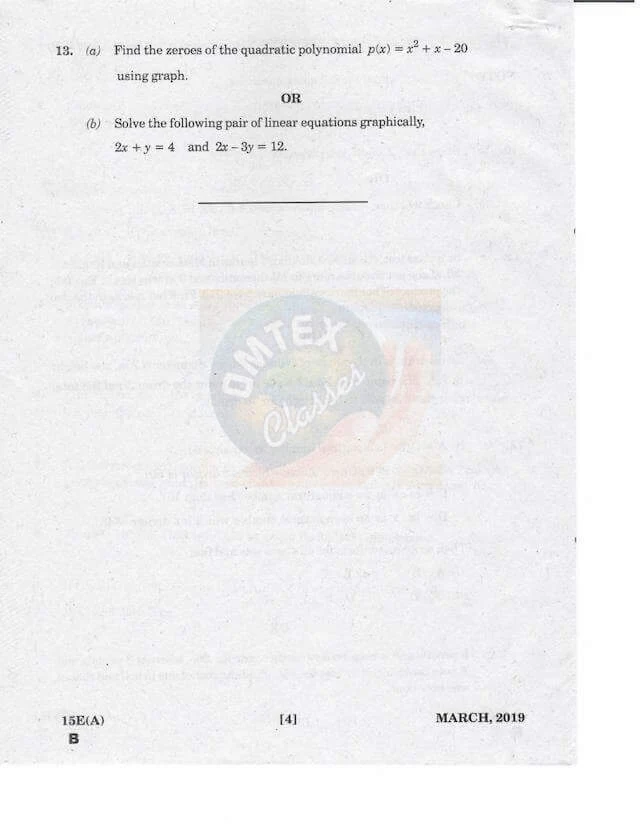
13. Internal Choice: Graphs
[A] Find zeroes of $p(x) = x^2 + x – 20$ using graph.
 The parabola intersects X-axis at $x=4$ and $x=-5$.
Zeroes: 4, -5.
The parabola intersects X-axis at $x=4$ and $x=-5$.Zeroes: 4, -5.
OR
[B] Solve graphically: $2x + y = 4$ and $2x – 3y = 12$.
 Intersection point is $(3, -2)$.
Intersection point is $(3, -2)$.
SECTION – IV
(Multiple Choice)
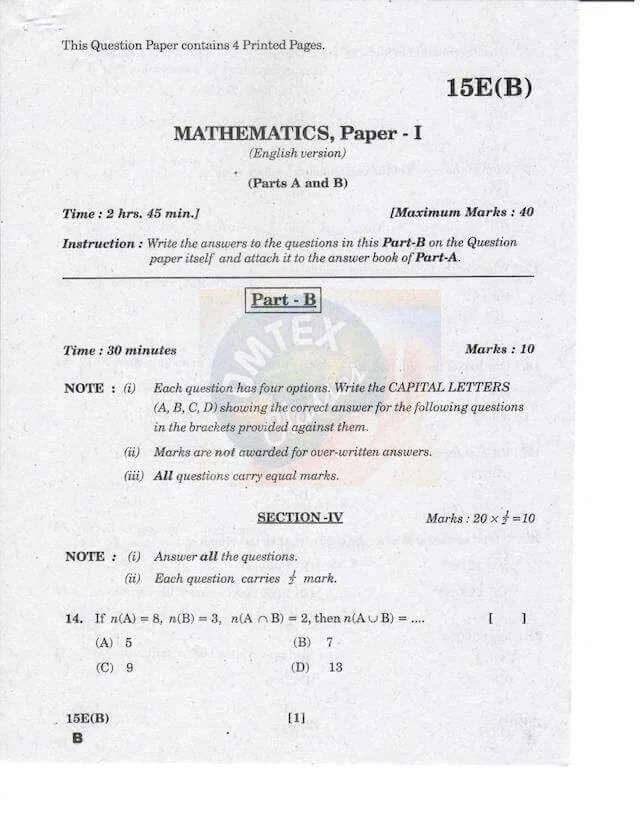
Q14. Sets formula calculation.
Answer: C (9)
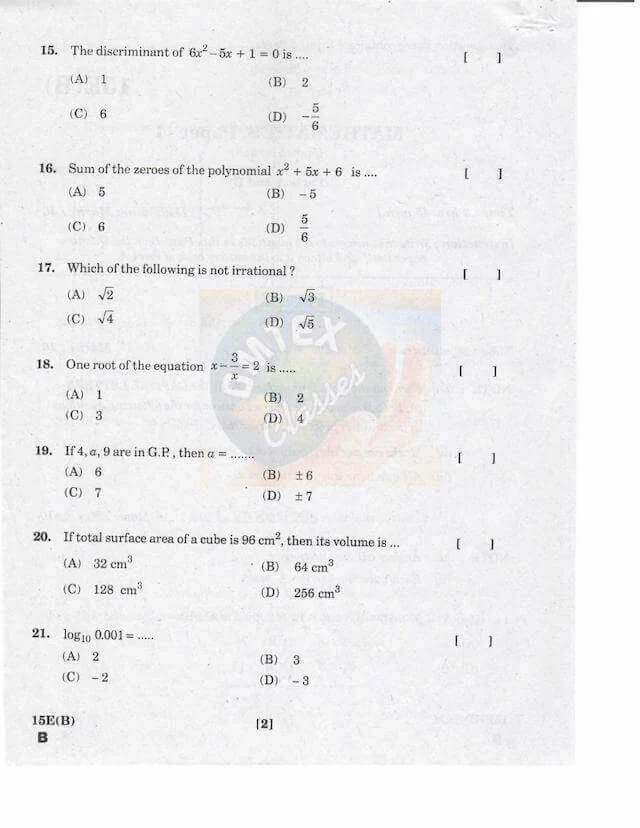
Q15. Discriminant calculation.
Answer: A (1)
Q16. Sum of zeroes.
Answer: B (-5)
Q17. Not irrational ($\sqrt{4}$).
Answer: C
Q18. Root of equation.
Answer: C (3)
Q19. Geometric Progression.
Answer: B (±6)
Q20. Cube volume from Surface Area.
Answer: B (64)
Q21. Log calculation.
Answer: D (-3)
Q22. Cubic Poly Relation.
Answer: A
Q23. Next term in AP.
Answer: D (√48)
Q24. The shaded region in the figure shows:

Answer: C (μ – B)
Q25. Linear Polynomial.
Answer: A
Q26. Common Difference.
Answer: A (1)
Q27. Sum of odd numbers ($n^2$).
Answer: B
Q28. Quadratic from zeroes.
Answer: A
Q29. The number of zeroes in the graph is:

Answer: D (3)
Q30. Line Intersection.
Answer: D (4,0)
Q31. Volume of Cone.
Answer: D (24π)
Q32. No solution condition ($k=3$).
Answer: A
Q33. Real distinct roots.
Answer: B