📄 Download Question Paper PDF
Get the official Maharashtra Board SSC Science 1 (March 2020) Question Paper for offline practice.
Download PDF NowBOARD QUESTION PAPER: MARCH 2020
Science and Technology Part - 1
i. According to Mendeleev's periodic law, properties of elements are periodic function of their _________.
ii. The vapour content in the air is measured using a physical quantity called _________.
iii. For the normal human eye, the near point is at _________ cm.
iv. The astronomical object closest to us is _________.
v. In the Wilfley table method, the particles of gangue are separated by _________ separation method.
i. Find the odd one out: Voltmeter, Ammeter, Thermometer, Galvanometer.
ii. Complete the correlation: Alkene: \(C=C\) :: Alkyne: _________
iii. State true or false: The frequency of AC is 50 Hz.
iv. Match the Columns:
| The wavelength of red light | 700 nm |
v. Name the first artificial satellite sent by Russia in space.
i. The weight of an object changes from place to place though its mass is constant.
- Mass is the quantity of matter contained in an object, which remains constant everywhere.
- Weight is the force with which the Earth attracts an object, given by \(W = m \times g\).
- The value of gravitational acceleration (\(g\)) changes from place to place due to the Earth's shape (polar vs. equatorial radius) and height above the surface.
- Therefore, weight varies while mass remains constant.
ii. Stars twinkle but we do not see the twinkling of planets.
- Stars are very distant point sources of light. Atmospheric refraction causes the path of light to fluctuate, leading to a change in apparent position and brightness (twinkling).
- Planets are much closer to Earth and behave as extended sources (a collection of many point sources).
- The fluctuations in light from different points on a planet cancel each other out, resulting in a stable average brightness. Hence, planets do not twinkle.
iii. Elements belonging to the same group have the same valency.
- The valency of an element is determined by the number of valence electrons (electrons in the outermost shell).
- Elements in the same group of the periodic table possess the same number of valence electrons.
- Therefore, they exhibit the same valency.
i. How much heat energy is necessary to raise the temperature of 5 kg of water from \(20^{\circ}C\) to \(100^{\circ}C\)?
Given: Mass (\(m\)) = 5 kg, \(\Delta T\) = \(100^{\circ}C - 20^{\circ}C = 80^{\circ}C\).
Specific heat of water (\(c\)) = 1 kcal/kg\(^{\circ}C\).
Formula: \(Heat (Q) = m \times c \times \Delta T\)
Calculation: \(Q = 5 \times 1 \times 80 = 400 \text{ kcal}\).
Answer: 400 kcal of heat energy is required.
ii. Observe the given figure of Fleming's Right Hand Rule and write the labels of A and B correctly.
[Image of Fleming's Right Hand Rule]B: Induced Current (Middle Finger)
iii. Observe the graph regarding water temperature and volume:
b. At what temperature does this process take place? Between \(0^{\circ}C\) and \(4^{\circ}C\).
iv. Complete the reaction: \(CuSO_{4}(aq) + Fe(s) \rightarrow \_\_\_ + \_\_\_\). Name the type.
Type of Reaction: Displacement Reaction.
v. Write a short note on Alloying.
i. An element has its electronic configuration as 2, 8, 2.
b. Group: Group 2 (based on 2 valence electrons).
c. Period: Period 3 (based on 3 shells).
ii. Observe the given figure showing the orbit of a planet moving around the Sun and write the three laws related to it:
- First Law (Law of Orbits): The orbit of a planet is an ellipse with the Sun at one of the foci.
- Second Law (Law of Areas): The line joining the planet and the Sun sweeps equal areas in equal intervals of time.
- Third Law (Law of Periods): The square of the period of revolution of a planet around the Sun is directly proportional to the cube of the mean distance of the planet from the Sun (\(T^2 \propto r^3\)).
iii. Read the passage about home electrical connections (Fuse) and answer:
b. What is short circuit? When the live and neutral wires come in direct contact (due to damaged insulation), the resistance of the circuit decreases drastically, causing a very large current to flow. This is called a short circuit.
c. Function of a fuse: A fuse is a safety device with a low melting point. It melts and breaks the circuit when the current exceeds a safe limit, preventing damage to appliances and fire hazards.
iv. Observe the figure of light passing through a glass slab:
b. Laws related to the process:
- The incident ray, the refracted ray, and the normal to the interface of two transparent media at the point of incidence, all lie in the same plane.
- For a given pair of media, the ratio of the sine of the angle of incidence to the sine of the angle of refraction is constant (Snell's Law: \(n = \frac{\sin i}{\sin r}\)).
v. What is an artificial satellite? Name any two types and their functions.
Types:
- Weather Satellite: Study and prediction of weather conditions.
- Communication Satellite: Establish communication between different locations on Earth.
vi. Hydrocarbons:
b. Types: Saturated Hydrocarbons (Alkanes) and Unsaturated Hydrocarbons (Alkenes and Alkynes).
c. Examples: Methane (\(CH_4\)), Ethane (\(C_2H_6\)).
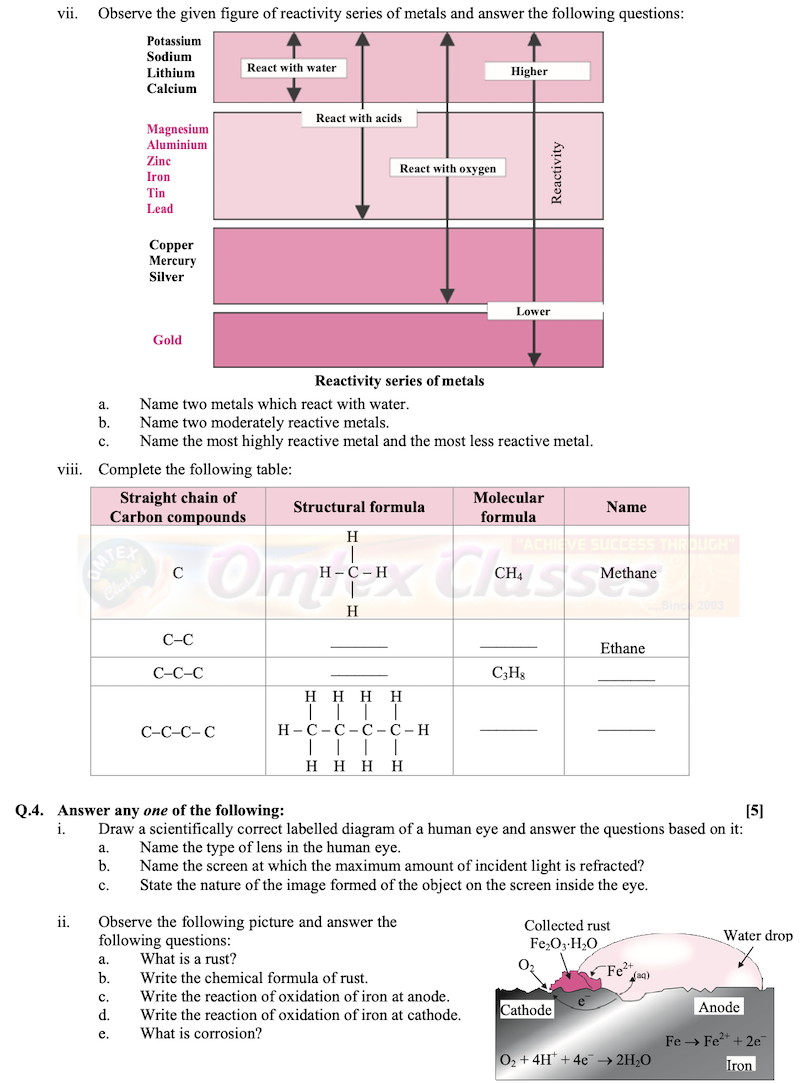
vii. Observe the Reactivity Series figure and answer:
b. Moderately reactive metals: Magnesium (Mg), Aluminium (Al), Zinc (Zn), Iron (Fe).
c. Most reactive: Potassium; Least reactive: Gold.
viii. Complete the table (Hydrocarbons):
| Straight chain | Molecular formula | Name |
|---|---|---|
| C-C | \(C_2H_6\) | Ethane |
| C-C-C | \(C_3H_8\) | Propane |
| C-C-C-C | \(C_4H_{10}\) | Butane |
i. Draw a scientifically correct labelled diagram of a human eye and answer questions:
[Image of Human Eye Diagram]b. Name the screen at which maximum amount of incident light is refracted? Cornea (Note: Most refraction happens at the cornea, though the image forms on the retina).
c. Nature of image formed on the screen: Real and Inverted.
ii. Observe the picture regarding Corrosion/Rusting:
b. Chemical formula of rust: \(Fe_2O_3 \cdot H_2O\)
c. Reaction at Anode (Oxidation): \(Fe(s) \rightarrow Fe^{2+}(aq) + 2e^-\)
d. Reaction at Cathode (Reduction): \(O_2(g) + 4H^+(aq) + 4e^- \rightarrow 2H_2O(l)\)
e. What is corrosion? It is the slow degradation of metals due to the action of atmospheric gases, moisture, and acids on their surface.
SSC-Science-1-Question-Paper-2020-March-English-Medium-Std-10th-Maharashtra-Board.