1. The reason for having attractive colours and fragrances of the flowers
is ...
(a) to get good price in the market.
(b) to give joy to others.
(c) to attract insects for the purpose of pollination.
(d) to attract human beings.
Ans. To attract insects for the purpose of pollination.
2. A father gave seeds to four of his sons and told them to convert seeds
into plants and bring the grown plants to show him after a period of
three months. None of his sons could fulfill his wish. What must be the
reason ?
Ans. Seeds develop into seedlings under appropriate conditions. Either the seeds
were damaged by boiling before they were given to the sons or the sons did
not plant them under appropriate conditions as a result of which the seeds
failed to develop into plants.
3. My neighbour gave birth to a twins. To our wonder, both the boys looked
similar to each other. How is that so ?
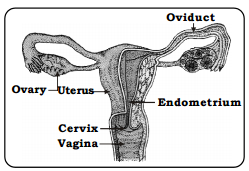
Ans. The sperms reach oviduct and encounter the egg. The egg cell or zygote, in
such case, gets split and separated into two parts during the early stage of
cell division. Each part then develops into a separate individual. As these
individuals are produced from a single zygote, they look similar.
4. Name those parts of the flowers which serve the same function as the
following do in the animals :
(a) Testes (b) Ovary
(c) Eggs (d) Sperms
(e) Fallopian tube.
Ans. (a) Pollen grain.
(b) Ovary.
(c) Female germ cell or egg cell.
(d) Male germ cells or gametes.
(e) Pollen tube.
5. A farmer plotted some seeds of a plant and also few branches of the
same plant in soil and provided appropriate conditions for them to grow.
Which method must have given the farmer flowers and fruits earlier
than the other ? Why ?
Ans. Plants produced by vegetative propagation take less time to grow and bear
flowers and fruits earlier than those produced from seeds. The branches
planted in the soil under favourable conditions must have borne flowers
and fruits earlier than the seeds.
6. A fish lays many eggs. A leopard gives birth to 2-3 cubs at a time. Why
is the difference ?
Ans. All animals want to make sure that their progeny should survive. Leopard
looks after its young ones till they become independent. If the number is
limited, it can do so. Fish do not look after their eggs or little ones. Therefore
they produce hundreds of eggs and leave them to develop by themselves.
Most of them die but because of the large number, a few succeed in
surviving.
7. Population size is an important factor in deciding the success rate of a
country. Why ?
Ans. There is undoubtedly a strong relation between high national fertility rate
and measures of poverty. As the population density increases, decrease in
per capita income and natural resources takes place. General health goes
down. It creates an economical burden on the nation.
Large families affect both the individual as well as community life. It gives
rise to economic pressure, poor health conditions, neglecting children,
poor housing, malnutrition, insufficient medical care, lack of better
education ultimately affecting the success of a nation.
8. What happens to the following parts of the flower after fertilization ?
(a) Egg cell (b) Secondary nucleus in the embryo sac
(c) Zygote (d) Ovule
(e) Ovary.
Ans. (a) One of the male gametes in pollen tube fuses with the egg cell to form
zygote.
(b) The second male gamete in the pollen tube fuses with the secondary
nucleus in the embryo sac to form endosperm.
(c) The zygote develops into embryo.
(d) The ovule develops into a seed.
(e) The ovary develops into the fruit.
9. Write the correlated term.
Amoeba : Simple binary fission :: Yeast : ................. .
Ans. Budding.
10. A scientist created a hen which was replica of a hen in his yard.
(a) What is the name of the process ?
(b) Give scientific reason for the process.
(c) Which was the first mammal to be created in this way ?
(d) Give one advantage of creating human beings in this way.
(e) Suggest some other name for this process.
Ans. (a) Cloning.
(b) Cloning is the process by which an entire organism is reproduced in a
genetically identical manner, from a single cell taken from the parent
organism.
(c) Dolly sheep.
(d) Brilliant or talented human beings could be created is the advantage.
(e) Duplicating, mirroring, replicating, imitating etc.
11. Dolly was the first cloned sheep.
She had three mothers but no father. From first mother diploid cell
having 2n chromosomes was selected. This cell was from udders of this
sheep. From second mother egg was taken out. The haploid nucleus of the
egg was removed by microsurgery. Now in this enucleated egg, diploid
nucleus from udder’s cell was inserted. This egg was then implanted in
the uterus of a third sheep which was called the surrogate mother. Then
one day Dolly was born. Later calf, monkey, cat, mice, etc. were also
cloned.
Questions :
(a) Who can be called the real mother of Dolly ? Why ?
(b) What is the meaning of surrogate mother ?
(c) Why had Dolly no father ?
(d) Which cell nucleus was used in cloning Dolly ?
(e) Which other animals have been cloned ?
Ans. (a) The sheep from whom the udder cell was taken can be called the real
mother of Dolly. Her diploid nucleus was taken, therefore, she is the
real mother of Dolly. Moreover, Dolly looked like her.
(b) Surrogate mother is the one which uterus is used for raising the foetus.
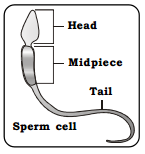
(c) Sperm was not used in cloning Dolly. Therefore, Dolly had no father.
(d) The udder’s cell nucleus was used in cloning Dolly.
(e) Sheep, calf, monkey, cat, mice, etc. are the other animals which have
been cloned.
12. What is the role of testosterone, glands like prostate and seminal vesicles
in the male reproductive system ?
Ans. (a) Testosteron is responsible for production of sperms. It is also responsible
for the development of secondary sexual characteristics in boys during
puberty.
(b) The glands like prostate and seminal vesicles produce the ejaculatory
fluid which helps in the transport of sperms and also provides nutrition.