Showing posts with label Natural Resources. Show all posts

Geography, Social Science, Class 10, India Resources, Indian Industries, Natural Resources

10th Social Science : Geography : Chapter 4 : India - Resources and Industries

Resources and Industries in India

An overview of India's natural resources and industrial landscape.

India - Resources and Industries Banner

Learning Objectives

  • To learn about the resource and its types.
  • To understand the concept of renewable and non- renewable resources.
  • To identify the different types and distribution of industries in India.
  • To analyse the problems of Indian industries.

Introduction

Any matter or energy derived from the environment that is used by living things including humans is called a natural resource. Natural resources include air, water, soil, minerals, fossil fuels, plants, wild life etc. Many natural resources are used as raw materials. They play a vital role in the economic development of any region. Natural resources are classified on several basis. Based on continued availability, the resources are categorised into two types. Renewable Resources are those which have natural regeneration after their utilisation.

Solar energy, wind energy, biogas, tidal energy, wave energy etc. are the renewable resources. Non- Renewable resources are the sources that cannot be replaced again after utilisation. Coal, petroleum, natural gas etc. fall under this category.

Map of India showing mineral distribution Map of India showing non-renewable resources Map of India showing renewable resources Map of India showing major industries Map showing software and automobile industry locations in India

Introduction to Environmental Management | Class 10 Science

Introduction - Environmental Management

Tags: Environmental Management, 10th Science : Chapter 22 : Environmental Management

ENVIRONMENTAL MANAGEMENT

Introduction

Environmental management deals with the different aspects of environment, its structure, function, its quality and its maintenance including conservation of its living and non -living components. The diversified natural resources on this earth provide the necessities for survival of all forms of life including man. Everything that comes from nature has some utility for man but its utilization is possible based on the availability of appropriate technology.

Resources can be renewed simultaneously along with their exploitation (forests, crops, wildlife, groundwater, wind and solar energy) . They can maintain themselves by natural recycling or can be replenished by proper management. Simultaneously, non-renewable resources cannot be recycled and can get exhausted by unlimited and continous use (mineral ores, coal, petroleum etc). They cannot be replaced easily. This would lead to a situation where non- renewable resources may come to an end after a certain period of time.

Expanding human population resulted in expanding needs of man. With scientific and technological advancement man started utilizing natural resources at a much larger scale. Continuous increase in population caused an increased demand for resources. Therefore, conservation of natural resources makes important contributions to the social and economic development of the country.

Diagram showing classification of resources into renewable (e.g., solar, wind, water) and non-renewable (e.g., coal, petroleum, minerals).

Conservation and Judicious Use of Natural Resources | Environmental Management

Conservation and Judicious Use of Resources

10th Science | Chapter 22: Environmental Management

Conservation and Judicious Use of Resources

Natural resources are conserved for their biological, economic and recreational values. The use of natural resources in excess and unplanned way leads to imbalance in the environment. A judicious balance should be maintained between exploitation of resources and its replenishment. Proper utilization and management of nature and its resources is termed as conservation.

We have to build a sustainable world, which should last forever. Some of the ways to sustain continuous use of resources are practices to utilise energy efficiently, avoid wastage of water, avoid usage of plastics and other non-biodegradable materials and to take care for the environment we live. It is important that we manage and use our resources carefully so as to preserve for the future generations.

Key Concepts in Environmental Management | Science Explained`

Points to Remember - Environmental Management | Science

Environmental Management (Science)

Points to Remember

  • Conservation is a process which is concerned with the use, preservation and proper management of natural resources from destructive activities of human being.
  • Conservation of natural resources contributes to the social and economic development of the country.
  • Forests of a country constitute a major asset for the people of the country.
  • National park is a reserved area for the conservation of entire wildlife including plants and animals.
  • Sanctuary is a place reserved exclusively for the use of animals.
  • Solar cell is a device that absorbs sunlight and converts it into electric energy.
  • Solar water heater does not require electricity, they heat up water directly from sunlight.
  • Biogas is produced by the anaerobic decomposition of cow dung.
  • The technique of collecting and storing rain water for future purpose is known as rainwater harvesting.
  • Unwanted, non-working and outdated electronic products become e-waste.

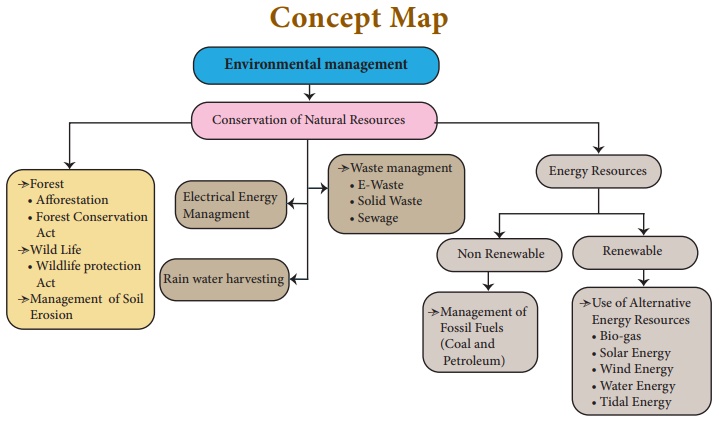
Concept Map: Environmental Management

Concept Map of Environmental Management