-
How does rainwater harvesting structures recharge ground water?
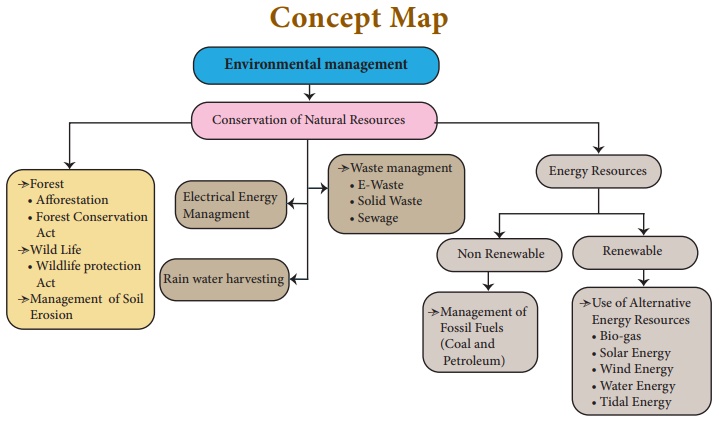
The main purpose of rainwater harvesting is to make the rainwater percolate under the ground so as to recharge ‘groundwater level’.
Methods of rainwater harvesting :
(i) Roof top rain water harvesting : Roof tops are excellent rain catchers. The rain water that falls on the roof of the houses, apartments, commercial buildings etc., is collected and stored in the surface tank and can be used for domestic purpose.
(ii) Recharge pit : In this method, the rain water is first collected from the roof tops or open spaces and is directed into the percolation pits through pipes for filtration.
(iii) After filtration the rainwater enters the recharge pit or ground wells.
-
How will you prevent soil erosion?
Management of soil erosion :
(i) Retain vegetation cover, so that soil is not exposed.
(ii) Cattle grazing should be controlled.
(iii) Crop rotation and soil management improve soil organic matter.
(iv) Runoff water should be stored in the catchment.
(v) Reforestation, terracing and contour ploughing.
(vi) Wind speed can be controlled by planting trees in form of a shelter belt.
-
What are the sources of solid wastes? How are solid wastes managed?
Sources of solid waste :
(i) Solid wastes mainly include municipal wastes, hospital wastes, industrial wastes and e-wastes etc.
(ii) The solid wastes are dumped in the soil which results in landscape pollution.
(iii) Solid - waste management involves the collection, treatment and proper disposing of solid material that is discarded from the household and industrial activities.
Methods of solid wastes disposal:
(i) Segregation : It is the separation of different type of waste materials like biodegradable and non biodegradable wastes.
(ii) Sanitary land fill : Solid wastes are dumped into low lying areas. The layers are compacted by trucks to allow settlement. The waste materials get stabilised in 2-12 months. The organic matter undergoes decomposition.
(iii) Incineration: It is the burning of non- biodegradable solid wastes (medical wastes) in properly constructed furnace at high temperature.
(iv) Composting : Biodegradable matter of solid wastes is digested by microbial action or earthworms and converted into humus.
Recycling of wastes :
(i) Papers from old books, magazines and news papers are recycled to produce papers in papermills.
(ii) Agricultural wastes like coconut shells, jute, cotton stalk, bagasse of sugarcane can be used to make paper and hard board. Paddy husk can be used as livestock fodder.
(iii) Cowdung and other organic wastes can be used in gobar gas plant to provide biogas and manure for fields.
3R Approach : The 3R approach such as, Reduce, Reuse and Recycle may be followed for effective waste management.
-
Enumerate the importance of forest.
(i) Forests are an important component of our environment and are dominated by microorganisms, flowering plants, shrubs, climbers, dense trees and provide a vast habitat for wild animals.
(ii) Forests also contribute to the economic development of our country.
(iii) Forests are vital for human life, it is a source for a wide range of renewable natural resource.
(iv) They provide wood, food, fodder, fibre and medicine.
(v) Forests are major factor of environmental concern. They act as carbon sink, regulate climatic conditions, increase rainfall, reduce global warming, prevent natural hazards like flood and landslides, protect wildlife and also act as catchments for water conservation.
(vi) They also play a vital role in maintaining the ecological balance.
-
What are the consequences of soil erosion?
Removal of upper layer of soil by wind and water is called soil erosion. The top layers of the soil contains humus and mineral salts which are vital for the growth of plants.
Soil erosion causes :
(i) Significant loss of humus and nutrients.
(ii) It decreases the fertility of the soil.
(iii) Vegetation, cover cannot be retained.
(iv) This will affect ground water levels.
-
Why is the management of forest and wildlife resource considered as a challenging task?
(i) Expanding human population results in expanding needs. Forests provide a variety of resources to fulfill man's needs.
(ii) Forests are destroyed for reasons like agriculture, urbanization, construction of dams, roads, buildings, industries, hydroelectric projects etc.,
(iii) A lot of these projects are related to the economic growth of the country.
(iv) Natural resources are conserved for their biological, economic and recreational values. The use of natural resources in excess and unplanned way leads to imbalance in the environment.
(v) Wildlife is needed for maintaining biological diversity. It also helps is promoting economic activities and generates revenue through tourism. Conservation of forest and wildlife is interrelated. Over exploitation of forest cover areas has resulted in animals becoming extinct, threatened or on the verge of extinction.
(vi) A judicious balance should be maintained between exploitation of resources and its replenishment. Proper utilization and management of nature and its resources is termed as conservation.
(vii) We have to build a sustainable world, which should last forever. There should be a sharing of global resources among living organisms.
(viii) Thus management of forests and wildlife is indeed a challenging task.