A. Read the following lines from the poem and answer the questions that follows.
1. Let me but live my life from year to year,
With forward face and unreluctant soul;
a. Whom does the word ‘me’ refer to?
The word ‘me’ refers to the poet.
b. What kind of life does the poet want to lead?
The poet wants to lead joyful life with forward face and unreluctant soul.
c. What does the phrase ‘unreluctant soul’ mean here?
Here, the phrase ‘unreluctant soul’ means the person who is willing to do something.
d. Identify the rhyming words of the given lines.
year, disappear soul, goal
2. Not hurrying to, nor turning from the goal;
Not mourning for the things that disappear
a. Why do you think the poet is not in a hurry?
The poet does not want to move away from his goal. So I think he is not in a hurry.
b. What should one not mourn for?
One should not mourn for the things, he has lost.
3. In the dim past, nor holding back in fear
From what the future veils; but with a whole
And happy heart, that pays its toll
To Youth and Age, and travels on with cheer.
a. What does the poet mean by the phrase ‘in the dim past’?
‘In the dim past’ refers to unhappy or unpleasant past experiences.
b. Is the poet afraid of future?
No, the poet is not afraid of future.
c. How can one travel on with cheer?
One can travel on with cheer by thinking of the experiences of youth and old age.
d. Who pays the toll to whom?
The poet’s happy heart pays its toll to his youth and old age.
e. What does the poet not want to do in fear?
The poet does not want to hold back his journey of life in fear.
f. Whose Youth and Age is referred to here?
The poet’s ‘youth and age’ is referred to here.
g. Identify the rhyme scheme of the given lines.
abba
4. So let the way wind up the hill or down,
O'er rough or smooth, the journey will be joy:
Still seeking what I sought when but a boy,
New friendship, high adventure, and a crown,
a. How is the way of life?
The way of life is full of twists, turns,and ups and downs. It is sometimes rough and sometimes smooth.
b. How should be the journey of life?
The journey of life should be joyful and looking ahead.
c. What did the poet seek as a boy?
As a boy, the poet sought new friendship, high adventure and a crown.
d. Is the poet a boy?
No. The poet is not a boy.
e. Identify the rhyme scheme of the given lines.
abba
f. Identify the rhyming words of the given lines.
down, crown joy, boy
5. My heart will keep the courage of the quest,
And hope the road's last turn will be the best.
a. What kind of quest does the poet seek here?
The poet seeks for the courage of the heart.
b. What is the poet’s hope?
The poet hopes that every turn in his life's journey will be the best. He is optimistic.
c. Identify the rhyming words of the given lines.
quest, best
6. In the dim past, nor holding back in fear
From what the future veils; but with a whole
And happy heart, that pays its toll
To Youth and Age, and travels on with cheer.
a. Identify the rhyming words of the given lines.
fear, cheer - whole, toll
7. Let me but live my life from year to year,
With forward face and unreluctant soul;
Not hurrying to, nor turning from the goal;
Not mourning for the things that disappear
a. Identify the rhyme scheme of the given lines.
a,b,b,a
Read and Enjoy
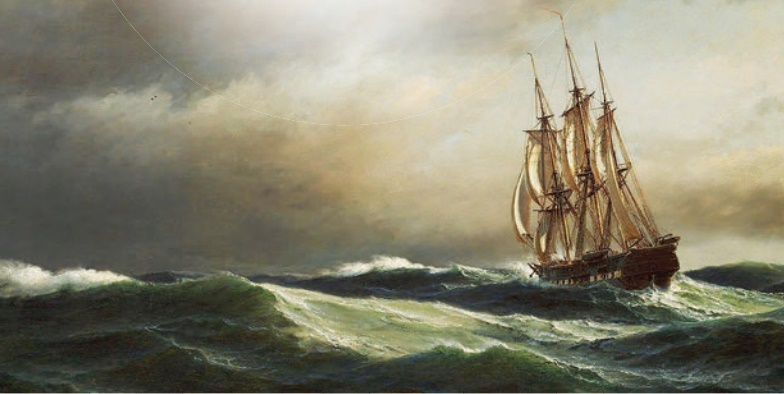
Sea Fever
John Masefield
I must go down to the seas again, to the lonely sea and the sky,
And all I ask is a tall ship and a star to steer her by;
And the wheel’s kick and the wind’s song and the white sail’s shaking,
And a grey mist on the sea’s face, and a grey dawn breaking.
I must go down to the seas again, for the call of the running tide
Is a wild call and a clear call that may not be denied;
And all I ask is a windy day with the white clouds flying,
And the flung spray and the blown spume, and the sea-gulls crying.
I must go down to the seas again, to the vagrant gypsy life,
To the gull’s way and the whale’s way where the wind’s like a whetted knife;
And all I ask is a merry yarn from a laughing fellow-rover,
And quiet sleep and a sweet dream when the long trick’s over.