HSC Physics Board Papers with Solution
- Physics - March 2025 - English Medium View Answer Key
- Physics - March 2025 - Marathi Medium View Answer Key
- Physics - March 2025 - Hindi Medium View Answer Key
- Physics - March 2024 - English Medium View Answer Key Answer Key
- Physics - March 2024 - Marathi Medium View Answer Key
- Physics - March 2024 - Hindi Medium View Answer Key
- Physics - March 2023 - English Medium View Answer Key
- Physics - July 2023 - English Medium View Answer Key
- Physics - March 2022 - English Medium View Answer Key
- Physics - July 2022 - English Medium View Answer Key
- Physics - July 2021 - English Medium View Answer Key
- Physics - February 2020 - English Medium View Answer Key
- Physics - February 2019 - English Medium View Answer Key
- Physics - March 2013 View
- Physics - October 2013 View Answer Key
- Physics - March 2014 View Answer Key
- Physics - October 2014 View Answer Key
- Physics - March 2015 View Answer Key
- Physics - October 2015 View Answer Key
- Physics - March 2016 View Answer Key
- Physics - July 2016 View Answer Key
- Physics - March 2017 View Answer Key
- Physics - July 2017 View Answer Key











Board Question Paper : March 2019 - Physics (Solutions)
Note: The following solutions cover all sections of the question paper including internal choices.
SECTION A
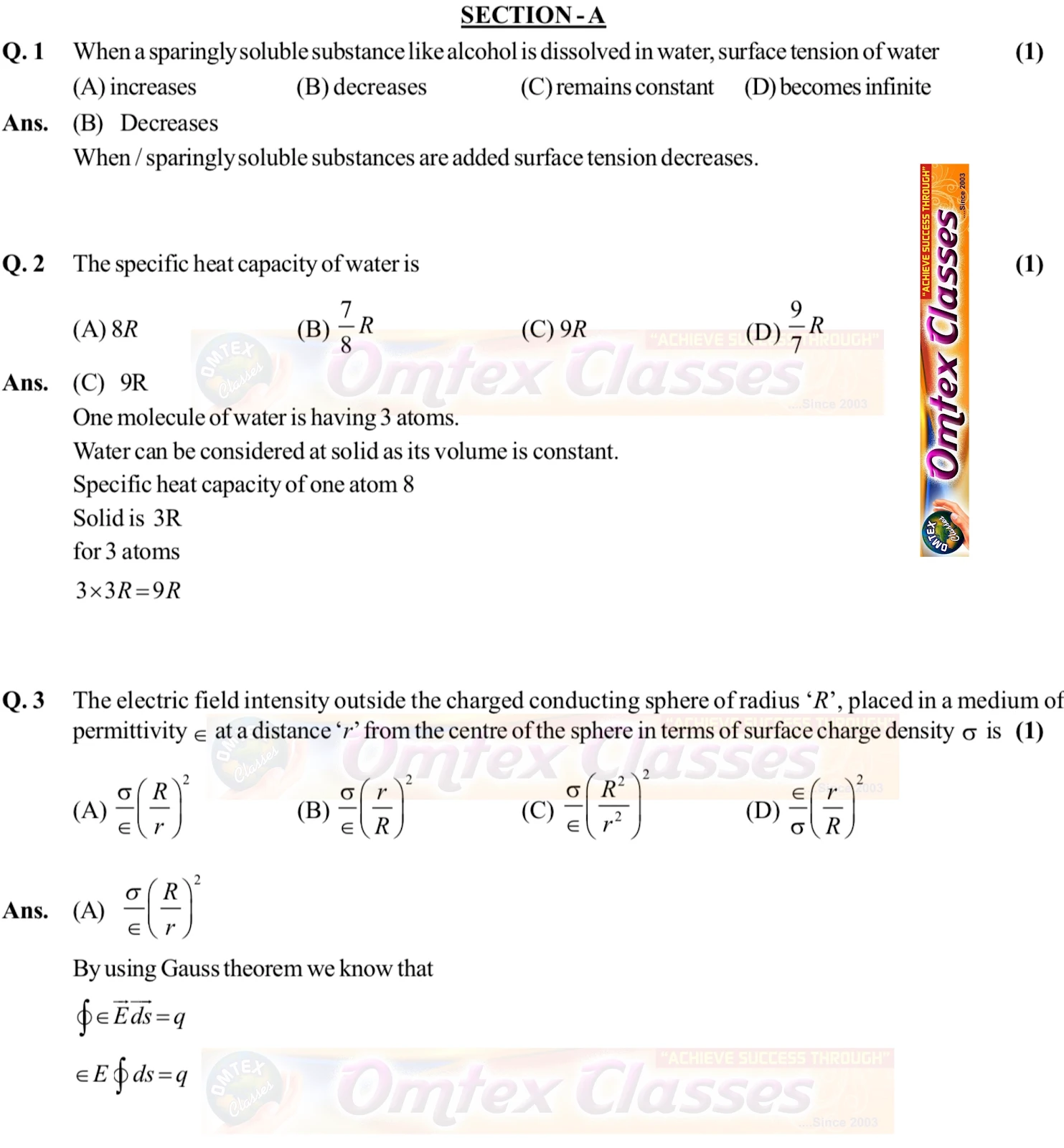
- (A) increases
- (B) decreases
- (C) remains constant
- (D) becomes infinite
Explanation: Adding a sparingly soluble organic substance like alcohol significantly reduces the surface tension of water.
- (A) 8R
- (B) \(\frac{7}{8}R\)
- (C) 9R
- (D) \(\frac{9}{7}R\)
Explanation: The specific heat capacity of water is approximately \(4186 \text{ J/kg K}\). The molar mass of water is \(18 \text{ g/mol}\).
Molar heat capacity \(C = 18 \times 4.186 \approx 75.3 \text{ J/mol K}\).
Gas constant \(R \approx 8.314 \text{ J/mol K}\).
\(9R = 9 \times 8.314 = 74.8 \text{ J/mol K}\).
Hence, \(C \approx 9R\).
- (A) \(\frac{\sigma}{\varepsilon} \left(\frac{R}{r}\right)^2\)
- (B) \(\frac{\sigma}{\varepsilon} \left(\frac{r}{R}\right)^2\)
- (C) \(\frac{\sigma}{\varepsilon} \left(\frac{R}{r^2}\right)\)
- (D) \(\frac{\varepsilon}{\sigma} \left(\frac{r}{R}\right)^2\)
Explanation: Electric field \(E = \frac{1}{4\pi\varepsilon} \frac{q}{r^2}\).
Charge \(q = \sigma \times 4\pi R^2\).
Substitute \(q\): \(E = \frac{\sigma 4\pi R^2}{4\pi\varepsilon r^2} = \frac{\sigma}{\varepsilon} \frac{R^2}{r^2} = \frac{\sigma}{\varepsilon} \left(\frac{R}{r}\right)^2\).
- (A) 0.50 Å
- (B) 0.75 Å
- (C) 1.2 Å
- (D) 1.5 Å
Explanation: de Broglie wavelength \(\lambda \propto \frac{1}{\sqrt{E}}\).
\(E_1 = 150 \text{ eV}\), \(\lambda_1 = 10^{-10} \text{ m} = 1.0 \text{ Å}\).
\(E_2 = 0.60 \text{ keV} = 600 \text{ eV}\).
\(\frac{\lambda_2}{\lambda_1} = \sqrt{\frac{E_1}{E_2}} = \sqrt{\frac{150}{600}} = \sqrt{\frac{1}{4}} = 0.5\).
\(\lambda_2 = 0.5 \times 1.0 \text{ Å} = 0.50 \text{ Å}\).
SECTION B
Given:
Distance of screen \(D = 150 \text{ cm} = 1.5 \text{ m}\)
Distance between slits \(d = 0.15 \text{ mm} = 0.15 \times 10^{-3} \text{ m}\)
Wavelength \(\lambda = 6500 \text{ Å} = 6.5 \times 10^{-7} \text{ m}\)
Formula for fringe width \(X\): $$ X = \frac{\lambda D}{d} $$ Calculation: $$ X = \frac{6.5 \times 10^{-7} \times 1.5}{0.15 \times 10^{-3}} $$ $$ X = \frac{9.75 \times 10^{-7}}{1.5 \times 10^{-4}} = 6.5 \times 10^{-3} \text{ m} $$ $$ X = 6.5 \text{ mm} $$ Ans: The fringe width is 6.5 mm.
According to Curie's Law for paramagnetic substances, susceptibility \(\chi\) is inversely proportional to absolute temperature \(T\). $$ \chi \propto \frac{1}{T} \implies \frac{\chi_2}{\chi_1} = \frac{T_1}{T_2} $$ Given:
\(T_1 = 300 \text{ K}\), \(\chi_1 = 1.2 \times 10^{-15}\)
\(T_2 = 200 \text{ K}\)
$$ \chi_2 = \chi_1 \times \frac{T_1}{T_2} $$ $$ \chi_2 = 1.2 \times 10^{-15} \times \frac{300}{200} $$ $$ \chi_2 = 1.2 \times 10^{-15} \times 1.5 = 1.8 \times 10^{-15} $$ Ans: The susceptibility at 200 K is \(1.8 \times 10^{-15}\).
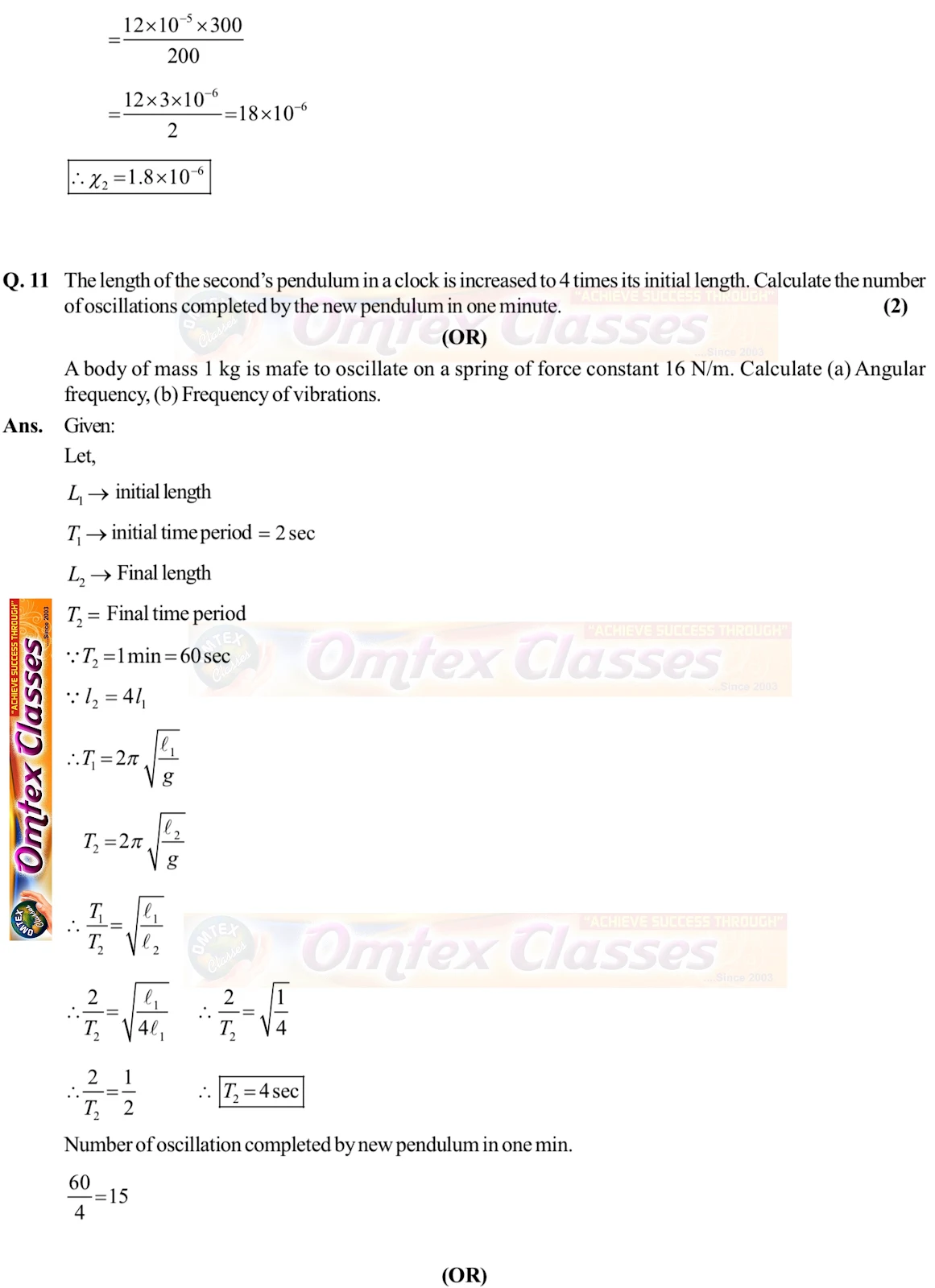
For a second's pendulum, initial time period \(T_1 = 2 \text{ s}\).
Formula: \(T \propto \sqrt{L}\).
Given \(L_2 = 4L_1\).
$$ \frac{T_2}{T_1} = \sqrt{\frac{L_2}{L_1}} = \sqrt{\frac{4L_1}{L_1}} = 2 $$ $$ T_2 = 2 T_1 = 2 \times 2 = 4 \text{ s} $$ The new time period is 4 seconds.
Time available \(t = 1 \text{ minute} = 60 \text{ s}\).
Number of oscillations \(n = \frac{t}{T_2} = \frac{60}{4} = 15\).
Ans: 15 oscillations.
Given: \(m = 1 \text{ kg}\), \(k = 15 \text{ N/m}\).
(i) Angular frequency \(\omega\): $$ \omega = \sqrt{\frac{k}{m}} = \sqrt{\frac{15}{1}} = \sqrt{15} \approx 3.873 \text{ rad/s} $$ (ii) Frequency \(n\): $$ n = \frac{\omega}{2\pi} = \frac{3.873}{2 \times 3.142} \approx 0.616 \text{ Hz} $$
Capacitance: The capacitance of a capacitor is defined as the ratio of the charge (\(Q\)) deposited on either conductor to the potential difference (\(V\)) between the two conductors. It is the ability of a conductor or capacitor to store electric charge.
$$ C = \frac{Q}{V} $$S.I. Unit: The S.I. unit of capacitance is the Farad (F).
Radius of Gyration (K): It is the radial distance from the axis of rotation to a point where the entire mass of the body can be supposed to be concentrated, so that the moment of inertia about that axis remains the same as that of the actual body.
$$ I = MK^2 $$Physical Significance: It is a measure of the distribution of the mass of the body about the axis of rotation. A larger radius of gyration implies the mass is distributed further away from the axis, resulting in a higher moment of inertia.
| p-type Semiconductor | n-type Semiconductor |
|---|---|
| Doped with trivalent impurity (e.g., Boron, Indium). | Doped with pentavalent impurity (e.g., Arsenic, Antimony). |
| Majority charge carriers are holes. | Majority charge carriers are electrons. |
| Minority charge carriers are electrons. | Minority charge carriers are holes. |
(i) Transducer: A device that converts one form of energy into another. In communication systems, it usually converts a physical signal (like sound or light) into an electrical signal (input transducer like a microphone) or vice-versa (output transducer like a speaker).
(ii) Attenuation: It refers to the loss of strength or power of a signal as it propagates through a transmission medium. It is usually measured in decibels (dB).
SECTION C
Consider a particle of mass \(m\) revolving in a vertical circle of radius \(r\).
1. At the Highest Point (Top):
Let velocity be \(v_2\).
Potential Energy (PE) relative to bottom = \(mg(2r)\).
Kinetic Energy (KE) = \(\frac{1}{2}mv_2^2\).
Total Energy \(E_2 = 2mgr + \frac{1}{2}mv_2^2\).
2. At the Lowest Point (Bottom):
Let velocity be \(v_1\).
PE = 0 (Reference level).
KE = \(\frac{1}{2}mv_1^2\).
Total Energy \(E_1 = \frac{1}{2}mv_1^2\).
3. At the Horizontal Position (Midway):
Let velocity be \(v_3\).
PE = \(mgr\).
KE = \(\frac{1}{2}mv_3^2\).
Total Energy \(E_3 = mgr + \frac{1}{2}mv_3^2\).
By the law of conservation of energy, the total energy at any point is constant: \(E_1 = E_2 = E_3 = \frac{5}{2}mgr\) (assuming minimum velocity condition where \(v_2 = \sqrt{gr}\)).
Definition: The minimum amount of energy required to remove a satellite from Earth's gravitational influence (i.e., to infinity) is called its Binding Energy.
Derivation:
Consider a satellite of mass \(m\) revolving around Earth (mass \(M\)) at radius \(r\) (\(r = R+h\)).
1. Potential Energy (PE) = \(-\frac{GMm}{r}\).
2. For circular orbit, centripetal force = gravitational force:
\(\frac{mv^2}{r} = \frac{GMm}{r^2} \implies mv^2 = \frac{GMm}{r}\).
3. Kinetic Energy (KE) = \(\frac{1}{2}mv^2 = \frac{GMm}{2r}\).
4. Total Energy (TE) = PE + KE = \(-\frac{GMm}{r} + \frac{GMm}{2r} = -\frac{GMm}{2r}\).
5. To remove the satellite to infinity (where TE = 0), energy required is:
Binding Energy = \(-(\text{Total Energy}) = -(-\frac{GMm}{2r}) = \frac{GMm}{2r}\).
Hooke's Law: Within the elastic limit, the stress produced in a body is directly proportional to the strain produced in it.
Stress \(\propto\) Strain.
Elastic Limit: The maximum value of stress up to which the body retains its elastic property (i.e., returns to its original dimensions upon removal of the deforming force) is called the elastic limit.
Modulus of Elasticity: The ratio of stress to strain within the elastic limit is a constant called the modulus of elasticity.
Consider a capillary tube of radius \(r\) dipped in a liquid of density \(\rho\) and surface tension \(T\). The liquid rises to a height \(h\).
The force due to surface tension acting upwards along the circumference of the meniscus is:
\(F_T = T \times 2\pi r\).
The vertical component of this force responsible for lifting the liquid column is:
\(F_v = T \times 2\pi r \times \cos \theta\) (where \(\theta\) is angle of contact).
This upward force is balanced by the weight of the liquid column (downward force):
Weight \(W = mg = (\text{Volume} \times \rho) \times g = (\pi r^2 h) \rho g\).
At equilibrium, \(F_v = W\):
\(2\pi r T \cos \theta = \pi r^2 h \rho g\)
\(2 T \cos \theta = r h \rho g\)
Thus, height \(h = \frac{2T \cos \theta}{r \rho g}\).
1. Reflection from Denser Medium (Rigid Boundary):
- Transverse Wave: A crest is reflected as a trough and a trough as a crest. There is a phase change of \(\pi\) radians (180°).
- Longitudinal Wave: A compression is reflected as a compression and a rarefaction as a rarefaction. There is a phase change of \(\pi\) radians.
2. Reflection from Rarer Medium (Free Boundary):
- Transverse Wave: A crest is reflected as a crest and a trough as a trough. There is no phase change (0 radians).
- Longitudinal Wave: A compression is reflected as a rarefaction and a rarefaction as a compression. There is no phase change.
Photoelectric Effect: The phenomenon of emission of electrons from a metal surface when electromagnetic radiation (light) of suitable frequency falls on it is called the photoelectric effect.
(i) Stopping Potential: The minimum negative (retarding) potential applied to the collector plate with respect to the emitter plate at which the photoelectric current becomes zero is called the stopping potential.
(ii) Photoelectric Work Function (\(\Phi_0\)): The minimum energy required by an electron to escape from the metal surface at zero velocity is called the photoelectric work function of that metal.
Perfectly Black Body: A body that absorbs all the radiant energy incident upon it, regardless of wavelength or angle of incidence, is called a perfectly black body. Coefficient of absorption \(a = 1\).
Ferry’s Black Body:
- It consists of a double-walled hollow metal sphere with a small aperture.
- The inner surface is coated with lampblack (absorption ~98%) and the outer surface is nickel-plated.
- A conical projection is placed diametrically opposite to the aperture to prevent direct reflection.
- Any radiation entering through the aperture undergoes multiple reflections inside. At each reflection, about 98% energy is absorbed. After a few reflections, the hole acts as a perfect absorber (black body).
Let \(E\) be the EMF and \(r\) be the internal resistance.
Terminal P.D. \(V = E \frac{R}{R+r}\).
Also, balancing length \(L \propto V\).
Case 1: \(R_1 = 5 \Omega\), \(L_1 = 150 \text{ cm}\).
$$ V_1 \propto 150 \implies E \frac{5}{5+r} = k(150) \quad \dots(1) $$ Case 2: \(R_2 = 10 \Omega\), \(L_2 = 175 \text{ cm}\).
$$ V_2 \propto 175 \implies E \frac{10}{10+r} = k(175) \quad \dots(2) $$ Divide (1) by (2): $$ \frac{\frac{5E}{5+r}}{\frac{10E}{10+r}} = \frac{150}{175} $$ $$ \frac{5}{10} \times \frac{10+r}{5+r} = \frac{6}{7} $$ $$ \frac{1}{2} \frac{10+r}{5+r} = \frac{6}{7} $$ $$ 7(10+r) = 12(5+r) $$ $$ 70 + 7r = 60 + 12r $$ $$ 10 = 5r \implies r = 2 \Omega $$ For open circuit, \(R = \infty\), \(V = E\). Let length be \(L_0\).
From (1): \(E \frac{5}{5+2} = k(150) \implies \frac{5}{7}E = k(150)\).
Since \(E = k L_0\),
$$ \frac{5}{7} k L_0 = k(150) $$ $$ L_0 = \frac{150 \times 7}{5} = 30 \times 7 = 210 \text{ cm} $$ Ans: Internal resistance \(r = 2 \Omega\), Balancing length for open circuit = 210 cm.
Given:
\(KE = 5 \text{ MeV} = 5 \times 10^6 \times 1.6 \times 10^{-19} \text{ J}\)
\(B = 2 \text{ T}\)
\(v = 3 \times 10^7 \text{ m/s}\)
Mass of proton \(m_p = 1.67 \times 10^{-27} \text{ kg}\)
Charge \(q = 1.6 \times 10^{-19} \text{ C}\)
1. Radius \(r\):
$$ r = \frac{mv}{qB} $$ $$ r = \frac{1.67 \times 10^{-27} \times 3 \times 10^7}{1.6 \times 10^{-19} \times 2} $$ $$ r = \frac{5.01 \times 10^{-20}}{3.2 \times 10^{-19}} = \frac{5.01}{32} \approx 0.156 \text{ m} $$ 2. Frequency \(f\):
$$ f = \frac{qB}{2\pi m} $$ $$ f = \frac{1.6 \times 10^{-19} \times 2}{2 \times 3.142 \times 1.67 \times 10^{-27}} $$ $$ f = \frac{3.2 \times 10^{-19}}{10.49 \times 10^{-27}} \approx 0.305 \times 10^8 \text{ Hz} = 30.5 \text{ MHz} $$ Ans: Radius = 0.156 m, Frequency = 30.5 MHz.
Conditions for Parallel Resonance: Resonance occurs when the inductive reactance equals the capacitive reactance (\(X_L = X_C\)), making the circuit purely resistive and impedance maximum (current minimum).
Resonant Frequency: The frequency of the applied AC source at which the impedance of the parallel circuit becomes maximum and current becomes minimum is called the resonant frequency.
Expression:
For a tank circuit (L and C in parallel):
Admittance \(Y = \frac{1}{Z} = \sqrt{(\frac{1}{R})^2 + (\frac{1}{X_C} - \frac{1}{X_L})^2}\) (assuming ideal case or deriving from currents).
Current is min when \(I_L \sin \phi = I_C\).
For ideal L-C parallel: \(X_L = X_C \implies 2\pi f L = \frac{1}{2\pi f C}\).
\(f^2 = \frac{1}{4\pi^2 LC}\).
\(f_r = \frac{1}{2\pi\sqrt{LC}}\).
Energy of electron in \(n^{th}\) orbit: \(E_n = -\frac{m e^4}{8 \varepsilon_0^2 h^2 n^2}\).
When an electron jumps from a higher orbit \(n_2\) to a lower orbit \(n_1\), the energy difference is emitted as a photon:
\(\Delta E = E_{n_2} - E_{n_1} = h\nu = \frac{hc}{\lambda}\).
\(\frac{hc}{\lambda} = \left(-\frac{m e^4}{8 \varepsilon_0^2 h^2 n_2^2}\right) - \left(-\frac{m e^4}{8 \varepsilon_0^2 h^2 n_1^2}\right)\)
\(\frac{hc}{\lambda} = \frac{m e^4}{8 \varepsilon_0^2 h^2} \left( \frac{1}{n_1^2} - \frac{1}{n_2^2} \right)\)
\(\frac{1}{\lambda} = \frac{m e^4}{8 \varepsilon_0^2 h^3 c} \left( \frac{1}{n_1^2} - \frac{1}{n_2^2} \right)\)
This constant \(\frac{m e^4}{8 \varepsilon_0^2 h^3 c}\) is Rydberg's constant \(R\).
Formula: \(\frac{1}{\lambda} = R \left( \frac{1}{n_1^2} - \frac{1}{n_2^2} \right)\).
Law of Radioactive Decay: The rate of decay of radioactive atoms at any instant is directly proportional to the number of undecayed nuclei present at that instant.
Derivation:
Let \(N\) be the number of nuclei at time \(t\).
\(\frac{dN}{dt} \propto -N\)
\(\frac{dN}{dt} = -\lambda N\) (where \(\lambda\) is decay constant).
\(\frac{dN}{N} = -\lambda dt\).
Integrating both sides:
\(\int_{N_0}^{N} \frac{dN}{N} = -\lambda \int_{0}^{t} dt\)
\([\ln N]_{N_0}^{N} = -\lambda [t]_0^t\)
\(\ln N - \ln N_0 = -\lambda t\)
\(\ln (\frac{N}{N_0}) = -\lambda t\)
\(\frac{N}{N_0} = e^{-\lambda t}\)
\(N = N_0 e^{-\lambda t}\).
Graph: An exponential decay curve starting from \(N_0\) on y-axis and asymptotically approaching zero on x-axis (time).
SECTION D
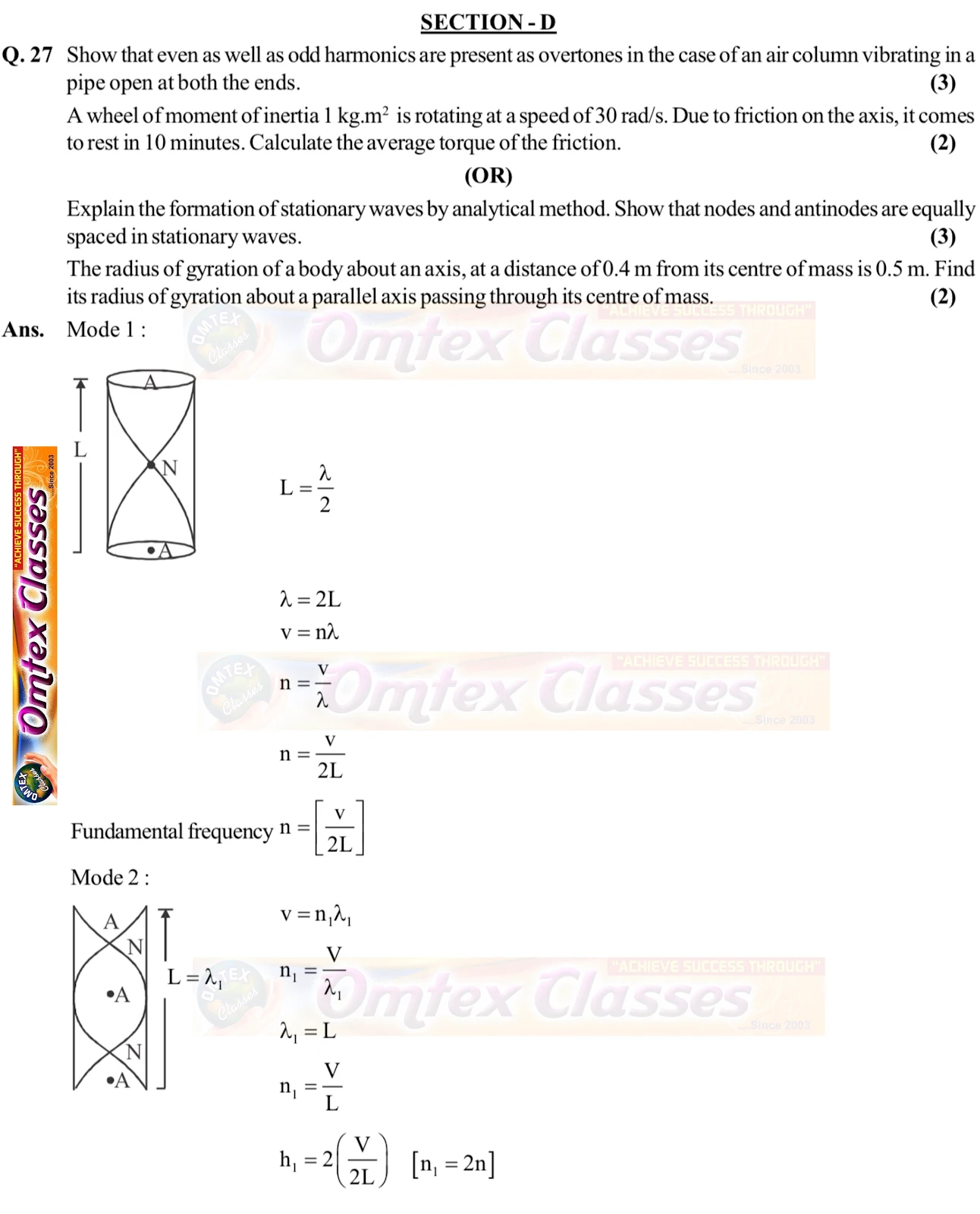
For a pipe open at both ends length \(L\):
1. Fundamental mode: Length \(L = \frac{\lambda_1}{2} \implies \lambda_1 = 2L\). Frequency \(n = \frac{v}{2L}\).
2. Second harmonic (1st overtone): \(L = \lambda_2\). Frequency \(n_1 = \frac{v}{\lambda_2} = \frac{v}{L} = 2(\frac{v}{2L}) = 2n\).
3. Third harmonic (2nd overtone): \(L = \frac{3\lambda_3}{2} \implies \lambda_3 = \frac{2L}{3}\). Frequency \(n_2 = \frac{v}{\lambda_3} = \frac{3v}{2L} = 3n\).
Thus, frequencies are \(n, 2n, 3n \dots\). Both even and odd harmonics are present.
Given:
\(I = 1 \text{ kg m}^2\)
Initial speed \(\omega_0 = 30 \text{ rad/s}\)
Final speed \(\omega = 0\)
Time \(t = 10 \text{ min} = 600 \text{ s}\)
Angular acceleration \(\alpha = \frac{\omega - \omega_0}{t} = \frac{0 - 30}{600} = -0.05 \text{ rad/s}^2\).
Torque \(\tau = I \alpha = 1 \times (-0.05) = -0.05 \text{ Nm}\).
Magnitude of torque = 0.05 Nm.
Analytical Method:
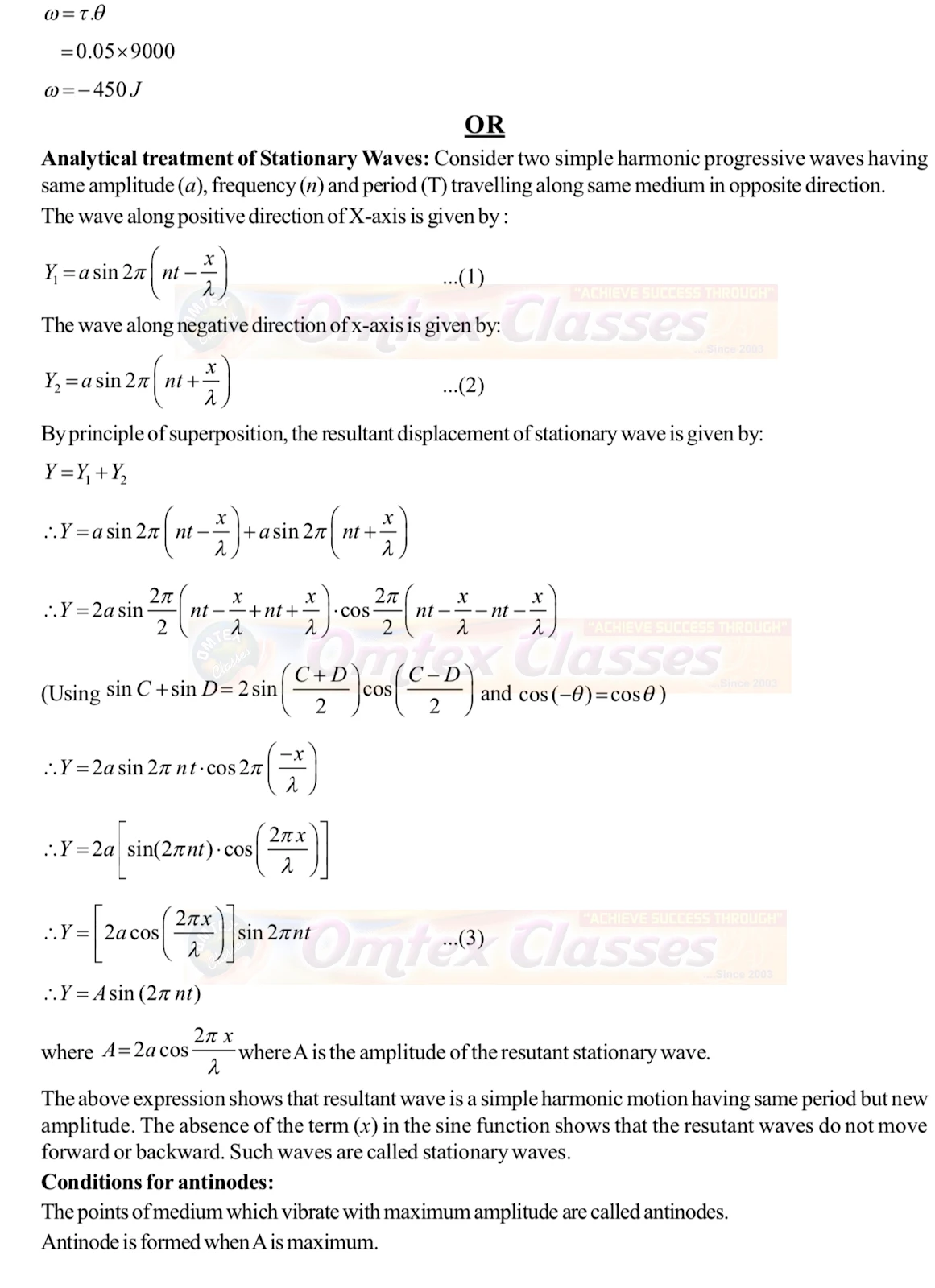
Consider two waves of same amplitude \(a\) and frequency traveling in opposite directions.
\(y_1 = a \sin(\omega t - kx)\) and \(y_2 = a \sin(\omega t + kx)\).
Resultant \(y = y_1 + y_2 = a[\sin(\omega t - kx) + \sin(\omega t + kx)]\).
Using \(\sin C + \sin D\), \(y = 2a \cos(kx) \sin(\omega t)\).
Amplitude \(A = 2a \cos(kx)\).
Nodes (Min displacement \(A=0\)): \(\cos kx = 0 \implies kx = (2n+1)\frac{\pi}{2} \implies x = (2n+1)\frac{\lambda}{4}\). Distance between nodes = \(\frac{\lambda}{2}\).
Antinodes (Max displacement \(A=\pm 2a\)): \(\cos kx = \pm 1 \implies kx = n\pi \implies x = n\frac{\lambda}{2}\). Distance between antinodes = \(\frac{\lambda}{2}\).
Distance between Node and adjacent Antinode = \(\frac{\lambda}{4}\). Thus, they are equally spaced.
Using Parallel Axis Theorem: \(I = I_{cm} + Mh^2\).
In terms of radius of gyration \(K\): \(MK^2 = MK_{cm}^2 + Mh^2\).
\(K^2 = K_{cm}^2 + h^2\).
Given: \(K = 0.5 \text{ m}\), \(h = 0.4 \text{ m}\).
\((0.5)^2 = K_{cm}^2 + (0.4)^2\)
\(0.25 = K_{cm}^2 + 0.16\)
\(K_{cm}^2 = 0.25 - 0.16 = 0.09\)
\(K_{cm} = \sqrt{0.09} = 0.3 \text{ m}\).
Ans: Radius of gyration about axis through CM is 0.3 m.
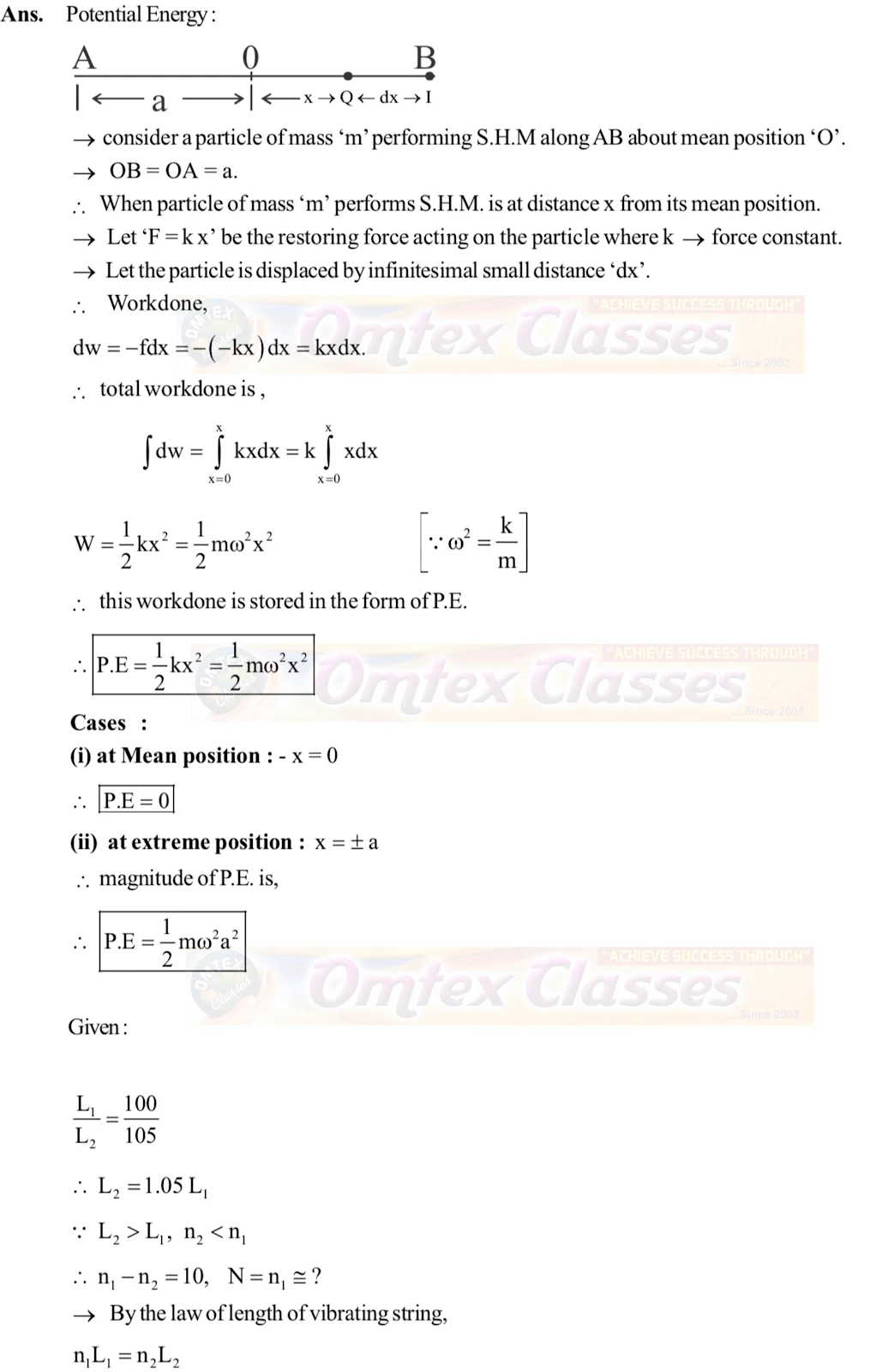
Derivation:
Force \(F = -kx\). Work done to displace particle by \(dx\) against force is \(dW = -F dx = kx dx\).
Total work to move from 0 to \(x\): \(W = \int_0^x kx dx = \frac{1}{2}kx^2\).
Potential Energy \(PE = \frac{1}{2}kx^2 = \frac{1}{2}m\omega^2 x^2\).
(i) Mean position (\(x=0\)): \(PE = 0\).
(ii) Extreme position (\(x=\pm A\)): \(PE = \frac{1}{2}kA^2\).
Let initial length be \(L\), initial frequency \(n\).
\(n \propto \frac{1}{L}\).
New length \(L' = L + 0.05L = 1.05L\).
New frequency \(n'\).
\(\frac{n'}{n} = \frac{L}{L'} = \frac{L}{1.05L} = \frac{1}{1.05}\).
\(n' = \frac{n}{1.05}\).
Since \(L\) increased, \(n\) decreases. So \(n > n'\).
Beats \(n - n' = 10\).
\(n - \frac{n}{1.05} = 10\)
\(n (1 - \frac{1}{1.05}) = 10\)
\(n (\frac{1.05 - 1}{1.05}) = 10\)
\(n (\frac{0.05}{1.05}) = 10\)
\(n = \frac{10 \times 1.05}{0.05} = \frac{10.5}{0.05} = 210 \text{ Hz}\).
Ans: Frequency of tuning fork is 210 Hz.
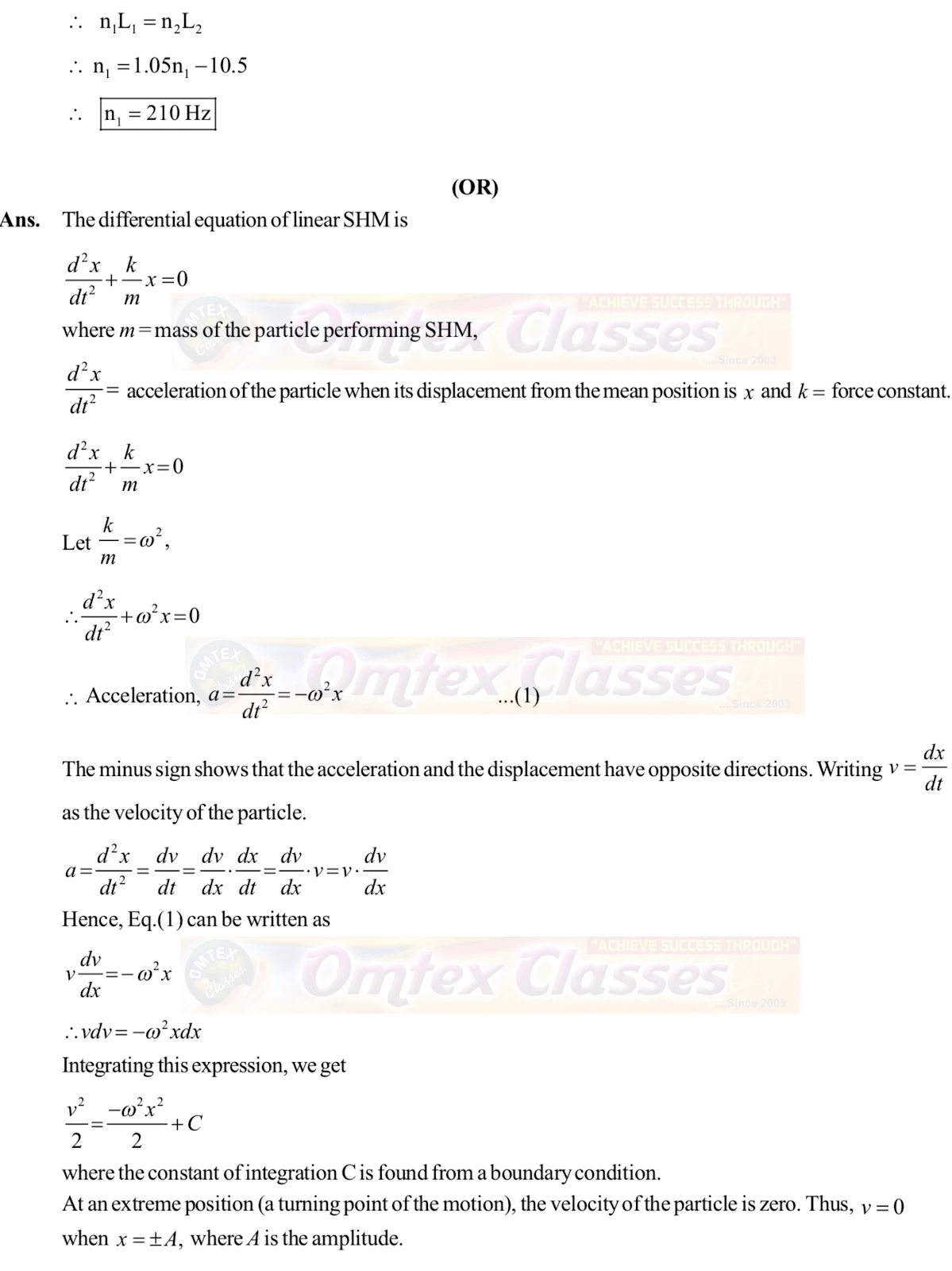
Differential equation: \(\frac{d^2x}{dt^2} + \omega^2 x = 0\).
1. Acceleration: \(a = \frac{d^2x}{dt^2} = -\omega^2 x\).
2. Velocity: \(a = \frac{dv}{dt} = v\frac{dv}{dx} = -\omega^2 x\).
\(\int v dv = -\omega^2 \int x dx \implies \frac{v^2}{2} = -\frac{\omega^2 x^2}{2} + C\).
At \(x=A, v=0 \implies C = \frac{\omega^2 A^2}{2}\).
\(v = \omega \sqrt{A^2 - x^2}\).
3. Displacement: \(v = \frac{dx}{dt} = \omega \sqrt{A^2 - x^2}\).
\(\int \frac{dx}{\sqrt{A^2-x^2}} = \int \omega dt\).
\(\sin^{-1}(\frac{x}{A}) = \omega t + \phi\).
\(x = A \sin(\omega t + \phi)\).
Given:
Length \(L = 1 \text{ m}\).
Mass of wire \(M = 2 \text{ g} = 0.002 \text{ kg}\).
Linear density \(m = \frac{M}{L} = \frac{0.002}{1} = 0.002 \text{ kg/m}\).
Frequency \(n = 300 \text{ Hz}\).
Formula: \(n = \frac{1}{2L} \sqrt{\frac{T}{m}}\).
\(300 = \frac{1}{2(1)} \sqrt{\frac{T}{0.002}}\).
\(600 = \sqrt{\frac{T}{0.002}}\).
Squaring both sides: \(360000 = \frac{T}{0.002}\).
\(T = 360000 \times 0.002 = 720 \text{ N}\).
Ans: Tension is 720 N.
Using Huygens' principle, consider a plane wavefront incident on a plane surface separating two media (velocities \(v_1, v_2\)).
By drawing secondary wavelets, if time \(t\) is taken for wave to travel distance \(BC\) in medium 1 and \(AE\) in medium 2:
\(\sin i = \frac{BC}{AC} = \frac{v_1 t}{AC}\)
\(\sin r = \frac{AE}{AC} = \frac{v_2 t}{AC}\)
Ratio: \(\frac{\sin i}{\sin r} = \frac{v_1}{v_2} = \mu\) (constant).
This proves Snell's Law. Also, geometry shows incident ray, refracted ray, and normal lie in the same plane.
Given: \(\frac{I_1}{I_2} = \frac{81}{1}\).
Since \(I \propto a^2\), amplitude ratio \(\frac{a_1}{a_2} = \sqrt{\frac{81}{1}} = \frac{9}{1}\).
Ratio of intensities at max and min:
$$ \frac{I_{max}}{I_{min}} = \left(\frac{a_1 + a_2}{a_1 - a_2}\right)^2 $$ $$ \frac{I_{max}}{I_{min}} = \left(\frac{9 + 1}{9 - 1}\right)^2 = \left(\frac{10}{8}\right)^2 = \left(\frac{5}{4}\right)^2 = \frac{25}{16} $$ Ans: The ratio is 25:16.
Brewster's Law: The tangent of the polarizing angle (\(\theta_p\)) is numerically equal to the refractive index (\(\mu\)) of the medium. \(\mu = \tan \theta_p\).
Proof:
From Snell's law: \(\mu = \frac{\sin \theta_p}{\sin r}\).
From Brewster's law: \(\mu = \tan \theta_p = \frac{\sin \theta_p}{\cos \theta_p}\).
Comparing: \(\frac{\sin \theta_p}{\sin r} = \frac{\sin \theta_p}{\cos \theta_p} \implies \sin r = \cos \theta_p = \sin(90 - \theta_p)\).
So, \(r = 90 - \theta_p \implies \theta_p + r = 90^\circ\).
Since angle of reflection = angle of incidence = \(\theta_p\), the angle between reflected and refracted ray is \(180 - (\theta_p + r) = 180 - 90 = 90^\circ\).
For single slit diffraction, the condition for secondary maxima is given by: $$ a \sin \theta = (2n + 1) \frac{\lambda}{2} $$ For the first maximum, \(n = 1\): $$ a \sin \theta = \frac{3\lambda}{2} $$ Given:
\(\theta = 30^\circ\), \(\sin 30^\circ = 0.5\).
\(\lambda = 4300 \text{ Å} = 4.3 \times 10^{-7} \text{ m}\).
$$ a (0.5) = 1.5 \times (4.3 \times 10^{-7}) $$ $$ 0.5 a = 6.45 \times 10^{-7} $$ $$ a = \frac{6.45 \times 10^{-7}}{0.5} = 12.9 \times 10^{-7} \text{ m} $$ $$ a = 1.29 \mu\text{m} $$ Ans: Slit width a = 1.29 \(\mu\)m.


