QUESTION BANK HSC (SYJC)
SECTION II – POETRY AND APPRECIATION
SET 4: Q.3 POETRY (15 Marks)
HSC ENGLISH
OMTEX CLASSES
IMPORTANT QUESTION BANK FOR BOARD EXAM 2026.
Q.3 (A) Read the given extract and complete the activities given below: (10)
Afoot and light-hearted I take to the open road,
Healthy, free, the world before me,
The long brown path before me leading wherever I choose.
Henceforth I ask not good-fortune, I myself am good-fortune,
Henceforth I whimper no more, postpone no more, need nothing,
Done with indoor complaints, libraries, querulous criticisms,
Strong and content I travel the open road.
The earth, that is sufficient,
I do not want the constellations any nearer,
I know they are very well where they are,
I know they suffice for those who belong to them.
(Still here I carry my old delicious burdens,
I carry them, men and women, I carry them with me wherever I go,
I swear it is impossible for me to get rid of them,
I am fill’d with them, and I will fill them in return.)
1) ____
2) ____
‘The long brown path before me leading wherever I choose’
‘Song of the open road’
(B) Appreciation: (04)
- About the poet and the title
- The theme
- Language/ poetic devices used in the poem
- Special features
- Your opinion about the poem
ENGLISH (HSC) - IMPORTANT QUESTION BANK
When I had money, money, O!
I knew no joy till I went poor;
For many a false man as a friend
Came knocking all day at my door.
Then felt I like a child that holds
A trumpet that he must not blow
Because a man is dead; I dared
Not speak to let this false world know.
Much have I thought of life, and seen
How poor men's hearts are ever light;
And how their wives do hum like bees
About their work from morn till night.
So, when I hear these poor ones laugh,
And see the rich ones coldly frown
Poor men, think I, need not go up
So much as rich men should come down.
When I had money, money, O!
My many friends proved all untrue;
But now I have no money, O!
My friends are real, though very few.
Q3. (A) Read the given extract and complete the activities gives below: (10)
WEAVERS, weaving at break of day,
Why do you weave a garment so gay?
Blue as the wing of a halcyon wild,
We weave the robes of a new-born child.
Weavers, weaving at fall of night,
Why do you weave a garment so bright?
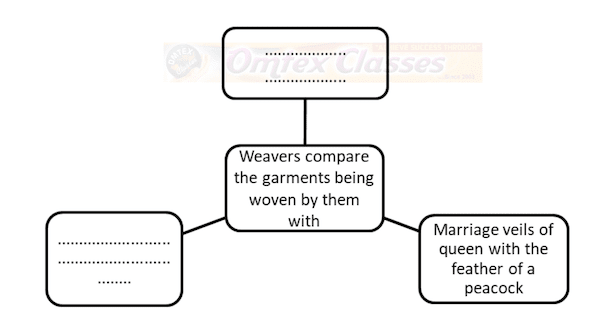
Like the plumes of a peacock, purple and green,
We weave the marriage-veils of a queen.
Weavers, weaving solemn and still,
What do you weave in the moonlight chill?
White as a feather and white as a cloud,
We weave a dead man's funeral shroud.
| Time of the Day | Type of Garment | Colour of Garment | For whom |
|---|---|---|---|
| Early in the Morning | ____ | Blue | New-born child |
| ____ | Marriage veils of Queen | Purple and Green | ____ |
| In the Dead Night | Dead man’s funeral shroud | ____ | Dead Man |
(B) Appreciation: (4)
- About the poem, significance of the title.
- Form of the poem, theme and its significance.
- Poetic style, language features, poetic devices.
- Inspirational message, values, morals reflected.
- Your opinion and critical evaluation of the poem.
Afoot and light-hearted I take to the open road,
Healthy, free, the world before me,
The long brown path before me leading wherever I choose.
...
Henceforth I ask not good-fortune, I myself am good-fortune,
Henceforth I whimper no more, postpone no more, need nothing,
...
The earth, that is sufficient,
I do not want the constellations any nearer,
I know they are very well where they are,
I know they suffice for those who belong to them.
Q.3 (A) Read the given extract and complete the activities given below: (10)
No stir in the air, no stir in the sea,
The Ship was still as she could be;
Her sails from heaven received no motion,
Her keel was steady in the ocean.
Without either sign or sound of their shock,
The waves flow’d over the Inchcape Rock;
So little they rose, so little they fell,
They did not move the Inchcape Bell.
The Abbot of Aberbrothok
Had placed that bell on the Inchcape Rock;
On a buoy in the storm it floated and swung,
And over the waves its warning rung.
When the Rock was hid by the surge’s swell,
The Mariners heard the warning Bell;
And then they knew the perilous Rock,
And blest the Abbot of Aberbrothok.

Abbot of Aberbrothok placed a bell on the Inchcape rock because____
| Examples | Figure of Speech | Explanation |
|---|---|---|
| 1.The Ship was still as she could be. | ____ | ____ |
| 2. No stir in the air, no stir in the sea. | ____ | ____ |
No stir in the air, no stir in the sea,
____
____
Her keel was steady in the ocean.
(B) APPRECIATION: (04)
- About the poet and the title
- The theme
- Poetic style, Language, poetic devices.
- Special feature
- Values
- Your opinion about the poem
My father travels on the late evening train
Standing among silent commuters in the yellow light
Suburbs slide past his unseeing eyes
His shirt and pants are soggy and his black raincoat
Stained with mud and his bag stuffed with books
Is falling apart. His eyes dimmed by age
fade homeward through the humid monsoon night.
Now I can see him getting off the train
Like a word dropped from a long sentence.
He hurries across the length of the grey platform,
Crosses the railway line, enters the lane,
His chappals are sticky with mud, but he hurries onward.
Home again, I see him drinking weak tea,
Eating a stale chapati, reading a book.
He goes into the toilet to contemplate
Man's estrangement from a man-made world.
Coming out he trembles at the sink,
The cold water running over his brown hands,
A few droplets cling to the greying hairs on his wrists.
His sullen children have often refused to share
Jokes and secrets with him. He will now go to sleep
Listening to the static on the radio, dreaming
Of his ancestors and grandchildren, thinking
Of nomads entering a subcontinent through a narrow pass.
Q.3 (A) Read the given extract and complete the activities given below: (10)
Is anybody happier because you passed his way?
Does anyone remember that you spoke to him today?
This day is almost over, and its toiling time is through;
Is there anyone to utter now a kindly word of you?
Did you give a cheerful greeting to the friend who came along?
Or a churlish sort of "Howdy" and then vanish in the throng?
Were you selfish pure and simple as you rushed along the way,
Or is someone mighty grateful for a deed you did today?
Can you say tonight, in parting with the day that's slipping fast,
That you helped a single brother of the many that you passed?
Is a single heart rejoicing over what you did or said;
Does a man whose hopes were fading now with courage look ahead?
Did you waste the day, or lose it, was it well or sorely spent?
Did you leave a trail of kindness or a scar of discontent?
As you close your eyes in slumber do you think that God would say,
You have earned one more tomorrow by the work you did today?

____ Share
____ Give
____ Care
____ live
(B) Appreciation: (4)
- About the poem, significance of the title.
- Form of the poem, theme and its significance.
- Poetic style, language features, poetic devices.
- Inspirational message, values, morals reflected.
- Your opinion and critical evaluation of the poem.
WEAVERS, weaving at break of day,
Why do you weave a garment so gay? . . .
Blue as the wing of a halcyon wild,
We weave the robes of a new-born child.
Weavers, weaving at fall of night,
Why do you weave a garment so bright? . . .
Like the plumes of a peacock, purple and green,
We weave the marriage-veils of a queen.
Weavers, weaving solemn and still,
What do you weave in the moonlight chill? . . .
White as a feather and white as a cloud,
We weave a dead man's funeral shroud.
Q.3 (A) Read the given extract and complete the activities given below: (10)
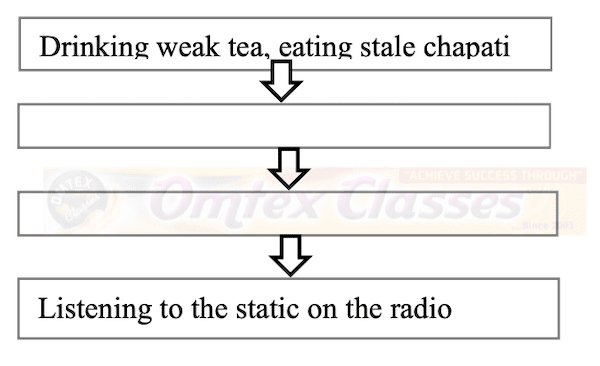
Home again, I see him drinking weak tea,
Eating a stale chapati, reading a book.
He goes into the toilet to contemplate
Man's estrangement from a man-made world.
Coming out he trembles at the sink,
The cold water running over his brown hands,
A few droplets cling to the greying hairs on his wrists.
His sullen children have often refused to share
Jokes and secrets with him. He will now go to sleep
Listening to the static on the radio, dreaming
Of his ancestors and grandchildren, thinking
Of nomads entering a subcontinent through a narrow pass.
a) ____
b) ____
“coming out he trembles sat the sink”
He will now go to sleep
Listening to static on the radio
____
____
(B) Appreciation: (04)
- About the poet and the title
- The theme
- Language/ poetic devices used in the poem
- Special features
- Your opinion about the poem
On the deck the Rover takes his stand,
So dark it is they see no land.
Quoth Sir Ralph, “It will be lighter soon,
For there is the dawn of the rising Moon.”
“Canst hear,” said one, “the breakers roar?
For methinks we should be near the shore.”
“Now, where we are I cannot tell,
But I wish we could hear the Inchcape Bell.”
They hear no sound, the swell is strong,
Though the wind hath fallen they drift along;
Till the vessel strikes with a shivering shock,
“Oh Christ! It is the Inchcape Rock!”
Sir Ralph the Rover tore his hair,
He curst himself in his despair;
The waves rush in on every side,
The ship is sinking beneath the tide.
Q.3 (A) Read the given extract and complete the activities given below: (10)
When I had money, money, O!
I knew no joy till I went poor;
For many a false man as a friend
Came knocking all day at my door.
Then felt I like a child that holds
A trumpet that he must not blow
Because a man is dead; I dared
Not speak to let this false world know.
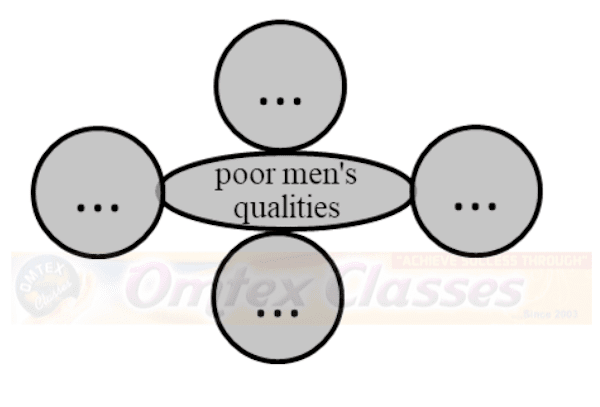
Much have I thought of life, and seen
How poor men's hearts are ever light;
And how their wives do hum like bees
About their work from morn till night.
So, when I hear these poor ones laugh,
And see the rich ones coldly frown
Poor men, think I, need not go up
So much as rich men should come down.
When I had money, money, O!
My many friends proved all untrue;
But now I have no money, O!
My friends are real, though very few.
1) The poet wanted to become poor because ____
2) The poet doesn’t want to speak to this fake world ____
| Stanza | Rhyming scheme | Rhyming words |
|---|---|---|
| Stanza-01 | ____ | ____ |
| Stanza-02 | ____ | ____ |
(B) Appreciation: (04)
- Form of the poem, theme and its significance
- Poetic style, language features, poetic devices
- Inspirational message, values, morals reflected
- Your opinion and critical evaluation of the poem.
Is anybody happier because you passed his way?
Does anyone remember that you spoke to him today?
This day is almost over, and its toiling time is through;
Is there anyone to utter now a kindly word of you?
Did you give a cheerful greeting to the friend who came along?
Or a churlish sort of "Howdy" and then vanish in the throng?
Were you selfish pure and simple as you rushed along the way,
Or is someone mighty grateful for a deed you did today?
Can you say tonight, in parting with the day that's slipping fast,
That you helped a single brother of the many that you passed?
Is a single heart rejoicing over what you did or said;
Does a man whose hopes were fading now with courage look ahead?
Did you waste the day, or lose it, was it well or sorely spent?
Did you leave a trail of kindness or a scar of discontent?
As you close your eyes in slumber do you think that God would say,
You have earned one more tomorrow by the work you did today?