Write the dual statement of the following compound statement.
A number is a real number and the square of the number is non-negative.
SOLUTION
A number is a real number or the square of the number is non-negative.
Write the dual statement of the following compound statement.
A number is a real number and the square of the number is non-negative.
A number is a real number or the square of the number is non-negative.
Write the dual statement of the following compound statement.
Radha and Sushmita cannot read Urdu.
Radha or Sushmita cannot read Urdu.
Write the dual statement of the following compound statement.
Karina is very good or everybody likes her.
Karina is very good and everybody likes her.
Write the dual statement of the following compound statement.
13 is a prime number and India is a democratic country.
13 is a prime number or India is a democratic country.
Write the dual of the following:
~(p ∧ q) ≡ ~ p ∨ ~ q
~(p ∨ q) ≡ ~ p ∧ ~ q
Write the dual of the following:
p ∨ (q ∨ r) ≡ (p ∨ q) ∨ r
p ∧ (q ∧ r) ≡ (p ∧ q) ∧ r
Write the dual of the following:
~(p ∨ q) ∧ [p ∨ ~ (q ∧ ~ r)]
~(p ∧ q) ∨ [p ∧ ~ (q ∨ ~ r)]
Write the dual of the following:
(p ∨ q) ∨ r
(p ∧ q) ∧ r
Chapter 1: Mathematical Logic
Exercise 1.1


Balbharati solutions for Mathematics and Statistics 1 (Commerce) 12th Standard HSC Maharashtra State Board
Exercise 1.1 | Q 1 | Page 2
It is an open sentence. Hence, it is not a statement.
[Note: Answer given in the textbook is ‘it is a statement’. However, we found that ‘It is not a statement’.]
Exercise 1.1 | Q 2 | Page 2
It is a statement which is true. Hence, it’s truth value is T.
Exercise 1.1 | Q 3 | Page 2
It is an exclamatory sentence. Hence, it is not a statement.
Exercise 1.1 | Q 4 | Page 2
It is a request. Hence, it is not a statement.
Exercise 1.1 | Q 5 | Page 2
It is a statement which is false. Hence, it’s truth value is F.
Exercise 1.1 | Q 6 | Page 2
It is a statement which is false. Hence, it’s truth value if F.
Exercise 1.1 | Q 7 | Page 3
It is an open sentence. Hence, it is not a statement.
Exercise 1.1 | Q 8 | Page 3
It is an interrogative sentence. Hence, it is not a statement.
Exercise 1.1 | Q 9 | Page 3
It is an imperative sentence, hence it is not a statement.
Exercise 1.1 | Q 10 | Page 3
It is a statement which is true. Hence, it’s truth value is T.
Exercise 1.1 | Q 11 | Page 3
It is a statement which is true. Hence, it’s truth value is T.
Exercise 1.1 | Q 12 | Page 3
It is a statement which is false. Hence, it’s truth value is F.
Exercise 1.1 | Q 13 | Page 3
It is a statement which is true. Hence, it’s truth value is T.
Exercise 1.1 | Q 14 | Page 3
It is a statement which is false. Hence, it’s truth value is F.
[Note: Answer in the textbook is incorrect]
Exercise 1.1 | Q 15 | Page 3
It is a statement which is false. Hence, it’s truth value is F.
Exercise 1.1 | Q 16 | Page 3
It is a statement which is true. Hence, it’s truth value is T.
[Note: Answer in the textbook is incorrect]
Exercise 1.1 | Q 17 | Page 3
It is a statement which is true. Hence, it’s truth value is T.
Exercise 1.1 | Q 18 | Page 3
It is a statement which is true. Hence, it’s truth value is T.
Exercise 1.1 | Q 19 | Page 3
It is a statement which is true. Hence, it’s truth value is T.
Exercise 1.1 | Q 20 | Page 3
It is a statement which is true. Hence, it’s truth value is T.
Exercise 1.1 | Q 21 | Page 3
It is an imperative sentence. Hence, it is not a statement.
Exercise 1.1 | Q 22 | Page 3
It is an imperative sentence. Hence, it is not a statement.
Exercise 1.1 | Q 23 | Page 3
It is an open sentence. Hence, it is not a statement.
Exercise 1.1 | Q 24 | Page 3
It is a statement which is true. Hence, it’s truth value is T.
Exercise 1.1 | Q 25 | Page 3

Express the following statement in symbolic form.
e is a vowel or 2 + 3 = 5
Let p : e is a vowel.
q : 2 + 3 = 5
The symbolic form is p ∨ q.
Express the following statement in symbolic form.
Mango is a fruit but potato is a vegetable.
Let p : Mango is a fruit.
q : Potato is a vegetable.
The symbolic form is p Λ q.
Express the following statement in symbolic form.
Milk is white or grass is green.
Let p : Milk is white.
q : Grass is green.
The symbolic form is p ∨ q.
Express the following statement in symbolic form.
I like playing but not singing.
Let p : I like playing.
q : I do not like singing.
The symbolic form is p ∧ q.
Express the following statement in symbolic form.
Even though it is cloudy, it is still raining.
Let p : It is cloudy.
q : It is still raining.
The symbolic form is p ∧ q.

Write the truth value of the following statement.
Earth is a planet and Moon is a star.
Let p : Earth is a planet.
q : Moon is a star.
The truth values of p and q are T and F respectively.
The given statement in symbolic form is p ∧ q.
∴ p ∧ q ≡ T ∧ F ≡ F
∴ Truth value of the given statement is F.
Write the truth value of the following statement.
16 is an even number and 8 is a perfect square.
Let p : 16 is an even number.
q : 8 is a perfect square.
The truth values of p and q are T and F respectively.
The given statement in symbolic form is p ∧ q.
∴ p ∧ q ≡ T ∧ F ≡ F
∴ Truth value of the given statement is F.
Write the truth value of the following statement.
A quadratic equation has two distinct roots or 6 has three prime factors.
Let p : A quadratic equation has two distinct roots.
q : 6 has three prime factors.
The truth values of p and q are F and F respectively.
The given statement in symbolic form is p ∨ q.
∴ p ∨ q ≡ F ∨ F ≡ F
∴ Truth value of the given statement is F.
Write the truth value of the following statement.
The Himalayas are the highest mountains but they are part of India in the North East.
Let p : Himalayas are the highest mountains.
q : Himalayas are the part of India in the north east.
The truth values of p and q are T and T respectively.
The given statement in symbolic form is p ∧ q.
∴ p ∧ q ≡ T ∧ T ≡ T
∴ Truth value of the given statement is T.

Write the negation of the following statement.
All men are animals.
Some men are not animals.
Write the negation of the following statement.
− 3 is a natural number.
– 3 is not a natural number.
Write the negation of the following statement.
It is false that Nagpur is capital of Maharashtra
Nagpur is capital of Maharashtra.
Write the negation of the following statement.
2 + 3 ≠ 5
2 + 3 = 5

Write the truth value of the negation of the following statement.
Truth value of the given statement is T.
∴ Truth value of its negation is F.
Write the truth value of the negation of the following statement.
London is in England.
Truth value of the given statement is T.
∴ Truth value of its negation is F.
Write the truth value of the negation of the following statement.
For every x ∈ N, x + 3 < 8.
Truth value of the given statement is F.
∴ Truth value of its negation is T.

Write the following statement in symbolic form.
If triangle is equilateral then it is equiangular.
Let p : Triangle is equilateral.
q : Triangle is equiangular.
The symbolic form is p → q.
Write the following statement in symbolic form.
It is not true that “i” is a real number.
Let p : i is a real number.
The symbolic form is ~ p.
Write the following statement in symbolic form.
Even though it is not cloudy, it is still raining.
Let p : It is cloudy.
q : It is raining.
The symbolic form is ~p ∧ q.
Write the following statement in symbolic form.
Milk is white if and only if the sky is not blue.
Let p : Milk is white.
q : Sky is blue.
The symbolic form is p ↔ ~ q.
Write the following statement in symbolic form.
Stock prices are high if and only if stocks are rising.
Let p : Stock prices are high.
q : Stock are rising
The symbolic form is p ↔ q.
Write the following statement in symbolic form.
If Kutub-Minar is in Delhi then Taj-Mahal is in Agra.
Let p : Kutub-Minar is in Delhi.
q : Taj-Mahal Is in Agra.
The symbolic form is p → q.

Find the truth value of the following statement.
It is not true that 3 − 7i is a real number.
Let p : 3 – 7i is a real number.
The truth value of p is F.
The given statement in symbolic form is ~p.
∴ ~ p ≡ ~ F ≡ T
∴ Truth value of the given statement is T.
Find the truth value of the following statement.
If a joint venture is a temporary partnership, then discount on purchase is credited to the supplier.
Let p : A joint venture is a temporary partnership. q : Discount on purchase is credited to the supplier.
The truth value of p and q are T and F respectively.
The given statement in symbolic form is p → q.
∴ p → q ≡ T → F ≡ F
∴ Truth value of the given statement is F.
Find the truth value of the following statement.
Every accountant is free to apply his own accounting rules if and only if machinery is an asset.
Let p : Every accountant is free to apply his own accounting rules.
q : Machinery is an asset.
The truth values of p and q are F and T respectively.
The given statement in symbolic form is p ↔ q.
∴ p ↔ q ≡ F ↔ T ≡ F
∴ Truth value of the given statement is F.
Find the truth value of the following statement.
Neither 27 is a prime number nor divisible by 4.
Let p : 27 is a prime number.
q : 27 is divisible by 4.
The truth values of p and q are F and F respectively.
The given statement in symbolic form is ~ p ∧ ~ q.
∴ ~ p ∧ ~ q ≡ ~ F ∧ ~ F ≡ T ∧ T ≡ T
∴ Truth value of the given statement is T.
Find the truth value of the following statement.
3 is a prime number and an odd number.
Let p : 3 is a prime number.
q : 3 is an odd number.
The truth values of p and q are T and T respectively.
The given statement in symbolic form is p ∧ q.
∴ p ∧ q ≡ T ∧ T ≡ T
∴ Truth value of the given statement is T.

If p and q are true and r and s are false, find the truth value of the following compound statement.
p ∧ (q ∧ r)
p ∧ (q ∧ r) ≡ T ∧ (T ∧ F)
≡ T ∧ F
≡ F
Hence, truth value if F.
If p and q are true and r and s are false, find the truth value of the following compound statement.
(p → q) ∨ (r ∧ s)
(p → q) ∨ (r ∧ s) ≡ (T → T) ∨ (F ∧ F)
≡ T ∨ F
≡ T
Hence, truth value if T.
If p and q are true and r and s are false, find the truth value of the following compound statement.
~ [(~ p ∨ s) ∧ (~ q ∧ r)]
~ [(~ p ∨ s) ∧ (~ q ∧ r)] ≡ ~[(~T ∨ F) ∧ (~T ∧ F)]
≡ ~[(F ∨ F) ∧ (F ∧ F)
≡ ~ (F ∧ F)
≡ ~ F
≡ T
Hence, truth value if T.
If p and q are true and r and s are false, find the truth value of the following compound statement.
(p → q) ↔ ~(p ∨ q)
(p → q) ↔ ~(p ∨ q) ≡ (T → T) ↔ (T ∨ T)
≡ T ↔ ~ T
≡ T ↔ F
≡ F
Hence, truth value if F.
If p and q are true and r and s are false, find the truth value of the following compound statement.
[(p ∨ s) → r] ∨ ~ [~ (p → q) ∨ s]
[(p ∨ s) → r] ∨ ~ [~ (p → q) ∨ s]
≡ [(T ∨ F) → F] ∨ ~[~ (T → T) ∨ F]
≡ (T → F) ∨ ~ (~ T ∨ F)
≡ F ∨ ~ (F ∨ F)
≡ F ∨ ~ F
≡ F ∨ T
≡ T
Hence, truth value is T.
If p and q are true and r and s are false, find the truth value of the following compound statement.
~ [p ∨ (r ∧ s)] ∧ ~ [(r ∧ ~ s) ∧ q]
~ [p ∨ (r ∧ s)] ∧ ~ [(r ∧ ~ s) ∧ q]
≡ ~ [T ∨ (F ∧ F)] ∧ ~ [(F ∧ ~ F) ∧ T]
≡ ~ (T ∨ F) ∧ ~ [(F ∧ T) ∧ T]
≡ ~ T ∧ ~ (F ∧ T)
≡ F ∧ ~ F
≡ F ∧ T
≡ F
Hence, truth value is F.

Assuming that the following statement is true,
p : Sunday is holiday,
q : Ram does not study on holiday,
find the truth values of the following statements.
Sunday is not holiday or Ram studies on holiday.
Symbolic form of the given statement is ~ p ∨~q
∴ ~ p ∨~ q ≡ ~ T ∨ ~ T
≡ F ∨ F
≡ F
Hence, truth value is F.
Assuming that the following statement is true,
p : Sunday is holiday,
q : Ram does not study on holiday,
find the truth values of the following statements.
If Sunday is not holiday then Ram studies on holiday.
Symbolic form of the given statement is
~ p → ~ q
∴ ~ p → ~ q ≡ ~ T → ~ T
≡ F → F
≡ T
Hence, truth value is T.
Assuming that the following statement is true,
p : Sunday is holiday,
q : Ram does not study on holiday,
find the truth values of the following statements.
Sunday is a holiday and Ram studies on holiday.
Symbolic form of the given statement is p ∧ ~ q
∴ p ∧ ~ q ≡ T ∧ ~ T
≡ T ∧ F
≡ F
Hence, truth value is F.

If p : He swims
q : Water is warm
Give the verbal statement for the following symbolic statement.
p ↔ ~ q
He swims if and only if water is not warm.
If p : He swims
q : Water is warm
Give the verbal statement for the following symbolic statement.
~ (p ∨ q)
It is not true that he swims or water is warm.
If p : He swims
q : Water is warm
Give the verbal statement for the following symbolic statement.
q → p
If water is warm then he swims.
If p : He swims
q : Water is warm
Give the verbal statement for the following symbolic statement.
q ∧ ~ p
Water is warm and he does not swim.

Use quantifiers to convert the following open sentences defined on N, into a true statement.
x2 + 3x - 10 = 0
∃ x ∈ N, such that x2 + 3x – 10 = 0
It is true statement, since x = 2 ∈ N satisfies it.
Use quantifiers to convert the following open sentences defined on N, into a true statement.
3x - 4 < 9
∃ x ∈ N, such that 3x – 4 < 9
It is true statement, since
x = 2, 3, 4 ∈ N satisfies 3x - 4 < 9.
Use quantifiers to convert the following open sentences defined on N, into a true statement.
n2 ≥ 1
∀ n ∈ N, n2 ≥ 1
It is true statement, since all n ∈ N satisfy it.
Use quantifiers to convert the following open sentences defined on N, into a true statement.
2n - 1 = 5
∃ n ∈ N, such that 2n - 1 = 5
It is a true statement since all n = 3 ∈ N satisfy 2n - 1 = 5.
Use quantifiers to convert the following open sentences defined on N, into a true statement.
y + 4 > 6
∃ y ∈ N, such that y + 4 > 6
It is a true statement since y = 3, 4, ... ∈ N satisfy y + 4 > 6.
Use quantifiers to convert the following open sentences defined on N, into a true statement.
3y - 2 ≤ 9
∃ y ∈ N, such that 3y - 2 ≤ 9
It is a true statement since y = 1, 2, 3 ∈ N satisfy it.

If B = {2, 3, 5, 6, 7} determine the truth value of ∀ x ∈ B such that x is prime number.
For x = 6, x is not a prime number.
∴ x = 6 does not satisfies the given statement.
∴ The given statement is false.
∴ It’s truth value is F.
If B = {2, 3, 5, 6, 7} determine the truth value of
∃ n ∈ B, such that n + 6 > 12.
For n = 7, n + 6 = 7 + 6 = 13 > 12
∴ n = 7 satisfies the equation n + 6 > 12.
∴ The given statement is true.
∴ It’s truth value is T.
If B = {2, 3, 5, 6, 7} determine the truth value of
∃ n ∈ B, such that 2n + 2 < 4.
There is no n in B which satisfies 2n + 2 < 4.
∴ The given statement is false.
∴ It’s truth value is F.
If B = {2, 3, 5, 6, 7} determine the truth value of
∀ y ∈ B, such that y2 is negative.
There is no y in B which satisfies y2 < 0.
∴ The given statement is false.
∴ It’s truth value is F.
If B = {2, 3, 5, 6, 7} determine the truth value of
∀ y ∈ B, such that (y - 5) ∈ N
For y = 2, y – 5 = 2 – 5 = –3 ∉ N.
∴ y = 2 does not satisfies the equation (y – 5) ∈ N.
∴ The given statement is false.
∴ It’s truth value is F.

Prepare truth tables for the following statement pattern.
p → (~ p ∨ q)
p → (~ p ∨ q)
| p | q | ~p | ~ p ∨ q | p → (~ p ∨ q) |
| T | T | F | T | T |
| T | F | F | F | F |
| F | T | T | T | T |
| F | F | T | T | T |
Prepare truth tables for the following statement pattern.
(~ p ∨ q) ∧ (~ p ∨ ~ q)
(~ p ∨ q) ∧ (~ p ∨ ~ q)
| p | q | ~p | ~q | ~p∨q | ~p∨~q | (~p∨q)∧(~p∨~q) |
| T | T | F | F | T | F | F |
| T | F | F | T | F | T | F |
| F | T | T | F | T | T | T |
| F | F | T | T | T | T | T |
Prepare truth tables for the following statement pattern.
(p ∧ r) → (p ∨ ~ q)
(p ∧ r) → (p ∨ ~ q)
| p | q | r | ~q | p ∧ r | p∨~q | (p ∧ r) → (p ∨ ~ q) |
| T | T | T | F | T | T | T |
| T | T | F | F | F | T | T |
| T | F | T | T | T | T | T |
| T | F | F | T | F | T | T |
| F | T | T | F | F | F | T |
| F | T | F | F | F | F | T |
| F | F | T | T | F | T | T |
| F | F | F | T | F | T | T |
Prepare truth tables for the following statement pattern.
(p ∧ q) ∨ ~ r
(p ∧ q) ∨ ~ r
| p | q | r | ~r | p ∧ q | (p ∧ q) ∨ ~ r |
| T | T | T | F | T | T |
| T | T | F | T | T | T |
| T | F | T | F | F | F |
| T | F | F | T | F | T |
| F | T | T | F | F | F |
| F | T | F | T | F | T |
| F | F | T | F | F | F |
| F | F | F | T | F | T |
Examine whether the following statement pattern is a tautology, a contradiction or a contingency.
q ∨ [~ (p ∧ q)]
| p | q | p ∧ q | ~ (p ∧ q) | q ∨ [~ (p ∧ q)] |
| T | T | T | F | T |
| T | F | F | T | T |
| F | T | F | T | T |
| F | F | F | T | T |
All the truth values in the last column are T. Hence, it is a tautology.


Examine whether the following statement pattern is a tautology, a contradiction or a contingency.
(~ q ∧ p) ∧ (p ∧ ~ p)
| p | q | ~p | ~q | (~q∧p) | (p∧~p) | (~q∧p)∧(p∧~p) |
| T | T | F | F | F | F | F |
| T | F | F | T | T | F | F |
| F | T | T | F | F | F | F |
| F | F | T | T | F | F | F |
All the truth values in the last column are F. Hence, it is a contradiction.
Examine whether the following statement pattern is a tautology, a contradiction or a contingency.
(p ∧ ~ q) → (~ p ∧ ~ q)
| p | q | ~p | ~q | p∧~q | ~p∧~q | (p∧~q)→(~p∧~q) |
| T | T | F | F | F | F | T |
| T | F | F | T | T | F | F |
| F | T | T | F | F | F | T |
| F | F | T | T | F | T | T |
The truth values in the last column are not identical. Hence, it is contingency.
Examine whether the following statement pattern is a tautology, a contradiction or a contingency.
~ p → (p → ~ q)
| p | q | ~p | ~q | p→~q | ~p→(p→~q) |
| T | T | F | F | F | T |
| T | F | F | T | T | T |
| F | T | T | F | T | T |
| F | F | T | T | T | T |
All the truth values in the last column are T. Hence, it is tautology.

Prove that the following statement pattern is a tautology.
(p ∧ q) → q
| p | q | p ∧ q | (p∧q)→q |
| T | T | T | T |
| T | F | F | T |
| F | T | F | T |
| F | F | F | T |
All the truth values in the last column are T. Hence, it is tautology.
Prove that the following statement pattern is a tautology.
(p → q) ↔ (~ q → ~ p)
| p | q | ~p | ~q | p→q | ~q→~p | (p→q)↔(~q→~p) |
| T | T | F | F | T | T | T |
| T | F | F | T | F | F | T |
| F | T | T | F | T | T | T |
| F | F | T | T | T | T | T |
All the truth values in the last column are T. Hence, it is a tautology.
Prove that the following statement pattern is a tautology.
(~p ∧ ~q ) → (p → q)
| p | q | ~p | ~q | ~p∧~q | p→q | (~p∧~q)→(p→q) |
| T | T | F | F | F | T | T |
| T | F | F | T | F | F | T |
| F | T | T | F | F | T | T |
| F | F | T | T | T | T | T |
All the truth values in the last column are T. Hence, it is a tautology.
Prove that the following statement pattern is a tautology.
(~ p ∨ ~ q) ↔ ~ (p ∧ q)
| p | q | ~p | ~q | ~p∨~q | p∧q | ~p∨~q | (~p∨~q↔~(p ∧ q) |
| T | T | F | F | F | T | F | T |
| T | F | F | T | T | F | T | T |
| F | T | T | F | T | F | T | T |
| F | F | T | T | T | F | T | T |
All the truth values in the last column are T. Hence, it is a tautology.

Prove that the following statement pattern is a contradiction.
(p ∨ q) ∧ (~p ∧ ~q)
| p | q | ~p | ~q | p∨q | ~p∧~q | (p∨q)∧(~p∧~q) |
| T | T | F | F | T | F | F |
| T | F | F | T | T | F | F |
| F | T | T | F | T | F | F |
| F | F | T | T | F | T | F |
All the truth values in the last column are F. Hence, it is a contradiction.
Prove that the following statement pattern is a contradiction.
(p ∧ q) ∧ ~p
| p | q | ~p | p∧q | (p∧q)∧~p |
| T | T | F | T | F |
| T | F | F | F | F |
| F | T | T | F | F |
| F | F | T | F | F |
All the truth values in the last column are F. Hence, it is a contradiction.
Prove that the following statement pattern is a contradiction.
(p ∧ q) ∧ (~p ∨ ~q)
| p | q | ~p | ~q | p∧q | ~p∨~q | (p∧q)∧(~p∨~q) |
| T | T | F | F | T | F | F |
| T | F | F | T | F | T | F |
| F | T | T | F | F | T | F |
| F | F | T | T | F | T | F |
All the truth values in the last column are F. Hence, it is a contradiction.
Prove that the following statement pattern is a contradiction.
(p → q) ∧ (p ∧ ~ q)
| p | q | ~q | p→q | p∧~q | (p→q)∧(p∧~q) |
| T | T | F | T | F | F |
| T | F | T | F | T | F |
| F | T | F | T | F | F |
| F | F | T | T | F | F |
All the truth values in the last column are F. Hence, it is a contradiction.

Show that the following statement pattern is contingency.
(p∧~q) → (~p∧~q)
| p | q | ~p | ~q | p∧~q | ~p∧~q | (p∧~q)→(~p∧~q) |
| T | T | F | F | F | F | T |
| T | F | F | T | T | F | F |
| F | T | T | F | F | F | T |
| F | F | T | T | F | T | T |
The truth values in the last column are not identical. Hence, it is contingency.
Show that the following statement pattern is contingency.
(p → q) ↔ (~ p ∨ q)
| p | q | ~p | p→q | ~p∨q | (p→q)↔(~p∨q) |
| T | T | F | T | T | T |
| T | F | F | F | F | T |
| F | T | T | T | T | T |
| F | F | T | T | T | T |
All the truth values in the last column are T. Hence, it is a tautology. Not contingency.
Show that the following statement pattern is contingency.
p ∧ [(p → ~ q) → q]
| p | q | ~q | p→~q | (p→~q)→q | p∧[(p→~q)→q] |
| T | T | F | F | T | T |
| T | F | T | T | F | F |
| F | T | F | T | T | F |
| F | F | T | T | F | F |
Truth values in the last column are not identical. Hence, it is contingency.
Show that the following statement pattern is contingency.
(p → q) ∧ (p → r)
| p | q | r | p→q | p→r | (p→q)∧(p→r) |
| T | T | T | T | T | T |
| T | T | F | T | F | F |
| T | F | T | F | T | F |
| T | F | F | F | F | F |
| F | T | T | T | T | T |
| F | T | F | T | T | T |
| F | F | T | T | T | T |
| F | F | F | T | T | T |
The truth values in the last column are not identical. Hence, it is contingency.

Exercise 1.6 | Q 6.1 | Page 16
Using the truth table, verify
p ∨ (q ∧ r) ≡ (p ∨ q) ∧ (p ∨ r)
| 1 | 2 | 3 | 4 | 5 | 6 | 7 | 8 |
| p | q | r | q∧r | p∨(q∧r) | p∨q | p∨r | (p∨q)∧(p∨r) |
| T | T | T | T | T | T | T | T |
| T | T | F | F | T | T | T | T |
| T | F | T | F | T | T | T | T |
| T | F | F | F | T | T | T | T |
| F | T | T | T | T | T | T | T |
| F | T | F | F | F | T | F | F |
| F | F | T | F | F | F | T | F |
| F | F | F | F | F | F | F | F |
The entries in columns 5 and 8 are identical.
∴ p ∨ (q ∧ r) ≡ (p ∨ q) ∧ (p ∨ r)
Using the truth table, verify
p → (p → q) ≡ ~ q → (p → q)
| 1 | 2 | 3 | 4 | 5 | 6 |
| p | q | ~q | p→q | p→(p→q) | ~q→(p→q) |
| T | T | F | T | T | T |
| T | F | T | F | F | F |
| F | T | F | T | T | T |
| F | F | T | T | T | T |
In the above truth table, entries in columns 5 and 6 are identical.
∴ p → (p → q) ≡ ~ q → (p → q)
Using the truth table, verify
~(p → ~q) ≡ p ∧ ~ (~ q) ≡ p ∧ q
| 1 | 2 | 3 | 4 | 5 | 6 | 7 | 8 |
| p | q | ~q | p→~q | ~(p→~q) | ~(~q) | p∧~(~q) | p∧q |
| T | T | F | F | T | T | T | T |
| T | F | T | T | F | F | F | F |
| F | T | F | T | F | T | F | F |
| F | F | T | T | F | F | F | F |
In the above table, entries in columns 5, 7, and 8 are identical.
∴ ~(p → ~q) ≡ p ∧ ~ (~ q) ≡ p ∧ q
Using the truth table, verify
~(p ∨ q) ∨ (~ p ∧ q) ≡ ~ p
| 1 | 2 | 3 | 4 | 5 | 6 | 7 |
| p | q | ~p | (p∨q) | ~(p∨q) | ~p∧q | ~(p∨q)∨(~p∧q) |
| T | T | F | T | F | F | F |
| T | F | F | T | F | F | F |
| F | T | T | T | F | T | T |
| F | F | T | F | T | F | T |
In the above truth table, the entries in columns 3 and 7 are identical.
∴ ~(p ∨ q) ∨ (~ p ∧ q) ≡ ~ p

Exercise 1.6 | Q 7.1 | Page 16
Using the truth table, verify
p ∨ (q ∧ r) ≡ (p ∨ q) ∧ (p ∨ r)
| 1 | 2 | 3 | 4 | 5 | 6 | 7 | 8 |
| p | q | r | q∧r | p∨(q∧r) | p∨q | p∨r | (p∨q)∧(p∨r) |
| T | T | T | T | T | T | T | T |
| T | T | F | F | T | T | T | T |
| T | F | T | F | T | T | T | T |
| T | F | F | F | T | T | T | T |
| F | T | T | T | T | T | T | T |
| F | T | F | F | F | T | F | F |
| F | F | T | F | F | F | T | F |
| F | F | F | F | F | F | F | F |
The entries in columns 5 and 8 are identical.
∴ ∨ (q ∧ r) ≡ (p ∨ q) ∧ (p ∨ r)
Prove that the following pair of statement pattern is equivalent.
p ↔ q and (p → q) ∧ (q → p)
| 1 | 2 | 3 | 4 | 5 | 6 |
| p | q | p↔q | p→q | q→p | (p→q)∧(q→p) |
| T | T | T | T | T | T |
| T | F | F | F | T | F |
| F | T | F | T | F | F |
| F | F | T | T | T | T |
In the above table, entries in columns 3 and 6 are identical.
∴ Statement p ↔ q and (p → q) ∧ (q → p) are equivalent.
Prove that the following pair of statement pattern is equivalent.
p → q and ~ q → ~ p and ~ p ∨ q
| 1 | 2 | 3 | 4 | 5 | 6 | 7 |
| p | q | ~p | ~q | p→q | ~q→~p | ~p∨q |
| T | T | F | F | T | T | T |
| T | F | F | T | F | F | F |
| F | T | T | F | T | T | T |
| F | F | T | T | T | T | T |
In the above table, entries in columns 5, 6 and 7 are identical.
∴ Statement p → q and ~q → ~p and ~p ∨ q are equivalent.
Prove that the following pair of statement pattern is equivalent.
~(p ∧ q) and ~p ∨ ~q
| 1 | 2 | 3 | 4 | 5 | 6 | 7 |
| p | q | ~p | ~q | p∧q | ~(p∧q) | ~p∨~q |
| T | T | F | F | T | F | F |
| T | F | F | T | F | T | T |
| F | T | T | F | F | T | T |
| F | F | T | T | F | T | T |
In the above table, entries in columns 6 and 7 are identical.
∴ Statement ~(p ∧ q) and ~p ∨ ~q are equivalent.
Write the dual of the following:
(p ∨ q) ∨ r
(p ∧ q) ∧ r
Write the dual of the following:
~(p ∨ q) ∧ [p ∨ ~ (q ∧ ~ r)]
~(p ∧ q) ∨ [p ∧ ~ (q ∨ ~ r)]
Write the dual of the following:
p ∨ (q ∨ r) ≡ (p ∨ q) ∨ r
p ∧ (q ∧ r) ≡ (p ∧ q) ∧ r
Write the dual of the following:
~(p ∧ q) ≡ ~ p ∨ ~ q
~(p ∨ q) ≡ ~ p ∧ ~ q
Write the dual statement of the following compound statement.
13 is a prime number and India is a democratic country.
13 is a prime number or India is a democratic country.
Write the dual statement of the following compound statement.
Karina is very good or everybody likes her.
Karina is very good and everybody likes her.
Write the dual statement of the following compound statement.
Radha and Sushmita cannot read Urdu.
Radha or Sushmita cannot read Urdu.
Write the dual statement of the following compound statement.
A number is a real number and the square of the number is non-negative.
A number is a real number or the square of the number is non-negative.
Write the negation of the following statement.
All the stars are shining if it is night.
Let q : All stars are shining.
p : It is night.
The given statement in symbolic form is p → q. It’s negation is ~ (p → q) ≡ p ∧ ~ q
∴ The negation of a given statement is ‘It is night and some stars are not shining’.
Write the negation of the following statement.
∀ n ∈ N, n + 1 > 0
∃ n ∈ N such that n + 1 ≤ 0.
Write the negation of the following statement.
∃ n ∈ N, (n2 + 2) is odd number.
∀ n ∈ N, (n2 + 2) is not odd number.
Write the negation of the following statement.
Some continuous functions are differentiable.
All continuous functions are not differentiable.
Using the rules of negation, write the negation of the following:
(p → r) ∧ q
~ [(p → r) ∧ q] ≡ ~(p → r) ∨ ~q ....[Negation of conjunction]
≡ (p ∧ ~ r) ∨ ~q .....[Negation of implication]
Using the rules of negation, write the negation of the following:
~(p ∨ q) → r
~[~(p ∨ q) → r] ≡ ~(p ∨ q) ∧ ~r ....[Negation of implication]
≡ (~p ∧ ~q) ∧ ~r .....[Negation of disjunction]
Using the rules of negation, write the negation of the following:
(~p ∧ q) ∧ (~q ∨ ~r)
~[(~p ∧ q) ∧ (~q ∨ ~r)]
≡ ~(~ p ∧ q) ∨ ~ (~ q ∨ ~r) ...[Negation of conjunction]
≡ [~(~ p) ∨ ~ q] ∨ [~(~q) ∧ ~(~r)] ...[Negation of conjunction and disjunction]
≡ (p ∨ ~q) ∨ (q ∨ r) .....[Negation on negation]
Write the converse, inverse, and contrapositive of the following statement.
If it snows, then they do not drive the car.
Let p : It snows.
q : They do not drive the car.
∴ The given statement is p → q.
Its converse is q → p.
If they do not drive the car then it snows.
Its inverse is ~p → ~q.
If it does not snow then they drive the car.
Its contrapositive is ~q → ~p.
If they drive the car then it does not snow.
Write the converse, inverse, and contrapositive of the following statement.
If he studies, then he will go to college.
Let p : He studies.
q : He will go to college.
∴ The given statement is p → q.
Its converse is q → p.
If he will go to college then he studies.
Its inverse is ~p → ~q.
If he does not study then he will not go to college.
Its contrapositive is ~q → ~p.
If he will not go to college then he does not study.
With proper justification, state the negation of the following.
(p → q) ∨ (p → r)
~[(p → q) ∨ (p → r)]
≡ ~(p → q) ∧ ~(p → r) ...[Negation of disjunction]
≡ (p ∧ ~ q) ∧ (p ∧ ~r) ....[Negation of implication]
With proper justification, state the negation of the following.
(p ↔ q) ∨ (~q → ~r)
~[(p ↔ q) ∨ (~q → ~r)]
≡ ~(p ↔ q) ∧ (~q → ~r) ....[Negation of disjunction]
≡ [(p ∧ ~q) ∨ (q ∧ ~p)] ∧ ~(~q → ~r) ....[Negation of double implication]
≡ [(p ∧ ~q) ∨ (q ∧ ~p)] ∧ [~ q ∧ ~(~r)] ....[Negation of implication]
≡ [(p ∧ ~q) ∨ (q ∧ ~p)] ∧ (~ q ∧ r) ....[Negation of negation]
With proper justification, state the negation of the following.
(p → q) ∧ r
~[(p → q) ∧ r]
≡ ~ (p → q) ∨ ~ r ....[Negation of conjunction]
≡ (p ∧ ~q) ∨ ~ r ....[Negation of implication]
Without using truth table, show that
p ↔ q ≡ (p ∧ q) ∨ (~p ∧ ~q)
L.H.S.
≡ p ↔ q
≡ (p → q) ∧ (q → p)
≡ (~p ∨ q) ∧ (~q ∨ p)
≡ [~ p ∧ (~ q ∨ p)] ∨ [q ∧ (~ q ∨ p)] ....[Distributive law]
≡ [(~ p ∧ ~ q) ∨ (~ p ∧ p)] ∨ [(q ∧ ~ q) ∨ (q ∧ p)] .....[Distributive Law]
≡ [(~ p ∧ ~ q) ∨ F] ∨ [F ∨ (q ∧ p)] ....[Complement Law]
≡ (~ p ∧ ~ q) ∨ (q ∧ p) ....[Identity Law]
≡ (p ∧ q) ∨ (~ p ∧ ~ q) ....[Commutative Law]
≡ R.H.S.
Without using truth table, show that
p ∧ [(~ p ∨ q) ∨ ~ q] ≡ p
L.H.S.
≡ p ∧ [(~ p ∨ q) ∨ ~ q]
≡ p ∧ [(~ p ∨ (q ∨ ~ q)] .....[Associative law]
≡ p ∧ (~ p ∨ T) .....[Complement law]
≡ p ∧ T .....[Identity law]
≡ p .....[Identity law]
≡ R.H.S.
Without using truth table, show that
~ [(p ∧ q) → ~ q] ≡ p ∧ q
L.H.S.
≡ ~ [(p ∧ q) → ~ q]
≡ (p ∧ q) ∧ ~ (~ q) ....[Negation of implication]
≡ (p ∧ q) ∧ q .....[Negation of a negation]
≡ p ∧ (q ∧ q) ....[Associative law]
≡ p ∧ q .....[Identity law]
≡ R.H.S.
Without using truth table, show that
~r → ~ (p ∧ q) ≡ [~ (q → r)] → ~ p
L.H.S.
≡ ~r → ~ (p ∧ q)
≡ ~(~ r) ∨ ~ (p ∧ q) ....[p → q ≡ ~ p ∨ q]
≡ r ∨ ~(p ∧ q) ....[Negation of negation]
≡ r ∨ (~p ∨ ~q) ....[De Morgan’s law]
≡ ~p ∨ (~q ∨ r) .....[Commutative and associative law]
≡ ~p ∨ (q → r) ....[p → q ≡ ~ p ∨ q]
≡ (q → r) ∨ ~p ......[Commutative law]
≡ ~[~ (q → r)] ∨ ~ p ......[Negation of negation]
≡ [~ (q → r)] → ~ p .....[p → q ≡ ~ p ∨ q]
= R.H.S.
Without using truth table, show that
(p ∨ q) → r ≡ (p → r) ∧ (q → r)
L.H.S.
≡ (p ∨ q) → r
≡ ~ (p ∨ q) ∨ r ....[p → q → ~ p ∨ q]
≡ (~ p ∧ ~ q) ∨ r ....[De Morgan’s law]
≡ (~ p ∨ r) ∧ (~ q ∨ r) .....[Distributive law]
≡ (p → r) ∧ (q → r) .....[p → q → ~ p ∨ q]
= R.H.S.
Using the algebra of statement, prove that
[p ∧ (q ∨ r)] ∨ [~ r ∧ ~ q ∧ p] ≡ p
L.H.S.
= [p ∧ (q ∨ r)] ∨ [~ r ∧ ~ q ∧ p]
≡ [p ∧ (q ∨ r)] ∨ [(~ r ∧ ~ q)∧ p] ...[Associative Law]
≡ [p ∧ (q ∨ r)] ∨ [(~q ∧ ~r) ∧ p] ....[Commutative Law]
≡ [p ∧ (q ∨ r)] ∨ [~ (q ∨ r) ∧ p] ....[De Morgan’s Law]
≡ [p ∧ (q ∨ r)] ∨ [p ∧ ~(q ∨ r)] .....[Commutative Law]
≡ p ∧ [(q ∨ r) ∨ ~(q ∨ r)] ....[Distributive Law]
≡ p ∧ t ......[Complement Law]
≡ p .....[Identity Law]
= R.H.S.
Using the algebra of statement, prove that
(p ∧ q) ∨ (p ∧ ~ q) ∨ (~ p ∧ ~ q) ≡ (p ∨ ~ q)
L.H.S.
= (p ∧ q) ∨ (p ∧ ~ q) ∨ (~ p ∧ ~ q)
≡ (p ∧ q) ∨ [(p ∧ ~ q) ∨ (~ p ∧ ~ q)] ....[Associative Law]
≡ (p ∧ q) ∨ [(~q ∧ p) ∨ (~ q ∧ ~ p)] ....[Commutative Law]
≡ (p ∧ q) ∨ [~q ∧ (p ∨ ~ p)] ....[Distributive Law]
≡ (p ∧ q) ∨ (~q ∧ t) .....[Complement Law]
≡ (p ∧ q) ∨ (~q) .....[Identity Law]
≡ (p ∨ ~ q) ∧ (q ∨ ~q) .....[Distributive Law]
≡ (p ∨ ~ q) ∧ t ....[Complement Law]
≡ p ∨ ~ q .....[Identity Law]
= R.H.S.
Using the algebra of statement, prove that
(p ∨ q) ∧ (~ p ∨ ~ q) ≡ (p ∧ ~ q) ∨ (~ p ∧ q)
L.H.S.
= (p ∨ q) ∧ (~ p ∨ ~ q)
≡ [(p ∨ q) ∧ ~ p] ∨ [(p ∨ q) ∧ ~ q] .....[Distributive law]
≡ [(p ∧ ~ p) ∨ (q ∧ ~ p)] ∨ [(p ∧ ~ q) ∨ (q ∧ ~ q)] .....[Distributive law]
≡ [F ∨ (q ∧ ~p)] ∨ [(p ∧ ~ q) ∨ F] .....[Complement law]
≡ (q ∧ ~p) ∨ (p ∧ ~ q) .....[Identity law]
≡ (p ∧ ~ q) ∨ (~ p ∧ q) ....[Commutative law]
= R.H.S.
Represent the truth of the following statement by the Venn diagram.
Some hardworking students are obedient.
Let U : The set of all students.
H : The set of all hardworking students.
O : The set of all obedient students.

Represent the truth of the following statement by the Venn diagram.
No circles are polygons.
Let U : The set of all closed geometrical figures in plane.
P : The set of all polygons
C : The set of all circles.

The above Venn diagram represents truth of the given statement, P ∩ C ≠ φ
Represent the truth of the following statement by the Venn diagram.
All teachers are scholars and scholars are teachers.
Let U : The set of all human beings.
T : The set of all teachers.
S : The set of all scholars

The above Venn diagram represents truth of the given statement, T = S
Represent the truth of the following statement by the Venn diagram.
If a quadrilateral is a rhombus, then it is a parallelogram.
Let U : The set of all quadrilaterals.
P : The set of all parallelograms.
R : The set of all rhombuses.

The above Venn diagram represents truth of the given statement, R ⊂ P.
Draw a Venn diagram for the truth of the following statement.
Some share brokers are chartered accountants.
Let U : The set of all human beings.
S : The set of all share brokers.
C : The set of all chartered accountants.

The above Venn diagram represents the truth of the given statement i.e., S ∩ C ≠ φ.
Draw a Venn diagram for the truth of the following statement.
No wicket keeper is bowler, in a cricket team.
Let U : The set of all human beings.
W : The set of all wicket keepers.
B : The set of all bowlers.

The above Venn diagram represents the truth of the given statement i.e., W ∩ B = φ.
Represent the following statement by the Venn diagram.
Some non-resident Indians are not rich.
Let, U : The set of all human beings.
N : The set of all non-resident Indians.
R : The set of all rich people.

The above Venn diagram represents the truth of the given statement i.e., N - R ≠ φ
Represent the following statement by the Venn diagram.
No circle is rectangle.
Let, U : The set of all geometrical figures.
C : The set of all circles.
R : The set of all rectangles.

The above Venn diagram represents the truth of the given statement i.e., C ∩ R = φ.
Represent the following statement by the Venn diagram.
If n is a prime number and n ≠ 2, then it is odd.
Let, U : The set of all real numbers.
P : The set of all prime numbers n and n ≠ 2.
O : The set of all odd numbers.

The above Venn diagram represents the truth of the given statement i.e., P ⊂ O.
Choose the correct alternative :
Which of the following is not a statement?
Smoking is injuries to health
2 + 2 = 4
2 is the only even prime number.
Come here
Come here
Choose the correct alternative :
Which of the following is an open statement?
x is a natural number.
Give answer a glass of water.
WIsh you best of luck.
Good morning to all.
Choose the correct alternative :
Let p ∧ (q ∨ r) ≡ (p ∧ q) ∨ (p ∧ r). Then, this law is known as.
commutative law
associative law
De-Morgan's law
distributive law
Choose the correct alternative :
The false statement in the following is
p ∧ (∼ p) is contradiction
(p → q) ↔ (∼ q → ∼ p) is a contradiction.
~ (∼ p) ↔ p is a tautology
p ∨ (∼ p) ↔ p is a tautology
Choose the correct alternative :
For the following three statements
p : 2 is an even number.
q : 2 is a prime number.
r : Sum of two prime numbers is always even.
Then, the symbolic statement (p ∧ q) → ∼ r means.
2 is an even and prime number and the sum of two prime numbers is always even.
2 is an even and prime number and the sum of two prime numbers is not always even.
If 2 is an even and prime number, then the sum of two prime numbers is not always even.
If 2 is an even and prime number, then the sum of two prime numbers is also even.
Choose the correct alternative :
If p : He is intelligent.
q : He is strong
Then, symbolic form of statement “It is wrong that, he is intelligent or strong” is
∼p ∨ ∼ p
∼ (p ∧ q)
∼ (p ∨ q)
p ∨ ∼ q
Choose the correct alternative :
The negation of the proposition “If 2 is prime, then 3 is odd”, is
If 2 is not prime, then 3 is not odd.
2 is prime and 3 is not odd.
2 is not prime and 3 is odd.
If 2 is not prime, then 3 is odd.
Choose the correct alternative :
The statement (∼ p ∧ q) ∨∼ q is
p ∨ q
p ∧ q
∼ (p ∨ q)
∼ (p ∧ q)
Choose the correct alternative :
Which of the following is always true?
(p → q) ≡ ∼ q → ∼ p
∼ (p ∨ q) ≡ ∼ p ∨ ∼ q
∼ (p → q) ≡ p ∧ ∼ q
∼ (p ∨ q) ≡ ∼ p ∧ ∼ q
Choose the correct alternative :
∼ (p ∨ q) ∨ (∼ p ∧ q) is logically equivalent to
∼ p
p
q
∼ q
Choose the correct alternative :
If p and q are two statements then (p → q) ↔ (∼ q → ∼ p) is
contradiction
tautology
Neither (i) not (ii)
None of the these
Choose the correct alternative :
If p is the sentence ‘This statement is false’ then
truth value of p is T
truth value of p is F
p is both true and false
p is neither true nor false
Choose the correct alternative :
Conditional p → q is equivalent to
p → ∼ q
∼ p ∨ q
∼ p → ∼ q
p ∨∼q
Choose the correct alternative :
Negation of the statement “This is false or That is true” is
That is true or This is false
That is true and This is false
That is true and That is false
That is false and That is true
Choose the correct alternative :
If p is any statement then (p ∨ ∼ p) is a
contingency
contradiction
tautology
None of them
Fill in the blanks :
The statement q → p is called as the ––––––––– of the statement p → q.
The statement q → p is called as the Converse of the statement p → q.
Fill in the blanks :
Conjunction of two statement p and q is symbolically written as –––––––––.
Fill in the blanks :
If p ∨ q is true then truth value of ∼ p ∨ ∼ q is –––––––––.
If p ∨ q is true then truth value of ∼ p ∨ ∼ q is F.
Fill in the blanks :
Negation of “some men are animal” is –––––––––.
Negation of “some men are animal” is No men are animals.
Fill in the blanks :
Truth value of if x = 2, then x2 = − 4 is –––––––––.
Truth value of if x = 2, then x2 = − 4 is F.
Fill in the blanks :
Inverse of statement pattern p ↔ q is given by –––––––––.
Inverse of statement pattern p ↔ q is given by ∼ p → ∼ q.
Fill in the blanks :
p ↔ q is false when p and q have ––––––––– truth values.
p ↔ q is false when p and q have different truth values.
Fill in the blanks :
Let p : the problem is easy. r : It is not challenging then verbal form of ∼ p → r is –––––––––.
Let p : the problem is easy. r : It is not challenging then verbal form of ∼ p → r is If the problem is not easy them it is not challenging.
Fill in the blanks :
Truth value of 2 + 3 = 5 if and only if − 3 > − 9 is –––––––––.
Truth value of 2 + 3 = 5 if and only if − 3 > − 9 is T.
State whether the following statement is True or False :
Truth value of 2 + 3 < 6 is F.
True
False
State whether the following statement is True or False :
There are 24 months in year is a statement.
True
False
State whether the following statement is True or False :
p ∨ q has truth value F is both p and q has truth value F.
True
False
State whether the following statement is True or False :
The negation of 10 + 20 = 30 is, it is false that 10 + 20 ≠ 30.
True
False
State whether the following statement is True or False :
Dual of (p ∧ ∼ q) ∨ t is (p ∨ ∼ q) ∨ C.
True
False
State whether the following statement is True or False :
Dual of “John and Ayub went to the forest” is “John and Ayub went to the forest”.
True
False
State whether the following statement is True or False :
“His birthday is on 29th February” is not a statement.
True
False
State whether the following statement is True or False :
x2 = 25 is true statement.
True
False
State whether the following statement is True or False :
Truth value of
True
False
State whether the following statement is True or False :
p ∧ t = p.
True
False
Solve the following :
State which of the following sentences are statements in logic.
Ice cream Sundaes are my favourite.
Is a statement
Is not a statement
Solve the following :
State which of the following sentences are statements in logic.
x + 3 = 8 ; x is variable.
Is a statement
Is not a statement
Solve the following :
State which of the following sentences are statements in logic.
Read a lot to improve your writing skill.
Is a statement
Is not a statement
Solve the following :
State which of the following sentences are statements in logic.
z is a positive number.
Is a statement
Is not a statement
Solve the following :
State which of the following sentences are statements in logic.
(a + b)2 = a2 + 2ab + b2 for all a, b ∈ R.
Is a statement
Is not a statement
Solve the following :
State which of the following sentences are statements in logic.
(2 + 1)2 = 9.
Is a statement
Is not a statement
Solve the following :
State which of the following sentences are statements in logic.
Why are you sad?
Is a statement
Is not a statement
Solve the following :
State which of the following sentences are statements in logic.
How beautiful the flower is!
Is a statement
Is not a statement
Solve the following :
State which of the following sentences are statements in logic.
The square of any odd number is even.
Is a statement
Is not a statement
Solve the following :
State which of the following sentences are statements in logic.
All integers are natural numbers.
Is a statement
Is not a statement
Solve the following :
State which of the following sentences are statements in logic.
If x is real number then x2 ≥ 0.
Is a statement
Is not a statement
Solve the following :
State which of the following sentences are statements in logic.
Do not come inside the room.
Is a statement
Is not a statement
Solve the following :
State which of the following sentences are statements in logic.
What a horrible sight it was!
Is a statement
Is not a statement
Which of the following sentence is a statement? In case of a statement, write down the truth value.
The square of every real number is positive.
Is a statement
Is not a statement
Which of the following sentence is a statement? In case of a statement, write down the truth value.
Every parallelogram is a rhombus.
Is a statement
Is not a statement
Which of the following sentence is a statement? In case of a statement, write down the truth value.
a2 − b2 = (a + b) (a − b) for all a, b ∈ R.
Is a statement
Is not a statement
Which of the following sentence is a statement? In case of a statement, write down the truth value.
Please carry out my instruction.
Is a statement
Is not a statement
Which of the following sentence is a statement? In case of a statement, write down the truth value.
The Himalayas is the highest mountain range.
Is a statement
Is not a statement
Which of the following sentence is a statement? In case of a statement, write down the truth value.
(x − 2) (x − 3) = x2 − 5x + 6 for all x∈R.
Is a statement
Is not a statement
Which of the following sentence is a statement? In case of a statement, write down the truth value.
What are the causes of rural unemployment?
Is a statement
Is not a statement
Which of the following sentence is a statement? In case of a statement, write down the truth value.
0! = 1
Is a statement
Is not a statement
Which of the following sentence is a statement? In case of a statement, write down the truth value.
The quadratic equation ax2 + bx + c = 0 (a ≠ 0) always has two real roots.
Is a statement
Is not a statement
The quadratic equation ax2 + bx + c = 0 (a ≠ 0) always has two real roots is a statement.
Hence, its truth value is F.
Which of the following sentence is a statement? In case of a statement, write down the truth value.
What is happy ending?
Is a statement
Is not a statement
Assuming the first statement p and second as q. Write the following statement in symbolic form.
The Sun has set and Moon has risen.
Let p : The sun has set.
q : The moon has risen
The symbolic form is p ∧ q.
Assuming the first statement p and second as q. Write the following statement in symbolic form.
Mona likes Mathematics and Physics.
Let p : Mona likes Mathematics
q : Mona likes Physics
The symbolic form is p ∧ q.
Assuming the first statement p and second as q. Write the following statement in symbolic form.
3 is prime number if 3 is perfect square number.
Let p : 3 is a prime number.
q : 3 is a perfect square number.
The symbolic form is p ↔ q.
Assuming the first statement p and second as q. Write the following statement in symbolic form.
Kavita is brilliant and brave.
Let p : Kavita is brilliant.
q : Kavita is brave.
The symbolic form is p ∧ q.
Assuming the first statement p and second as q. Write the following statement in symbolic form.
If Kiran drives the car, then Sameer will walk.
Let p : Kiran drives the car.
q : Sameer will walk.
The symbolic form is p → q.
Assuming the first statement p and second as q. Write the following statement in symbolic form.
The necessary condition for existence of a tangent to the curve of the function is continuity.
The given statement can also be expressed as ‘If the function is continuous, then the tangent to the curve exists’.
Let p : The function is continuous
q : The tangent to the curve exists.
∴ p → q is the symbolic form of the given statement.
Assuming the first statement p and second as q. Write the following statement in symbolic form.
To be brave is necessary and sufficient condition to climb the Mount Everest.
Let p : To be brave
q : climb the Mount Everest
∴ p ↔ q is the symbolic form of the given statement.
Assuming the first statement p and second as q. Write the following statement in symbolic form.
x3 + y3 = (x + y)3 if xy = 0.
Let p : x3 + y3 = (x + y)3
q : xy = 0
∴ p ↔ q is the symbolic form of the given statement.
Assuming the first statement p and second as q. Write the following statement in symbolic form.
The drug is effective though it has side effects.
The given statement can also be expressed as “The drug is effective and it has side effects”
Let p : The drug is effective.
q : It has side effects.
∴ p ∧ q is the symbolic form of the given statement.
Assuming the first statement p and second as q. Write the following statement in symbolic form.
If a real number is not rational, then it must be irrational.
Let p : A real number is not rational.
q : A real number must be irrational.
The symbolic form is p → q.
Assuming the first statement p and second as q. Write the following statement in symbolic form.
It is not true that Ram is tall and handsome.
Let p : Ram is tall.
q : Ram is handsome.
The symbolic form is ∼(p ∧ q).
Assuming the first statement p and second as q. Write the following statement in symbolic form.
Even though it is not cloudy, it is still raining.
Let p : it is cloudy.
q : It is still raining.
The symbolic form is ~ p ∧ q.
Assuming the first statement p and second as q. Write the following statement in symbolic form.
It is not true that intelligent persons are neither polite nor helpful.
Let p : Intelligent persons are neither polite nor helpful
The symbolic form is ∼ p.
Alternate method:
Let p : Intelligent persons are polite.
q : Intelligent persons are helpful.
The symbolic form is ~(~ p ∧ ~ q).
Assuming the first statement p and second as q. Write the following statement in symbolic form.
If the question paper is not easy then we shall not pass.
Let p : The question paper is not easy.
q : We shall not pass.
The symbolic form is p → q.
If p : Proof is lengthy.
q : It is interesting.
Express the following statement in symbolic form.
Proof is lengthy and it is not interesting.
p ∧ ∼ q
If p : Proof is lengthy.
q : It is interesting.
Express the following statement in symbolic form.
If proof is lengthy then it is interesting.
p → q
If p : Proof is lengthy.
q : It is interesting.
Express the following statement in symbolic form.
It is not true that the proof is lengthy but it is interesting.
∼(p ∧ q)
If p : Proof is lengthy.
q : It is interesting.
Express the following statement in symbolic form.
It is interesting iff the proof is lengthy.
q ↔ p
Let p : Sachin wins the match.
q : Sachin is a member of Rajya Sabha.
r : Sachin is happy.
Write the verbal statement of the following.
(p ∧ q) ∨ r
Sachin wins the match or he is the member of Rajya Sabha or Sachin is happy.
Let p : Sachin wins the match.
q : Sachin is a member of Rajya Sabha.
r : Sachin is happy.
Write the verbal statement of the following.
p → r
If Sachin wins the match then he is happy.
Let p : Sachin wins the match.
q : Sachin is a member of Rajya Sabha.
r : Sachin is happy.
Write the verbal statement of the following.
∼ p ∨ q
Sachin does not win the match or he is the member of Rajya Sabha.
Let p : Sachin wins the match.
q : Sachin is a member of Rajya Sabha.
r : Sachin is happy.
Write the verbal statement of the following.
p → (p ∧ r)
If sachin wins the match, then he is the member of Rajyasabha or he is happy.
Let p : Sachin wins the match.
q : Sachin is a member of Rajya Sabha.
r : Sachin is happy.
Write the verbal statement of the following.
p → q
If Sachin wins the match then he is a member of Rajyasabha.
Let p : Sachin wins the match.
q : Sachin is a member of Rajya Sabha.
r : Sachin is happy.
Write the verbal statement of the following.
(p ∧ q) ∧ ∼ r
Sachin wins the match and he is the member of Rajyasabha but he is not happy.
Let p : Sachin wins the match.
q : Sachin is a member of Rajya Sabha.
r : Sachin is happy.
Write the verbal statement of the following.
∼ (p ∨ q) ∧ r
It is false that Sachin wins the match or he is the member of Rajyasabha but he is happy.
Determine the truth value of the following statement.
4 + 5 = 7 or 9 − 2 = 5
Let p : 4 + 5 = 7
q : 9 – 2 = 5
The truth values of p and q are F and F respectively. The given statement in symbolic form is p ∨ q.
∴ p ∨ q ≡ F ∨ F ≡ F
∴ Truth value of the given statement is F.
Determine the truth value of the following statement.
If 9 > 1 then x2 − 2x + 1 = 0 for x = 1
Let p : 9 > 1
q : x2 – 2x + 1 = 0 for x = 1
The truth values of p and q are T and T respectively. The given statement in symbolic form is p → q.
∴ p → q ≡ T → T ≡ T
∴ Truth value of the given statement is T.
Determine the truth value of the following statement.
x + y = 0 is the equation of a straight line if and only if y2 = 4x is the equation of the parabola.
Let p : x + y = 0 is the equation of a straight line.
q : y2 = 4x is the equation of the parabola.
The truth values of p and q are T and T respectively.
The given statement in symbolic form is p ↔ q.
∴ p ↔ q ≡ T ↔ T ≡ T
∴ Truth value of the given statement is T.
Determine the truth value of the following statement.
It is not true that 2 + 3 = 6 or 12 + 3 =5
Let p : 2 + 3 = 6
q : 12 + 3 = 5
The truth values of p and q are F and F respectively.
The given statement in symbolic form is ~(p ∨ q).
∴ ~(p ∨ q) ≡ ~(F ∨ F) ≡ ~F ≡ T
∴ Truth value of the given statement is T.
Assuming the following statement.
p : Stock prices are high.
q : Stocks are rising.
to be true, find the truth value of the following.
Stock prices are not high or stocks are rising.
Given that the truth values of both p and q are T.
The symbolic form of the given statement is ~ p ∨ q.
∴ ~ p ∨ q ≡ ~ T ∨ T ≡ F ∨ T
Hence, truth value is T.
Assuming the following statement.
p : Stock prices are high.
q : Stocks are rising.
to be true, find the truth value of the following.
Stock prices are high and stocks are rising if and only if stock prices are high.
The symbolic form of the given statement is
(p ∧ q) ↔ p.
∴ (p ∧ q) ↔ p ≡ (T ∧ T) ↔ T
≡ T ↔ T
≡ T
Hence, truth value is T.
Assuming the following statement.
p : Stock prices are high.
q : Stocks are rising.
to be true, find the truth value of the following.
If stock prices are high then stocks are not rising.
The Symbolic form of the given statement is p → ~ q.
∴ p → ~ q ≡ T → ~ T ≡ T → F ≡ F
Hence, truth value is F.
Assuming the following statement.
p : Stock prices are high.
q : Stocks are rising.
to be true, find the truth value of the following.
It is false that stocks are rising and stock prices are high.
The symbolic form of the given statement is ~(q ∧ p).
∴ ~(q ∧ p) ≡ ~(T ∧ T) ≡ ~T ≡ F
Hence, truth value is F.
Assuming the following statement.
p : Stock prices are high.
q : Stocks are rising.
to be true, find the truth value of the following.
Stock prices are high or stocks are not rising iff stocks are rising.
The symbolic form of the given statement is (p ∨ ~q) ↔ q.
∴ (p ∨ ~q) ↔ q ≡ (T ∨ ~T) ↔ T
≡ (T ∨ F) ↔ T
≡ T ↔ T
≡ T
Hence, truth value is T.
Rewrite the following statement without using conditional –
(Hint : p → q ≡ ∼ p ∨ q)
If price increases, then demand falls.
Let p : Prince increases.
q : demand falls.
The given statement is p → q.
But p → q ≡ ~p ∨ q.
The given statement can be written as ‘Price does not increase or demand falls’.
Rewrite the following statement without using conditional –
(Hint : p → q ≡ ∼ p ∨ q)
If demand falls, then price does not increase.
Let p : demand falls.
q : Price does not increase.
The given statement is p → q.
But p → q ≡ ~ p ∨ q.
∴ The given statement can be written as ‘Demand does not fall or price does not increase’.
If p, q, r are statements with truth values T, T, F respectively determine the truth values of the following.
(p ∧ q) → ∼ p.
(p ∧ q) → ∼ p ≡ (T ∧ T) → ∼ T
≡ T → F
≡ F.
Hence, truth value is F.
If p, q, r are statements with truth values T, T, F respectively determine the truth values of the following.
p ↔ (q → ∼ p)
p ↔ (q → ∼ p) ≡ T ↔ (T → ∼ T)
≡ T ↔ (T → F)
≡ T ↔ F
≡ F
Hence, truth value is F.
If p, q, r are statements with truth values T, T, F respectively determine the truth values of the following.
(p ∧ ∼ q) ∨ (∼ p ∧ q)
(p ∧ ∼ q) ∨ (∼ p ∧ q) ≡ (T ∧ ∼ T) ∨ (∼ T ∧ T)
≡ (T ∧ F) ∨ (F ∧ T)
≡ F ∨ F
≡ F
Hence, truth value is F.
If p, q, r are statements with truth values T, T, F respectively determine the truth values of the following.
∼ (p ∧ q) → ∼ (q ∧ p)
∼ (p ∧ q) → ∼ (q ∧ p) ≡ ∼ (T ∧ T) → ∼ (T ∧ T)
≡ ~ T → ~ T
≡ F → F
≡ T
Hence, truth value is T.
If p, q, r are statements with truth values T, T, F respectively determine the truth values of the following.
∼ [(p → q) ↔ (p ∧ ∼ q)]
∼[(p → q) ↔ (p ∧ ∼q)] ≡ ∼ [(T → T) ↔ (T ∧ ∼ T)]
≡ ~[T ↔ (T ∧ F)]
≡ ~(T ↔ F)
≡ ~ F
≡ T
Hence, truth value is T.
Write the negation of the following.
If ∆ABC is not equilateral, then it is not equiangular.
Let p : ∆ ABC is not equilateral.
q : ∆ ABC is not equiangular.
The given statement is p → q.
Its negation is ~(p → q) ≡ p ∧ ~ q
∴ The negation of given statement is '∆ ABC is not equilateral and it is equiangular'.
Write the negation of the following.
Ramesh is intelligent and he is hard working.
Let p : Ramesh is intelligent.
q : Ramesh is hard working.
The given statement is p ∧ q.
Its negation is ~(p ∧ q) ≡ ~ p ∨ ~ q
∴ The negation of the given statement is ‘Ramesh is not intelligent or he is not hard-working.’
Write the negation of the following.
An angle is a right angle if and only if it is of measure 90°.
Let p : An angle is a right angle.
q : An angle is of measure 90°.
The given statement is p ↔ q.
Its negation is ~(p ↔ q) ≡ (p ∧ ~ q) ∨ (q ∧ ~ p)
∴ The negation of the given statement is ‘An angle is a right angle and it is not of measure 90° or an angle is of measure 90° and it is not a right angle.’
Write the negation of the following.
Kanchanganga is in India and Everest is in Nepal.
Let p : Kanchanganga is in India.
q : Everest is in Nepal.
The given statement is p ∧ q.
Its negation is ~(p ∧ q) ≡ ~ p ∨ ~ q.
The negation of a given statement is ‘Kanchanganga is not in India or Everest is not in Nepal’.
Write the negation of the following.
If x ∈ A ∩ B, then x ∈ A and x ∈ B.
Let p : x ∈ A ∩ B
q : x ∈ A
r : x ∈ B
The given statement is p → (q ∧ r).
Its negation is ~[p → (q ∧ r)], and
~[p → (q ∧ r)] ≡ p ∧ ~ (q ∧ r) ≡ p ∧ ~ q ∨ ~ r
∴ The negation of given statement is x ∈ A ∩ B and x ∉ A or x ∉ B.
Construct the truth table for the following statement pattern.
(p ∧ ~q) ↔ (q → p)
| p | q | ~q | p∧~q | q→p | (p∧~q)↔(q→p) |
| T | T | F | F | T | F |
| T | F | T | T | T | T |
| F | T | F | F | F | T |
| F | F | T | F | T | F |
Construct the truth table for the following statement pattern.
(~p ∨ q) ∧ (~p ∧ ~q)
| p | q | ~p | ~q | ~p∨q | ~p∧~q | (~p∨q)∧(~p∧~q) |
| T | T | F | F | T | F | F |
| T | F | F | T | F | F | F |
| F | T | T | F | T | F | F |
| F | F | T | T | T | T | T |
Construct the truth table for the following statement pattern.
(p ∧ r) → (p ∨ ~q)
| p | q | r | ~q | p∧r | p∨~q | (p∧r)→(p∨~q) |
| T | T | T | F | T | T | T |
| T | T | F | F | F | T | T |
| T | F | T | T | T | T | T |
| T | F | F | T | F | T | T |
| F | T | T | F | F | F | T |
| F | T | F | F | F | F | T |
| F | F | T | T | F | T | T |
| F | F | F | T | F | T | T |
Construct the truth table for the following statement pattern.
(p ∨ r) → ~(q ∧ r)
| p | q | r | p∨r | q∧r | ~q∧r) | (p∨r)→~(q ∧ r) |
| T | T | T | T | T | F | F |
| T | T | F | T | F | T | T |
| T | F | T | T | F | T | T |
| T | F | F | T | F | T | T |
| F | T | T | T | T | F | F |
| F | T | F | F | F | T | T |
| F | F | T | T | F | T | T |
| F | F | F | F | F | T | T |
Construct the truth table for the following statement pattern.
(p ∨ ~q) → (r ∧ p)
| p | q | r | ~q | p∨~q | r∧p | (p∨~q)→(r∧p) |
| T | T | T | F | T | T | T |
| T | T | F | F | T | F | F |
| T | F | T | T | T | T | T |
| T | F | F | T | T | F | F |
| F | T | T | F | F | F | T |
| F | T | F | F | F | F | T |
| F | F | T | T | T | F | F |
| F | F | F | T | T | F | F |
What is tautology? What is contradiction?
Show that the negation of a tautology is a contradiction and the negation of a contradiction is a tautology.
Let Statement p tautology. Consider, truth table
| p | ~ p |
| T | F |
i.e., negation of tautology is contradiction.
Let statement of contradiction. Consider, truth table
| q | ~ q |
| F | T |
i.e., negation of contradiction is tautology.
Determine whether the following statement pattern is a tautology, contradiction, or contingency.
[(p ∧ q) ∨ (~p)] ∨ [p ∧ (~ q)]
| p | q | ~p | ~q | p∧q | (p∧q)∨(~p) | p∧~q | [(p∧q)∨(~p)]∨[p∧(~q)] |
| T | T | F | F | T | T | F | T |
| T | F | F | T | F | F | T | T |
| F | T | T | F | F | T | F | T |
| F | F | T | T | F | T | F | T |
All the truth values in the last column are T. Hence, it is a tautology.
Determine whether the following statement pattern is a tautology, contradiction, or contingency.
[(~p ∧ q) ∧ (q ∧ r)] ∨ (~q)
| p | q | r | ~p | ~q | ~p∧q | q∧r | (~p∧q)∧(q∧r) | [(~p∧q)∧(q∧r)]∨(~q) |
| T | T | T | F | F | F | T | F | F |
| T | T | F | F | F | F | F | F | F |
| T | F | T | F | T | F | F | F | T |
| T | F | F | F | T | F | F | F | T |
| F | T | T | T | F | T | T | T | T |
| F | T | F | T | F | T | F | F | F |
| F | F | T | T | T | F | F | F | T |
| F | F | F | T | T | F | F | F | T |
Truth values in the last column are not identical. Hence, it is contingency.
Determine whether the following statement pattern is a tautology, contradiction, or contingency.
[~(p ∨ q) → p] ↔ [(~p) ∧ (~q)]
| p | q | ~p | ~q | p∨q | ~(p∨q) | ~(p∨q)→p | (~p)∧(~q) | [~(p∨q)→p]↔[(~p)∧(~q)] |
| T | T | F | F | T | F | T | F | F |
| T | F | F | T | T | F | T | F | F |
| F | T | T | F | T | F | T | F | F |
| F | F | T | T | F | T | F | T | F |
All the truth values in the last column are F. Hence, it is a contradiction.
Determine whether the following statement pattern is a tautology, contradiction, or contingency.
[~(p ∧ q) → p] ↔ [(~p) ∧ (~q)]
| p | q | ~p | ~q | p∧q | ~(p∧q) | ~(p∧q)→p | (~p)∧(~q) | [~(p∧q)→p]↔[(~p)∧(~q)] |
| T | T | F | F | T | F | T | F | F |
| T | F | F | T | F | T | T | F | F |
| F | T | T | F | F | T | F | F | T |
| F | F | T | T | F | T | F | T | F |
Truth values in the last column are not identical. Hence, it is contingency.
Determine whether the following statement pattern is a tautology, contradiction, or contingency.
[P → (~q ∨ r)] ↔ ~[p → (q → r)]
| p | q | r | ~q | ~q∨r | q→r | p→(q→r) | P→(~q∨r) | ~[p→(q→r)] | [P→(~q∨r)]↔~[p → (q → r)] |
| T | T | T | F | T | T | T | T | F | F |
| T | T | F | F | F | F | F | F | T | F |
| T | F | T | T | T | T | T | T | F | F |
| T | F | F | T | T | T | T | T | F | F |
| F | T | T | F | T | T | T | T | F | F |
| F | T | F | F | F | F | T | T | F | F |
| F | F | T | T | T | T | T | T | F | F |
| F | F | F | T | T | T | T | T | F | F |
All the truth values in the last column are F. Hence, it is contradiction.
Using the truth table, prove the following logical equivalence.
p ∧ (q ∨ r) ≡ (p ∧ q) ∨ (p ∧ r)
| 1 | 2 | 3 | 4 | 5 | 6 | 7 | 8 |
| p | q | r | q∨r | p∧(q∨r) | p∧q | p∧r | (p∧q)∨(p∧r) |
| T | T | T | T | T | T | T | T |
| T | T | F | T | T | T | F | T |
| T | F | T | T | T | F | T | T |
| T | F | F | F | F | F | F | F |
| F | T | T | T | F | F | F | F |
| F | T | F | T | F | F | F | F |
| F | F | T | T | F | F | F | F |
| F | F | F | F | F | F | F | F |
In the above truth table, the entries in columns 5 and 8 are identical.
∴ p ∧ (q ∨ r) ≡ (p ∧ q) ∨ (p ∧ r)
Using the truth table, prove the following logical equivalence.
[~(p ∨ q) ∨ (p ∨ q)] ∧ r ≡ r
| 1 | 2 | 3 | 4 | 5 | 6 | 7 |
| p | q | r | p∨q | ~(p∨q) | [~(p∨q)∨(p∨q)] | [~(p∨q)∨(p∨q)]∧r |
| T | T | T | T | F | T | T |
| T | T | F | T | F | T | F |
| T | F | T | T | F | T | T |
| T | F | F | T | F | T | F |
| F | T | T | T | F | T | T |
| F | T | F | T | F | T | F |
| F | F | T | F | T | T | T |
| F | F | F | F | T | T | F |
In the above truth table, the entries in columns 3 and 7 are identical.
∴ [~(p ∨ q) ∨ (p ∨ q)] ∧ r ≡ r
Using the truth table, prove the following logical equivalence.
p ∧ (~p ∨ q) ≡ p ∧ q
| 1 | 2 | 3 | 4 | 5 | 6 |
| p | q | ~p | ~p∨q | p∧(~p∨q) | p∧q |
| T | T | F | T | T | T |
| T | F | F | F | F | F |
| F | T | T | T | F | F |
| F | F | T | T | F | F |
In the above truth table, the entries in columns 5 and 6 are identical.
∴ p ∧ (~p ∨ q) ≡ p ∧ q
Using the truth table, prove the following logical equivalence.
p ↔ q ≡ ~(p ∧ ~q) ∧ ~(q ∧ ~p)
| 1 | 2 | 3 | 4 | 5 | 6 | 7 | 8 | 9 | 10 |
| p | q | ~p | ~q | p↔q | p∧~q | ~(p∧~q) | (q∧~p) | ~(q∧~p) | ~(p∧~q)∧~(q ∧ ~p) |
| T | T | F | F | T | F | T | F | T | T |
| T | F | F | T | F | T | F | F | T | F |
| F | T | T | F | F | F | T | T | F | F |
| F | F | T | T | T | F | T | F | T | T |
In the above truth table, the entries in columns 5 and 10 are identical.
∴ p ↔ q ≡ ~(p ∧ ~q) ∧ ~(q ∧ ~p)
Using the truth table, prove the following logical equivalence.
~p ∧ q ≡ [(p ∨ q)] ∧ ~p
| 1 | 2 | 3 | 4 | 5 | 6 |
| p | q | ~p | ~p∧q | (p∨q) | (p∨q)∧~p |
| T | T | F | F | T | F |
| T | F | F | F | T | F |
| F | T | T | T | T | T |
| F | F | T | F | F | F |
In the above truth table, the entries in columns 4 and 6 are identical.
∴ ~p ∧ q ≡ [(p ∨ q)] ∧ ~p
Write the converse, inverse, contrapositive of the following statement.
If 2 + 5 = 10, then 4 + 10 = 20.
Let p : 2 + 5 = 10
q : 4 + 10 = 20
∴ The given statement is p → q.
Its converse is q → p.
If 4 + 10 = 20, then 2 + 5 = 10
Its inverse is ~p → ~q.
If 2 + 5 ≠ 10 then 4 + 10 ≠ 20.
Its contrapositive is ~q → ~p.
If 4 + 10 ≠ 20 then 2 + 5 ≠ 10.
Write the converse, inverse, contrapositive of the following statement.
If a man is bachelor, then he is happy.
Let p : A man is bachelor.
q : A man is happy.
∴ The given statement is p → q.
Its converse is q → p.
If a man is happy then he is bachelor.
Its inverse is ~p → ~q.
If a man is not bachelor then he is not happy.
Its contrapositive is ~q → ~p.
If a man is not happy then he is not bachelor.
Write the converse, inverse, contrapositive of the following statement.
If I do not work hard, then I do not prosper.
Let p : I do not work hard.
q : I do not prosper.
∴ The given statement is p → q.
Its converse is q → p.
If I do not prosper then I do not work hard.
Its inverse is ~p → ~q.
If I work hard then I prosper.
Its contrapositive is ~q → ~p.
If I prosper then I work hard.
State the dual of the following statement by applying the principle of duality.
(p ∧ ~q) ∨ (~ p ∧ q) ≡ (p ∨ q) ∧ ~(p ∧ q)
(p ∨ ~q) ∧ (~ p ∨ q) ≡ (p ∧ q) ∨ ~(p ∨ q)
State the dual of the following statement by applying the principle of duality.
p ∨ (q ∨ r) ≡ ~[(p ∧ q) ∨ (r ∨ s)]
p ∧ (q ∧ r) ≡ ~[(p ∨ q) ∧ (r ∧ s)]
State the dual of the following statement by applying the principle of duality.
2 is even number or 9 is a perfect square.
2 is even number and 9 is a perfect square.
Rewrite the following statement without using the connective ‘If ... then’.
If a quadrilateral is rhombus then it is not a square.
Let p : A quadrilateral is rhombus.
q : A quadrilateral is not a square.
The given statement is p → q.
But p → q ≡ ~p ∨ q.
∴ The given statement can be written as ‘A quadrilateral is not a rhombus or it is not a square’.
Rewrite the following statement without using the connective ‘If ... then’.
If 10 − 3 = 7 then 10 × 3 ≠ 30.
Let p : 10 − 3 = 7
q : 10 × 3 ≠ 30
The given statement is p → q.
But p → q ≡ ~p ∨ q.
∴ The given statement can be written as
'10 - 3 ≠ 7 or 10 × 3 ≠ 30'.
Rewrite the following statement without using the connective ‘If ... then’.
If it rains then the principal declares a holiday.
Let p : It rains.
q : The principal declares a holiday.
The given statement is p → q.
But p → q ≡ ~p ∨ q.
∴ The given statement can be written as ‘It does not rain or the principal declares a holiday’.
Write the dual of the following.
(~p ∧ q) ∨ (p ∧ ~q) ∨ (~p ∧ ~q)
(~p ∨ q) ∧ (p ∨ ~q) ∧ (~p ∨ ~q)
Write the dual of the following.
(p ∧ q) ∧ r ≡ p ∧ (q ∧ r)
(p ∨ q) ∨ r ≡ p ∨ (q ∨ r)
Write the dual of the following.
p ∨ (q ∧ r) ≡ (p ∨ q) ∧ (q ∨ r)
p ∧ (q ∨ r) ≡ (p ∧ q) ∨ (q ∧ r)
Write the dual of the following.
~(p ∨ q) ≡ ~p ∧ ~q
~(p ∧ q) ≡ ~p ∨ ~q
Consider the following statements.
i. If D is dog, then D is very good.
ii. If D is very good, then D is dog.
iii. If D is not very good, then D is not a dog.
iv. If D is not a dog, then D is not very good. Identify the pairs of statements having the same meaning. Justify.
Let p : D is dog.
q : D is very good.
Then the given statement in the symbolic form is i. p → q
ii. q → p
iii. ~q → ~p
iv. ~p → ~q
Since a statement and its contrapositive are equivalent, statements (i) and (iii) have the same meaning.
Since converse and inverse of a compound statement are equivalent, statements (ii) and (iv) have same meaning.
Express the truth of the following statement by the Venn diagram.
All men are mortal.
U : The set of all human being
A : The set of all men
B : The set of all mortal

The above Venn diagram represents the truth of the given statement, i.e. A ⊂ B.
Express the truth of the following statement by the Venn diagram.
Some persons are not politician.
U : The set of all human beings.
X : The set of all persons.
Y : The set of all politician

The above Venn diagram represents the truth of the given statement, i.e. Y - X ≠ Φ
Express the truth of the following statement by the Venn diagram.
Some members of the present Indian cricket are not committed.
U : The set of all human beings.
M : The set of all members of the present Indian cricket.
C : The set of all committed members of the present Indian cricket.

The above Venn diagram represents the truth of the given statement, i.e. C - M = Φ
Express the truth of the following statement by the Venn diagram.
No child is an adult.
U : Set of all human beings.
C : Set of all child.
A : Set of all Adult.
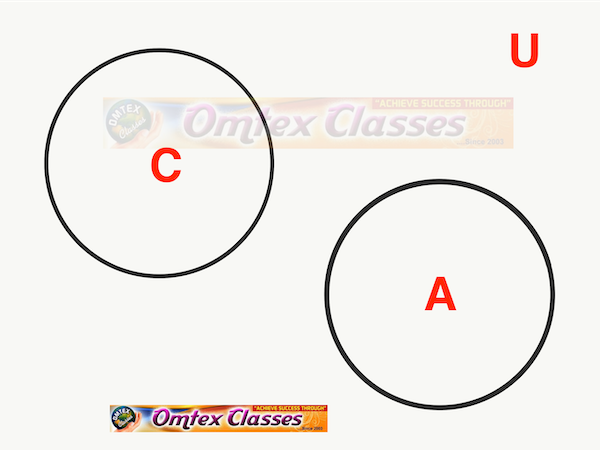
The above Venn diagram represents the truth of the given statement, i.e. C ∩ A = Φ
If A = {2, 3, 4, 5, 6, 7, 8}, determine the truth value of the following statement.
∃ x ∈ A, such that 3x + 2 > 9
For x = 3, 3x + 2 = 3(3) + 2 = 9 + 2 = 11 > 9
∴ x = 3 satisfies the equation 3x + 2 > 9.
∴ The given statement is true.
∴ Its truth value is T.
If A = {2, 3, 4, 5, 6, 7, 8}, determine the truth value of the following statement.
∀ x ∈ A, x2 < 18.
For x = 5, x2 = 52 = 25 < 18
∴ x = 5 does not satisfies the equation x2 < 18.
∴ The given statement is false.
∴ Its truth value is F.
If A = {2, 3, 4, 5, 6, 7, 8}, determine the truth value of the following statement.
∃ x ∈ A, such that x + 3 < 11.
For x = 2, x + 3 = 2 + 3 = 5 < 11.
∴ x = 2 satisfies the equation x + 3 < 11.
∴ The given statement is true.
∴ Its truth value is T.
If A = {2, 3, 4, 5, 6, 7, 8}, determine the truth value of the following statement.
∀ x ∈ A, x2 + 2 ≥ 5.
There is no x in A which satisfies x2 + 2 ≥ 5.
∴ The given statement is false.
∴ Its truth value is F.
Write the negation of the following statement.
7 is prime number and Tajmahal is in Agra.
Let p : 7 is prime number.
q : Tajmahal is in Agra.
The given statement in symbolic form is p ∧ q.
Its negation is ~(p ∧ q) ≡ ~p ∨ ~q.
∴ The negation of given statement is '7 is not prime number or Tajmahal is not in Agra.'
Write the negation of the following statement.
10 > 5 and 3 < 8
Let p : 10 > 5.
q : 3 < 8.
The given statement in symbolic form is p ∧ q.
Its negation is ~(p ∧ q) ≡ ~p ∨ ~q.
∴ The negation of given statement is '10 ≤ 5 or 3 ≥ 8.'
Write the negation of the following statement.
I will have tea or coffee.
Let p : I will have tea.
q : I will have coffee.
The given statement in symbolic form is p ∨ q.
Its negation is ~(p ∨ q) ≡ ~p ∧ ~q.
∴ The negation of given statement is ‘I will not have tea and coffee’.
Write the negation of the following statement.
∀ n ∈ N, n + 3 > 9.
∃ n ∈ N such that n + 3 ≤ 9.
Write the negation of the following statement.
∃ n ∈ A, such that x + 5 < 11.
∀ x ∈ A, x + 5 ≤ 11