b. Read the following paragraph and pick out the different types of nouns and put them in the table.
Hobby is an activity that we enjoy doing in our free time. It keeps us busy in our leisure time. People choose their hobby on the basis of their interests and personality. Do you know what Dr. A.P.J. Abdul Kalam’s hobby was?
Answer:
Proper Noun
Common Noun
Abstract Noun
Dr. A.P.J. Abdul Kalam
Hobby, activity, time, people
Interests, personality
C. Fill in the blanks with the suitable collective noun.
There are many situations in which we write formal letters. The formal letter has a specific format. The formal letter should be accurate and presented in an organised manner.
Letter Formats
Formal Letter
A formal letter includes:
Sender's address
Date
Name/designation and address of the receiver
Subject
Salutation
Body of the letter
Closing Paragraph
Complimentary close
Subscription
Sender’s Name Designation (if applicable)
Informal letter
An informal letter includes:
Sender's address
Date
Salutation
Body of the letter
Closing Paragraph
Complimentary close
Subscription
Sender’s Name
Samples and Exercises
Sample Formal Letter
Using the given letter as a model, write a complaining letter on any one of the topics given below.
a. To the Police commissioner about the noise caused by the loud speaker in a music shop near your school.
b. To the Postmaster General on non – receipt of book parcel.
c. To the Transport Manager, TNStC on non- stopping of buses near your school bus stop.
Sample Informal Letter
Using the given informal letter as a model, write a letter on any one of the topics given below.
a. Write letter to your father asking permission to go on a educational tour.
b. Write letter to your friend about your summer holidays.
c. Write letter to your sister advising her to take part in cultural programme in school annual day celebration.
Model Answers
FORMAL LETTER
a) To the Police commissioner about the noise caused by the loudspeaker in a music shop near your school.
From
Aditya
VIII std ‘A’;
Government Higher Secondary School,
Chennai - 600 011.
3rd March 2020.
To
The Police Commissioner,
Perambur, Chennai - 600 011.
Sir,
Sub: Complaint about the noise caused by the loudspeaker regarding.
We, the students of Government Higher Secondary School, are getting distracted by the noise caused by the loudspeaker in a music shop near our school. We are unable to listen to the lessons taught and concentrate on our studies. The noise from a loudspeaker is unbearable.
We request you to look into the matter immediately and take necessary action to stop this problem.
Thank you,
Yours faithfully,
Aditya VIII Std ‘A’ Section.
Address on the Cover:
To
The Police Commissioner,
Perambur,
Chennai - 600 011.
b) To the Postmaster General on non - receipt of book parcel.
From
G. Alex
School Pupil Leader,
SSR Higher Secondary School,
Tiruchirappalli - 620 001
10th May 2020.
To
The Postmaster General
Sangiliyandapuram,
Tiruchirappalli - 620 001.
Sir,
Sub: Complaint on the non-receipt of a book parcel - reg.
I had ordered some books from a publishing company, two weeks back. When I contacted the publishing company, they told us that they had sent us the books in a registered parcel two days back. But so far, we have not received the parcel.
You are requested to enquire into the matter and do the needful.
Thank you,
Yours faithfully,
G. Alex.
Address on the Cover:
To
The Postmaster General
Sangiliyandapuram,
Tiruchirappalli - 620 001.
c) To the Transport Manager, TNSTC on non- stopping of buses near your school bus stop.
From
Manisha. K,
VIII Std ‘B’,
Anitha Hr. Sec. School,
Vepery, Chennai - 600 007.
4th June 2020.
To
The Transport Manager,
TNSTC, Chennai - 600 002.
Sir,
Sub : Non-stopping of buses near the school bus stop - reg.
This is to bring to your notice that TNSTC buses do not stop near our school bus stop. The students are finding it difficult to commute to school. They had to walk a long distance to come to school and then go home from school. It takes a lot of time for all of us.
We request you to kindly look into this matter and take necessary action for the benefit of our school students.
Thank you,
Yours faithfully,
Manisha. K
Address on the Cover:
To
The Transport Manager,
TNSTC,
Chennai - 600 002.
INFORMAL LETTER
a) Write letter to your father asking permission to go on an educational tour.
NSK Hr. Sec. School,
Trichy.
12.06.2020
My dear Father,
I am fine here and hope this letter finds you and Mum in the best of health.
Dad, our class teacher has organized an educational tour to Ooty, next month. Industrial visit to Eucalyptus industry, Aruvankadu Cordite factory, Needle Industries, Rallies India, Hindustan Unilever, are proposed. I wish to participate in the tour. I promise to be good and take care of myself. So, please send me Rs. 1,200 for the trip. We shall be leaving on 18th July and will be back on 19th July (Sunday) night.
I am eagerly waiting for your reply.
Your loving son,
S. Mani
Address on the envelope:
To
Mr. K. Sivaram,
60-B, Gandhi Salai,
Thirunelveli.
b) Write letter to your friend about your summer holidays.
Chennai - 40
31.05.2020
My dear Ravi,
I am fine here and hope this letter finds you in good health.
I want to share my experiences during the summer vacation. I went to Ooty for ten days and the climate was really fine. I went to the Botanical Garden, where a flower show was conducted. I went to Doddabetta Peak, which is the highest peak in the Nilgiris. The view from the top of the peak is absolutely mesmerizing. I travelled in the Toy train from Mettupalayam to Ooty via Coonoor. Mudumalai National Park is attractive. Yesterday I returned from there. I am waiting to see you, Ravi.
Your loving friend,
M. Prakash
Address on the envelope:
To
Mr. T. Ravi,
26, Patel Road,
Ambattur, Chennai - 600 058.
c) Write letter to your sister advising her to take part in cultural programme in school annual day celebration.
Chennai - 40
10.01.2020
My dear sister Radha,
I hope this letter finds you in good health and spirits. I am writing this letter to advise you to take part in the cultural programme at your school annual day celebration. Some six months back, you joined the dance class and your master told me about your excellent performance. But now you hesitate to dance in your school auditorium. I think you should not feel a shy to dance in front of your teachers and other students. I wish you to participate in the dance programme. Please convey my regards to Dad and Mom.
Jane Eyre - Prose by C. Rajagopalachari - Unit 1 - 8th English - Speaking | 8th English : Unit 1 : Prose : The Nose-Jewel
Speaking
Greetings
There are a number of greetings we use when meeting people. These greetings depend on whether we are meeting people, leaving people or meeting people for the first time.
Meeting People for the First Time
When introduced to someone for the first time, use the following greetings:
Hello, it's a pleasure to meet you. How do you do?
Example Dialogues
Fatima: Ameera, this is Fatima.
Ameera: Hello, it's a pleasure to meet you. Fatima : How do you do?
Ameera: How do you do?
Note: The reply to 'How do you do?' is 'How do you do?' This is appropriate when you meet someone for the first time.
Meeting People
When meeting people during the day, use the following phrases.
Formal
Good morning / afternoon / evening!
How are you?
It's good to see you.
Informal
Hi!
Hey, how's it going?
What's up?
Example
Bhuvana : Good morning Roshini.
Ilango : Good morning. How are you?
Bhuvana : What's up?
Ilango : Nothing much. You?
Formal Greetings: Arriving
Good morning / afternoon / evening!
Hello (name) , how are you?
Good day Sir / Madam (very formal)
Good morning Mr. Raju.
Hello Ms. Sherlyn. How are you today?
Informal Greetings: Arriving
Hi / Hello! : How are you? / How are you doing?
How are you? : Very well, thank you. And you? (formal)
How are you doing? : Fine / Great (informal)
What's up? (very informal) : Not much. I'm just (watching TV, cooking dinner, etc.)
Informal Greetings After a Long Time
If you haven't seen a friend or family member for a long time, use one these informal greetings to mark the occasion.
It's great to see you!
How have you been?
Long time, no see.
How are you doing these days?
Formal Greetings: Departing
Use these greetings when you say goodbye at the end of the day. These greetings are appropriate for work and other formal and informal situations.
Formal
Good morning / afternoon / evening.
It was a pleasure seeing you.
Goodbye.
Goodnight. (Note: Use after 8 p.m.)
Informal
Nice seeing you!
Goodbye / Bye
See you later
Later (very informal)
Practice Dialogues
Greetings in Informal Conversations
Amala: Sanjay, what's up?
Sanjay: Hi Amala. Nothing much. I'm just hanging out. What's up with you?
Listen to the passage carefully and choose the right answer.
Why Do Birds Sing?
Why do birds sing? You might assume that birds sing because they are happy. While birds might be happy, they sing in order to communicate. One reason they sing is to stake a claim on territory. Birds sing to warn other birds to stay off their property. For example, a robin might stake a claim on a piece of land which measures about 200 feet wide by 200 feet long. This amount of land provides enough worms for the robin to feed its family. A bird maintains singing perches around the outside edges of its territory. The perches are high in the trees, so other birds can see and hear it. Birds also sing to find a mate. The length and complexity of the mating song gives information about the fitness of the bird. Healthy birds can sing longer, more complicated songs. Birds call to one another in shorter vocalizations in order to warn of danger and to locate one another. Birds sing instinctively. Young birds learn to perfect their songs by listening to adult birds and interacting with other birds. Birds in a local area might learn variations in the basic song which help them recognize other members of their group.
Questions
1) Why do birds sing?
a) To locate one another
b) To warn other birds
c) To find a mate
d) All of the above
Show Answer
[Answer: (d) All of the above]
2) Birds perch very high so that ......
a) other birds can hear them
b) other birds can see them
c) they can hide there
d) Both A and B are correct.
Show Answer
[Answer: (d) Both A and B are correct.]
3) The health of a bird can be determined…
a) by the length of its song
b) by the complexity of its song.
c) by the volume of its song
d) Both A and B are correct.
Show Answer
[Answer: (d) Both A and B are correct.]
4) Shorter bird vocalizations are …
a) territorial songs
b) mating songs
c) warnings
d) None of the above
Show Answer
[Answer: (c) warnings]
5) Young birds perfect their songs by …
a) natural instinct
b) listening and interaction
c) practice
d) Both B and C are correct
Show Answer
[Answer: (b) listening and interaction]
6) Fitness is …
a) health.
b) danger
c) a song
d) a warning.
Show Answer
[Answer: (a) health]
7) How do variations in the basic song help the birds?
Homophones are words with same pronunciation but different meanings, origins, or spelling. An abbreviation is a shortened form of a word or phrase. Example: PM - Prime Minister. An acronym is a shortened form of a phrase and is usually made up of the initial letters of that phrase. for example: NATO - North Atlantic Treaty Organization.
Vocabulary
Homophone
Homophones are words with same pronunciation but different meanings, origins, or spelling.
For Example:
new – knew
hole – whole
knight – night
see – sea
a. Pick out the correct homophone.
I am not allowed to drink soda. (aloud, allowed)
The wind blew the leaves. (blue, blew)
I will meet my friend. (meat, meet)
He will play the role in the second play. (role, roll)
I have seen the movie already. (scene, seen)
b. Choose the correct homophone.
Every morning my father likes to look at the ________ on the grass.
a) due
b) dew
[Answer: (b) dew]
Chennai is the ________ of Tamilnadu.
a) capitol
b) capital
[Answer: (b) capital]
I was very ________ last weekend because my friends went to the village without informing me.
a) bored
b) board
[Answer: (a) bored]
The cat caught the _______ of a mouse.
a) scent
b) cent
[Answer: (a) scent]
The _______ rises in the east.
a) son
b) sun
[Answer: (b) sun]
Abbreviation and Acronyms
a. Abbreviation:
An abbreviation is a shortened form of a word or phrase. Example: PM - Prime Minister
Example:
ATM:Automated Teller Machine
GB:Giga Byte
PC:Personal Computer
CEO:Chief Educational Officer
EMIS:Education Management Information System
IAS:Indian Administrative Service
NMMS:National Means cum Merit Scholarship
SBI:State Bank of India
OTP:One Time Password
IFSC:Indian Financial System Code
PDF:Portable Document Format
LED:Light Emitting Diode
UPS:Uninterruptible Power Supply
GST:Goods and Services Tax
b. Acronyms:
An acronym is a shortened form of a phrase and is usually made up of the initial letters of that phrase. for example: NATO - North Atlantic Treaty Organization.
Example:
AVADI:Armoured Vehicles and Ammunition Depot of India
RAM:Random Access Memory
ROM:Read-Only Memory
NEET:National Eligibility cum Entrance Test
UDISE:Unified District Information System for Education
PAN:Permanent Account Number
WHO:World Health Organization
NEWS:North, East, West and South.
SIM:Subscriber Identification Module
LAN:Local Area Network
VAT:Value Added Tax
Expand the following:
ECG - Electrocardiogram
ILO - International Labour Organisation
SCERT - State Council of Educational Research and Training
IIT - Indian Institute of Technology
ISRO - Indian Space Research Organisation
FIR - First Information Report
UNESCO - United Nations Educational, Scientific and Cultural Organization
UNICEF - United Nations International Children's Emergency Fund
NASA - National Aeronautics and Space Administration
Unit 1 | Prose | 8th English Book Back Questions & Answers
Read and Understand
A) Choose the correct synonyms for the italicized words.
1. Nice fun indeed.
a. infact
b. doubtedly
c. fine
Answer: (a) infact
2. The poor woman is in a panic.
a. fear
b. grid
c. crash
Answer: (a) fear
3. The mother consoled her little girl.
a. pretended
b. comforted
c. left
Answer: (b) comforted
4. You are always self-centred.
a. egostic
b. generous
c. heroic
Answer: (a) egoistic
5. What is the secret you are whispering?
a. rumour
b. murmur
c. louder
Answer: (b) murmur
B) Find the antonym for the following words.
1. Delight × displease
2. Disgrace × glory
3. Careless × careful
4. Secret × public
5. confine × release
C) Fill in the blanks.
1. The sparrows built their nests in the roof of Ramayya’s house.
2. The diamond jewel was lying in the muck-heap.
3. The diamond jewel belonged to Meenakshi Ammal’s daughter.
4. Kuppayi was the servant maid of Meenakshi Ammal.
5. Ramayya and his wife lived with the fear of getting caught.
D) Say the following statements are True or False.
1. Two sparrows built a nest on a tree top. [Answer: False]
2. Kuppayi swept out the diamond jewel. [Answer: True]
3. Ramayya gave the diamond jewel to the magistrate. [Answer: False]
4. Ramayya's wife put the stud away in her box. [Answer: True]
5. The Police searched Rammaya’s home. [Answer: False]
E) Answer the following questions
1. Where did the sparrows build the nest?
The sparrows built the nest in a nice spot in the roof of Ramayya’s house.
2. Why did the bird drop diamond stud?
The wife bird shouted at the male bird to go in search of food. So it dropped the diamond stud.
3. What were the words of Meenakshi Ammal to her daughter?
Meenakshi Ammal told her daughter not to tell her father about the lost diamond nose-stud.
4. Who was suspected of stealing the diamond nose stud?
The maid-servant Kuppayi was suspected of stealing the diamond nose stud.
5. What did Ramayya’s wife do with the stud?
Ramayya’s wife put the stud away in her box.
6. What happened to Ramayya’s wife at the end?
Ramayya’s wife developed a severe fever and was confined to her bed.
F) Answer the following in about 100 words.
1. Why did the sparrow throw the nose jewel into Ramayya's house?
One day, the male sparrow found a diamond nose-jewel in a heap. He picked it up and came to the nest with the shining stud in his beak and informed his wife about it. The female bird shouted at him and told, him that the diamond jewel was not of any use to her. She asked the male sparrow to search for food for their young ones. So the bird dropped the diamond stud on the floor and went out in search of little worms for the young ones.
2. Explain how Ramayya's wife reacted when she saw the nose jewel?
When Ramayya’s wife was sweeping the floor she found the diamond nose stud. She picked it up with delight and wore it. Her husband told her that it was a mistake to keep the jewel. She did not bother about it. She knew that the jewel belonged to her neighbour’s daughter. Yet she did not reveal about it to anyone. The maid-servant of the neighbour was suspected. The police searched her hut, but could not find it. Ramayya’s wife put the stud away in her box. She soon developed a server fever and was confined to her bed.
Additional Questions and Answers
Very Short Questions and Answers:
1. Where did Ramayya live?
Ramayya was a simple man who lived in a town.
2. What did the male-bird find?
The male-bird found a diamond stud in a heap.
3. What did Ramayya’s wife notice?
Ramayya’s wife noticed the diamond stud, as she was sweeping the floor.
4. Who was Kuppayi?
Kuppayi was the maid-servant of Meenakshi Ammal.
5. Did the police find anything?
The police could not find anything.
Short Questions and Answers:
1. What did the male-bird say to the female-bird about Ramayya’s wife?
The male-bird complained to his wife that Ramayya’s wife always quarrelled with his wife.
2. What was the state of Ramayya, when the police were searching the stud?
Ramayya’s heart was in a flutter. He was frightened that the police would come to his house and search for the stud.
Ramayya was a simple man living in the town. He lived with his wife in a nice house made of tiled roofs. He was not rich but he could take care of his family.
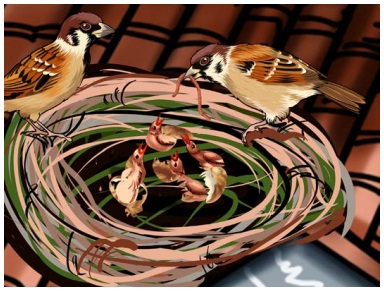
Two sparrows built a nest in a nice spot in the roof of Ramayya's house and the mother-bird laid her eggs in it.
“My dear," began the male sparrow.
“And what do you want now?" asked his wife.
"Why does the lady of this house always quarrel with her husband?"
"How am I to know?" said the female bird. “Let us mind our own business."
"You are always self-centred," said the male sparrow and added, "Should we not help this poor Ramayya?"
The female sparrow said with disdain, "Let me see what help you can do for him. Please do not talk about what does not concern us. See that the cat does not come near our nest. That would be enough for you and me."
Somewhere in the muck- heap lay a diamond nose- jewel. The male bird picked it up and came to the nest with the shining stud in his beak and said to his wife: "Look! Do you like this?
The wife-bird replied, "What am I to do with diamond nose studs or with ear-rings?
Find some grub; the young ones are hungry."
The bird dropped the diamond stud on the floor and went out in search of little worms for the young ones.
Ramayya's wife noticed the jewel as she was sweeping the floor. She picked it up with delight and wore it.
Ramayya questioned her angrily, "How did you get this diamond-stud?" "I found it lying here yesterday and took it. That is all."
"We should go and handover it to the village magistrate. If tomorrow the police should come and search our house, it will be disgrace to us?"
In Meenakshi Ammal's house nearby, the talk went thus: "I forgot and left it in the bathroom. Kuppayi, the servant woman must have swept it out. She is very careless and ignorant."
The mother, Meenakshi Ammal, consoled her little girl saying, "Let us search and find it. Don't tell father yet. He would go into a rage if he knew that you had lost the diamond nose stud."
A bird’s eye takes up about 50 percent of its head; our eyes take up about 5 percent of our head. To be comparable to a bird’s eyes, our eyes would have to be the size of baseballs.
What is the secret you are whispering?" asked Ramanatham.
The loss of the jewel had to be admitted. Soon the whole village knew about it. The maid-servant Kuppayi was suspected by everyone to have stolen it.
The police came and searched her hut, but could find nothing.
Ramayya's heart was in a flutter. Ramayya's wife put the stud away in her box. She soon developed a severe fever and was confined to her bed. No one thought of searching their house.
The he-sparrow said, "Look at the fun, my dear, the lady of this house is scared and is down with fever."
"Nice fun indeed!" said the she- sparrow. "The poor woman is in a panic. The fever may be the end of her."
"And a good thing too," said the cruel male sparrow.
"It is all your doing you brought and threw it here and tempted her," said the female bird.
The male bird answered gravely, "Did I tell her to steal the thing? This is bound to happen when human are being greedy.”
“Rightly said, we should never be greedy for what belongs to others". "Come, let us go now and bring some worms for the young ones.” And the two flew out.
Ramayya and his wife spend the rest of life in fear of being caught. The diamond Nose Jewel may still be with them, but the fear of getting caught was even more.
About the Author
Chakravarti Rajagopalachari (1878-1972) informally called Rajaji, was an Indian politician, independence activist, lawyer, writer, historian and statesman. Rajagopalachari was born in the village of Thorapalli in the Krishnagiri district. Rajagopalachari was the last Governor-General of India, as India soon became a Republic in 1950. Furthermore, he was the first Indian-born governor-general, since before him the posts were held by British nationals. He also served as leader of the Indian National Congress, Premier of the Madras Presidency, Governor of West Bengal, Minister for Home Affairs of the Indian Union and Chief Minister of Madras state. He was one of the first recipients of India's highest civilian award, the Bharat Ratna.


.jpg)

