3rd Science : Term 2 Unit 2 : Water

Learning Objectives
After learning this lesson, students will be able to
- understand the importance water
- list the sources of water
- understand the methods of preventing wastage of water
- explain the methods to conserve water bodies
- know about Problems caused due to stagnant water
Rhyme Time
Water... Water!
A thirsty bird from far away
Looked for water on its way
Empty ponds and lakes dry
Everywhere did it try.
Suddenly it spotted a dripping tap
A boy carelessly leaving it open
Was walking away.
The bird flew down and drank
To the little boy it said,
“Water is precious do not waste it
Close the tap after you drink!”
The boy realised and said, ‘sorry’.
He closed the tap and went satisfied
The bird flew on singing a happy song.

I. Water - A primary source of life
Water is one of the most important resources on Earth. All living things like small organisms, plants and animals need water to survive. People use water for various purposes. Rain is one of the main sources of water.
Do you know
- A camel can drink 60 to 100 litres of water at a time and live without water for several days.
- World Water Day is observed on 22nd March.
Let us Write
Observe the picture and fill in the blanks.

- We need water to wash our face.
- We need water to brush our teeth.
- We need water to cook our food.
- We need water to clean our vessels.
- We need water to drink.
Let us Do
A. Tick (✔) the activities for which water is needed
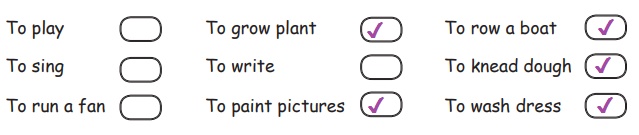
B. Name any four activities which you can do without water.
Let us Discuss
We find animals in this picture near a water source. Why they are gathered here?
Wild animals need water. As they are thirsty they have gathered here to drink water.

Write few lines about this picture.
- Wild animals need water.
- Hence, they come to water bodies in the forests.
- Just like us, animals too drink water when they are thirsty.
Ask your teacher:
Why wild animals are entering into human habitat?
Forests are destroyed by human beings. So the wild animals have no food or shelter. Naturally they enter human habitat in search of food.
II. Potable Water
Drinking water is known as potable water. Potable water is water that is good to drink and useful for food preparation.
Potable Water should be:
- free from dangerous chemicals.
- transparent.
- odourless and colourless.
- free from bacteria which cause diseases.

Different Sources of Drinking Water
Water is available in many natural sources, but not all the water sources are suitable for drinking. Water should be boiled to kill the germs in it, and only then it is suitable for drinking. A few sources of water are rain, well, river, lake and stream.
Let us Write
Rearrange the jumbled letters to find out the different sources of water.
E.g., Rain (anir)
- Lake ( a l k e )
- Pond ( o p d n )
- Stream ( m e r a t s)
- Well ( e l l w )
- Sea ( e a s )
- Ocean ( o n a e c )
Let us Discuss
Observe the pictures. Put a tick (✔) for the water which is good for drinking. Discuss about these with your friends.

Try to Answer
I freeze when I am cold and
I fall softly as snow,
I melt in the Sun and down the mountain I flow.
Who am I? Answer : Ice
Let us Do
Let us assemble a Simple Pump
Materials needed: Any hollow tube – PVC, metal or even a long papaya stem
Procedure: Hold the tube with your left hand and move it up and down into a bucket of water. Keep the palm of your right hand on the top of the tube and open and close it with each up and down reciprocation. Soon, water will start squirting out. Here the up-down motion of the left hand does the pumping while the right palm acts like a valve.

More to know
Each person on the Earth requires at least 20 to 50 litres of clean and safe water per day for drinking and other activities.
III. Why should we save water?
Only 3% of the water in the entire Earth is freshwater. Water is precious. So, we should never waste water.
Some methods to prevent wastage of water:
- Never allow water to overflow from buckets.
- Wash fruits and vegetables in a bowl of water and not under running tap water.
- Always close the taps while brushing the teeth.
- Use left over water in your water bottle to water a potted plant.
- Turn off the tap after each use.
- Use a sprinkler to water the garden.

Try to Answer
Write some activities through which we can save water.
- Take shorter showers.
- Check your toilet for leaks.
- Install rainwater tanks.
- Turn off the water while brushing.
- Install low-flush toilet.
Let us Do
Answer the following questions by putting a tick (✔). If your answer is different from all of the given pictures, write its name in the empty box.
1. Which one do you use to drink water?

2. Which of these is used to store drinking water at your home?

3. Where do you get your drinking water from?

Let us Complete
Join the dots and colour the picture. Complete the message.

Do you know
How people stored water in olden days?
In olden days, people stored water in different ways. Few methods are well, water tanks in forts, draw well, reservoirs, rivers and bunds, tanks, dams and bore wells.
Save every drop of water
IV. Conservation of Water Bodies
All the water that we get comes from rain. When it rains, some water flows over the ground giving rise to streams and rivers. Some water gets collected in low lying areas such as ponds and lakes. The flow of the river is blocked by building a dam across it. Some rainwater seeps into the ground as underground water.
Lake
It is a large area filled with water surrounded by land. It is usually a part of a river or some other water source.

Pond
A pond is a body of stagnant water, either natural or artificial; it is smaller than a lake.

Reservoirs
These are built in areas of low rainfall or in areas where there is no major river. Most of reservoirs are built using stones. Sathiyamoorthy reservoir located at Tiruvallur district in Poondi village.

Tanks
A water tank is a container for storing water for our daily use.

Methods to Conserve Water Bodies
- Deepening of ponds and lakes
- Plant trees at the bank of the lake and pond
- Reduce water pollution
- Avoid digging too many wells in a region
Use your brain power…
The trees in the forests need water to grow. From where do they get the water?
Trees serve as natural sponges, collecting and filtering rainfall and releasing it slowly into rivers. They get water from rain and from the wet soil deep below.
Problems caused due to Stagnation of Water
- Stagnant water can become a breeding ground for the mosquitoes that transmit diseases. Malaria and Dengue Fever are the main dangers of stagnant water.
- Waterborne diseases such as cholera, dysentery, typhoid are caused by drinking unclean water.
Symptoms of Dengue Fever:
- Severe headache
- Rashes on the arms and the legs
- Extreme tiredness
- Sudden onset of fever that lasts 3-7 days

Discuss with your friends and write. What will happen, if you drink unclean water?
Drinking unclean water can cause several kind of waterborne diseases, (eg) cholera, typhoid.
Let us Do
A. What are the activities to save water? If true put (✔), if false put (×).
- We should wash our vehicles everyday. (×)
- Planting more trees leads to rain fall. (✔)
- We can bathe in shower to save water. (✔)
- It is necessary to collect rain water. (✔)
B. Look at the pictures and answer the following.

If we fill them with water,
- Which will contain less water? B
- Which will contain more water? A
- How could you tell? By the size and volume of the vessel
Read the table given below. Then put tick (✔) in the column of the sources of water used for various purposes.

Always remember everyone should take care and keep the public resources of water clean. It is each one‛s responsibility to do so.