

Maharashtra Board Question Paper: March 2016
Subject: Mathematics & Statistics (Commerce) - Paper I
Time: 1 Hr 30 Min | Marks: 40
Section - I
Q.1. Attempt any SIX of the following: (12 Marks)
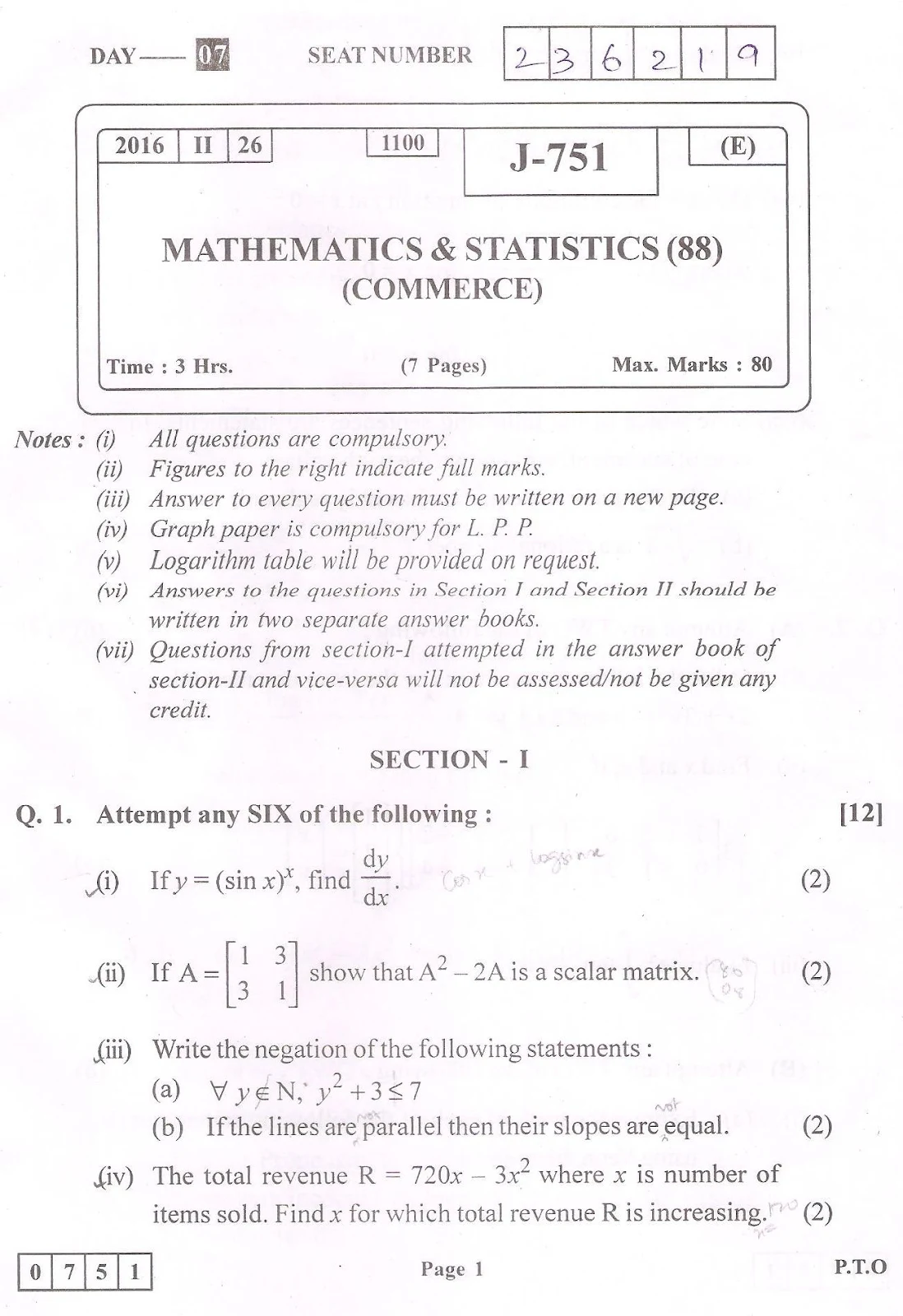
Given \( y = (\sin x)^x \)
Taking logarithm on both sides:
$$\log y = \log (\sin x)^x$$
$$\log y = x \cdot \log(\sin x)$$
Differentiating with respect to x:
$$\frac{1}{y} \frac{dy}{dx} = x \cdot \frac{d}{dx}[\log(\sin x)] + \log(\sin x) \cdot \frac{d}{dx}[x]$$
$$\frac{1}{y} \frac{dy}{dx} = x \cdot \frac{1}{\sin x} \cdot \cos x + \log(\sin x) \cdot 1$$
$$\frac{dy}{dx} = y [x \cot x + \log(\sin x)]$$
First, find \( A^2 \):
$$A^2 = A \cdot A = \begin{bmatrix}1 & 3 \\ 3 & 1\end{bmatrix} \begin{bmatrix}1 & 3 \\ 3 & 1\end{bmatrix}$$
$$= \begin{bmatrix} 1(1)+3(3) & 1(3)+3(1) \\ 3(1)+1(3) & 3(3)+1(1) \end{bmatrix} = \begin{bmatrix} 10 & 6 \\ 6 & 10 \end{bmatrix}$$
Now find \( 2A \):
$$2A = 2 \begin{bmatrix}1 & 3 \\ 3 & 1\end{bmatrix} = \begin{bmatrix}2 & 6 \\ 6 & 2\end{bmatrix}$$
Compute \( A^2 - 2A \):
$$\begin{bmatrix} 10 & 6 \\ 6 & 10 \end{bmatrix} - \begin{bmatrix}2 & 6 \\ 6 & 2\end{bmatrix} = \begin{bmatrix} 8 & 0 \\ 0 & 8 \end{bmatrix}$$
Since the non-diagonal elements are zero and diagonal elements are equal, it is a scalar matrix.
(a) \( \forall y \in N, y^2 + 3 \le 7 \)
(b) If the lines are parallel then their slopes are equal.
(a) The negation of a universal quantifier (\( \forall \)) is an existential quantifier (\( \exists \)), and the inequality is reversed.
(b) Let \( p \): The lines are parallel.
Let \( q \): Their slopes are equal.
Given statement is \( p \rightarrow q \).
Negation is \( p \land \sim q \).
Given \( R = 720x - 3x^2 \)
Differentiating w.r.t x:
$$\frac{dR}{dx} = 720 - 6x$$
For R to be increasing, \( \frac{dR}{dx} > 0 \).
$$720 - 6x > 0$$
$$720 > 6x$$
$$120 > x \implies x < 120$$
Since the number of items cannot be negative:
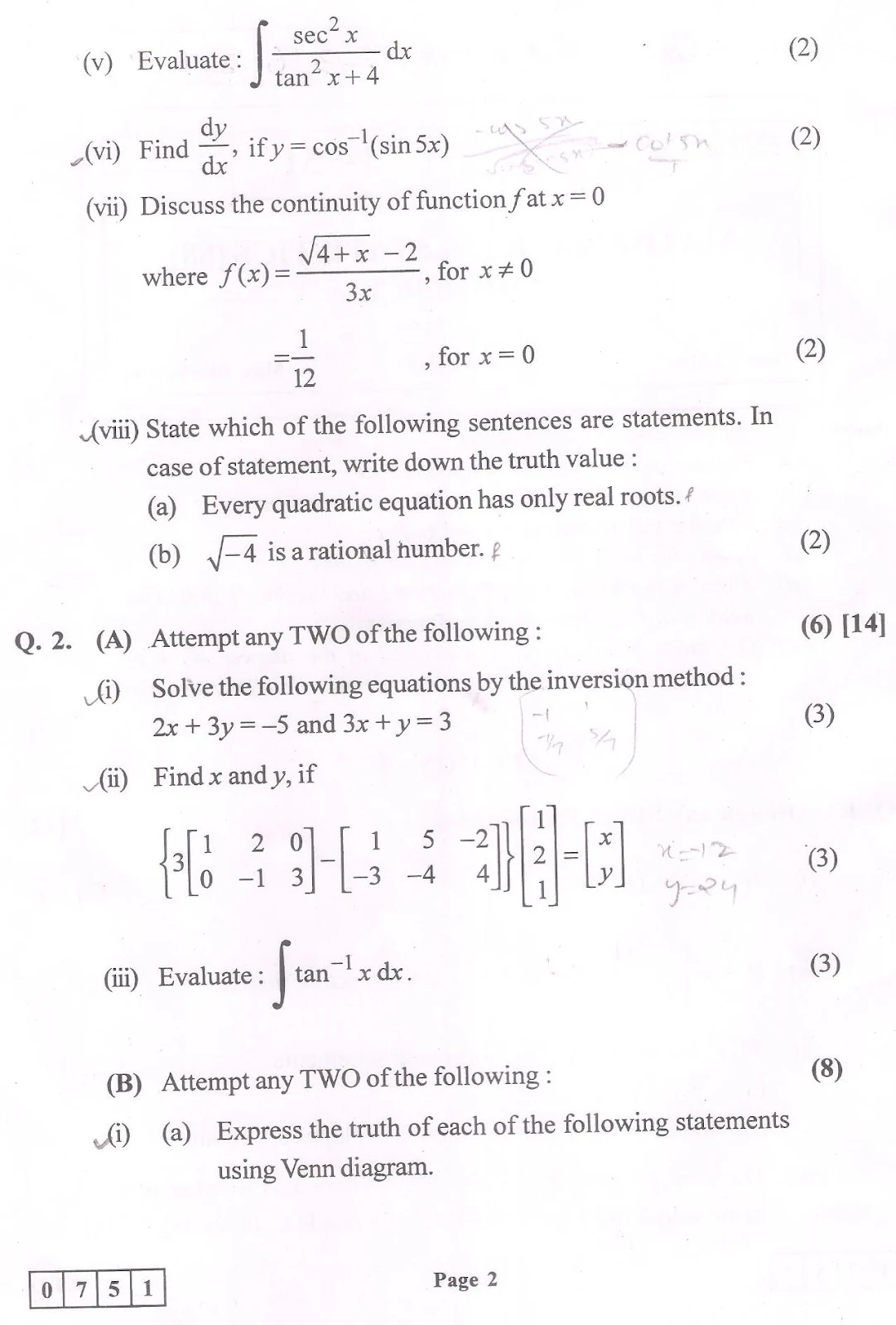
Let \( I = \int \frac{\sec^2 x}{\tan^2 x + 4} dx \)
Put \( \tan x = t \), then \( \sec^2 x dx = dt \).
$$I = \int \frac{1}{t^2 + 4} dt = \int \frac{1}{t^2 + 2^2} dt$$
Using formula \( \int \frac{1}{x^2+a^2}dx = \frac{1}{a}\tan^{-1}(\frac{x}{a}) + c \):
$$I = \frac{1}{2} \tan^{-1}\left(\frac{t}{2}\right) + c$$
Note: Question paper says \( \frac{dy}{dr} \), assuming typo for \( \frac{dy}{dx} \).
$$y = \cos^{-1}(\sin 5x)$$
We know that \( \sin \theta = \cos(\frac{\pi}{2} - \theta) \).
$$y = \cos^{-1}\left[ \cos\left(\frac{\pi}{2} - 5x\right) \right]$$
$$y = \frac{\pi}{2} - 5x$$
Differentiating w.r.t x:
\( f(x) = \frac{\sqrt{4+x}-2}{3x} \), for \( x \ne 0 \)
\( f(x) = \frac{1}{12} \), for \( x = 0 \)
Given \( f(0) = \frac{1}{12} \)
Evaluate limit at \( x \to 0 \):
$$\lim_{x \to 0} f(x) = \lim_{x \to 0} \frac{\sqrt{4+x}-2}{3x}$$
Rationalize the numerator:
$$= \lim_{x \to 0} \frac{\sqrt{4+x}-2}{3x} \times \frac{\sqrt{4+x}+2}{\sqrt{4+x}+2}$$
$$= \lim_{x \to 0} \frac{(4+x)-4}{3x(\sqrt{4+x}+2)} = \lim_{x \to 0} \frac{x}{3x(\sqrt{4+x}+2)}$$
$$= \lim_{x \to 0} \frac{1}{3(\sqrt{4+x}+2)} = \frac{1}{3(\sqrt{4+0}+2)}$$
$$= \frac{1}{3(2+2)} = \frac{1}{12}$$
Since \( \lim_{x \to 0} f(x) = f(0) = \frac{1}{12} \), the function is continuous at \( x=0 \).
(a) Every quadratic equation has only real roots.
(b) \( \sqrt{-4} \) is a rational number.
(a) It is a statement. Truth Value: False (F) (Quadratic equations can have complex roots).
(b) It is a statement. Truth Value: False (F) (\( \sqrt{-4} = 2i \), which is an imaginary number, not rational).
Q.2. (A) Attempt any TWO of the following: (6 Marks)
\( 2x + 3y = -5 \) and \( 3x + y = 3 \)
Matrix form \( AX = B \):
$$\begin{bmatrix} 2 & 3 \\ 3 & 1 \end{bmatrix} \begin{bmatrix} x \\ y \end{bmatrix} = \begin{bmatrix} -5 \\ 3 \end{bmatrix}$$
Determinant \( |A| = (2)(1) - (3)(3) = 2 - 9 = -7 \ne 0 \). Hence \( A^{-1} \) exists.
Adjoint of A for \( 2 \times 2 \) matrix: Swap diagonal, change signs of off-diagonal.
$$Adj A = \begin{bmatrix} 1 & -3 \\ -3 & 2 \end{bmatrix}$$
$$A^{-1} = \frac{1}{|A|} Adj A = \frac{-1}{7} \begin{bmatrix} 1 & -3 \\ -3 & 2 \end{bmatrix}$$
Using \( X = A^{-1}B \):
$$\begin{bmatrix} x \\ y \end{bmatrix} = \frac{-1}{7} \begin{bmatrix} 1 & -3 \\ -3 & 2 \end{bmatrix} \begin{bmatrix} -5 \\ 3 \end{bmatrix}$$
$$= \frac{-1}{7} \begin{bmatrix} (1)(-5) + (-3)(3) \\ (-3)(-5) + (2)(3) \end{bmatrix}$$
$$= \frac{-1}{7} \begin{bmatrix} -5 - 9 \\ 15 + 6 \end{bmatrix} = \frac{-1}{7} \begin{bmatrix} -14 \\ 21 \end{bmatrix}$$
$$= \begin{bmatrix} 2 \\ -3 \end{bmatrix}$$
Let's simplify the term inside the curly braces first:
$$3\begin{bmatrix}1 & 2 & 0 \\ 0 & -1 & 3\end{bmatrix} = \begin{bmatrix}3 & 6 & 0 \\ 0 & -3 & 9\end{bmatrix}$$
Subtracting the second matrix:
$$\begin{bmatrix}3 & 6 & 0 \\ 0 & -3 & 9\end{bmatrix} - \begin{bmatrix}1 & 5 & -2 \\ -3 & -4 & 4\end{bmatrix} = \begin{bmatrix} 2 & 1 & 2 \\ 3 & 1 & 5 \end{bmatrix}$$
Now multiply by the column matrix:
$$\begin{bmatrix} 2 & 1 & 2 \\ 3 & 1 & 5 \end{bmatrix} \begin{bmatrix}1 \\ 2 \\ 1\end{bmatrix} = \begin{bmatrix}x \\ y\end{bmatrix}$$
$$\begin{bmatrix} 2(1) + 1(2) + 2(1) \\ 3(1) + 1(2) + 5(1) \end{bmatrix} = \begin{bmatrix}x \\ y\end{bmatrix}$$
$$\begin{bmatrix} 2 + 2 + 2 \\ 3 + 2 + 5 \end{bmatrix} = \begin{bmatrix}x \\ y\end{bmatrix}$$
$$\begin{bmatrix} 6 \\ 10 \end{bmatrix} = \begin{bmatrix}x \\ y\end{bmatrix}$$
Use Integration by Parts. Let \( u = \tan^{-1}x \) and \( v = 1 \).
$$\int u v dx = u \int v dx - \int (\frac{du}{dx} \int v dx) dx$$
$$= \tan^{-1}x \cdot x - \int \frac{1}{1+x^2} \cdot x dx$$
$$= x \tan^{-1}x - \frac{1}{2} \int \frac{2x}{1+x^2} dx$$
Using \( \int \frac{f'(x)}{f(x)}dx = \log|f(x)| \):
Q.2. (B) Attempt any TWO of the following: (8 Marks)
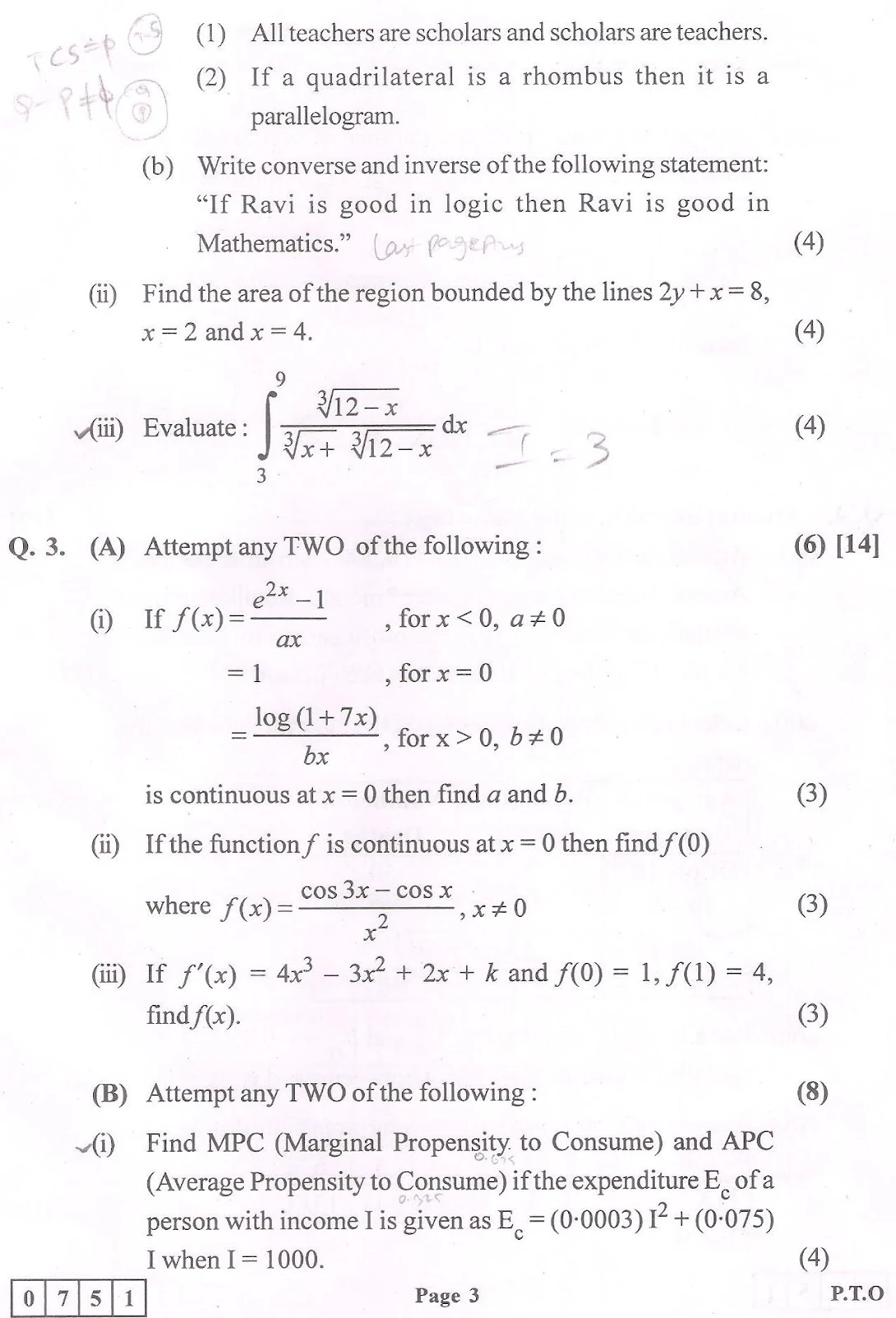
(1) All teachers are scholars and scholars are teachers.
(2) If a quadrilateral is a rhombus then it is a parallelogram.
(b) Write converse and inverse of the following statement:
"If Ravi is good in logic then Ravi is good in Mathematics."
(a) Venn Diagrams:
- (1) Since all teachers are scholars AND all scholars are teachers, the set of Teachers (T) and Scholars (S) are identical. Diagram: A single circle labelled T=S within the Universal set U.
- (2) All rhombuses are parallelograms. Diagram: A circle for Rhombus (R) completely inside a larger circle for Parallelogram (P), within Universal set U.
(b) Logic:
Let \( p \): Ravi is good in Logic.
Let \( q \): Ravi is good in Mathematics.
Given: \( p \rightarrow q \).
Converse (\( q \rightarrow p \)): If Ravi is good in Mathematics then Ravi is good in logic.
Inverse (\( \sim p \rightarrow \sim q \)): If Ravi is not good in logic then Ravi is not good in Mathematics.
Equation of line: \( 2y = 8 - x \implies y = \frac{8-x}{2} \).
Area \( A = \int_{a}^{b} y dx \)
Limits are \( x=2 \) to \( x=4 \).
$$A = \int_{2}^{4} \frac{8-x}{2} dx = \frac{1}{2} \left[ 8x - \frac{x^2}{2} \right]_2^4$$
$$= \frac{1}{2} \left[ (32 - \frac{16}{2}) - (16 - \frac{4}{2}) \right]$$
$$= \frac{1}{2} \left[ (32 - 8) - (16 - 2) \right]$$
$$= \frac{1}{2} [ 24 - 14 ] = \frac{1}{2} [ 10 ] = 5$$
Note: The limits of integration are missing in the source. Assuming limits \( a \) and \( b \) such that \( a+b=12 \) (e.g., 4 to 8) for the standard property to apply.
Let \( I = \int_a^b \frac{\sqrt[3]{12-x}}{\sqrt[3]{x}+\sqrt[3]{12-x}} dx \) ... (1)
Using property \( \int_a^b f(x)dx = \int_a^b f(a+b-x)dx \):
Here \( a+b = 12 \). Replace \( x \) with \( 12-x \).
$$I = \int_a^b \frac{\sqrt[3]{12-(12-x)}}{\sqrt[3]{12-x}+\sqrt[3]{12-(12-x)}} dx$$
$$I = \int_a^b \frac{\sqrt[3]{x}}{\sqrt[3]{12-x}+\sqrt[3]{x}} dx$$ ... (2)
Adding (1) and (2):
$$2I = \int_a^b \frac{\sqrt[3]{12-x} + \sqrt[3]{x}}{\sqrt[3]{x}+\sqrt[3]{12-x}} dx$$
$$2I = \int_a^b 1 dx = [x]_a^b = b-a$$
$$I = \frac{b-a}{2}$$
Q.3. (A) Attempt any TWO of the following: (6 Marks)
Since f is continuous at x=0, \( \lim_{x \to 0^-} f(x) = f(0) = \lim_{x \to 0^+} f(x) \).
Left Hand Limit (x < 0):
$$\lim_{x \to 0} \frac{e^{2x}-1}{ax} = \frac{1}{a} \lim_{x \to 0} \frac{e^{2x}-1}{2x} \cdot 2$$
$$= \frac{2}{a} (1) = \frac{2}{a}$$
Given \( f(0) = 1 \), so \( \frac{2}{a} = 1 \implies a = 2 \).
Right Hand Limit (x > 0):
$$\lim_{x \to 0} \frac{\log(1+7x)}{bx} = \frac{1}{b} \lim_{x \to 0} \frac{\log(1+7x)}{7x} \cdot 7$$
$$= \frac{7}{b} (1) = \frac{7}{b}$$
Given \( f(0) = 1 \), so \( \frac{7}{b} = 1 \implies b = 7 \).
If f is continuous, \( f(0) = \lim_{x \to 0} f(x) \).
$$\lim_{x \to 0} \frac{\cos 3x - \cos x}{x^2}$$
Use formula \( \cos C - \cos D = -2\sin(\frac{C+D}{2})\sin(\frac{C-D}{2}) \):
$$= \lim_{x \to 0} \frac{-2\sin(\frac{3x+x}{2})\sin(\frac{3x-x}{2})}{x^2}$$
$$= -2 \lim_{x \to 0} \frac{\sin(2x) \sin(x)}{x \cdot x}$$
$$= -2 [\lim_{x \to 0} \frac{\sin 2x}{2x} \cdot 2] [\lim_{x \to 0} \frac{\sin x}{x}]$$
$$= -2 [1 \cdot 2] [1] = -4$$
Integrate \( f'(x) \) to find \( f(x) \):
$$f(x) = \int (4x^3 - 3x^2 + 2x + k) dx$$
$$f(x) = 4\frac{x^4}{4} - 3\frac{x^3}{3} + 2\frac{x^2}{2} + kx + c$$
$$f(x) = x^4 - x^3 + x^2 + kx + c$$
Using \( f(0) = 1 \):
$$0 - 0 + 0 + 0 + c = 1 \implies c = 1$$
Using \( f(1) = 4 \) and \( c = 1 \):
$$(1)^4 - (1)^3 + (1)^2 + k(1) + 1 = 4$$
$$1 - 1 + 1 + k + 1 = 4 \implies 2 + k = 4 \implies k = 2$$
Q.3. (B) Attempt any TWO of the following: (8 Marks)
1. APC (Average Propensity to Consume):
$$APC = \frac{E_c}{I} = \frac{0.0003I^2 + 0.075I}{I} = 0.0003I + 0.075$$
At \( I = 1000 \):
$$APC = 0.0003(1000) + 0.075 = 0.3 + 0.075 = 0.375$$
2. MPC (Marginal Propensity to Consume):
$$MPC = \frac{dE_c}{dI} = \frac{d}{dI}(0.0003I^2 + 0.075I)$$
$$MPC = 0.0006I + 0.075$$
At \( I = 1000 \):
$$MPC = 0.0006(1000) + 0.075 = 0.6 + 0.075 = 0.675$$
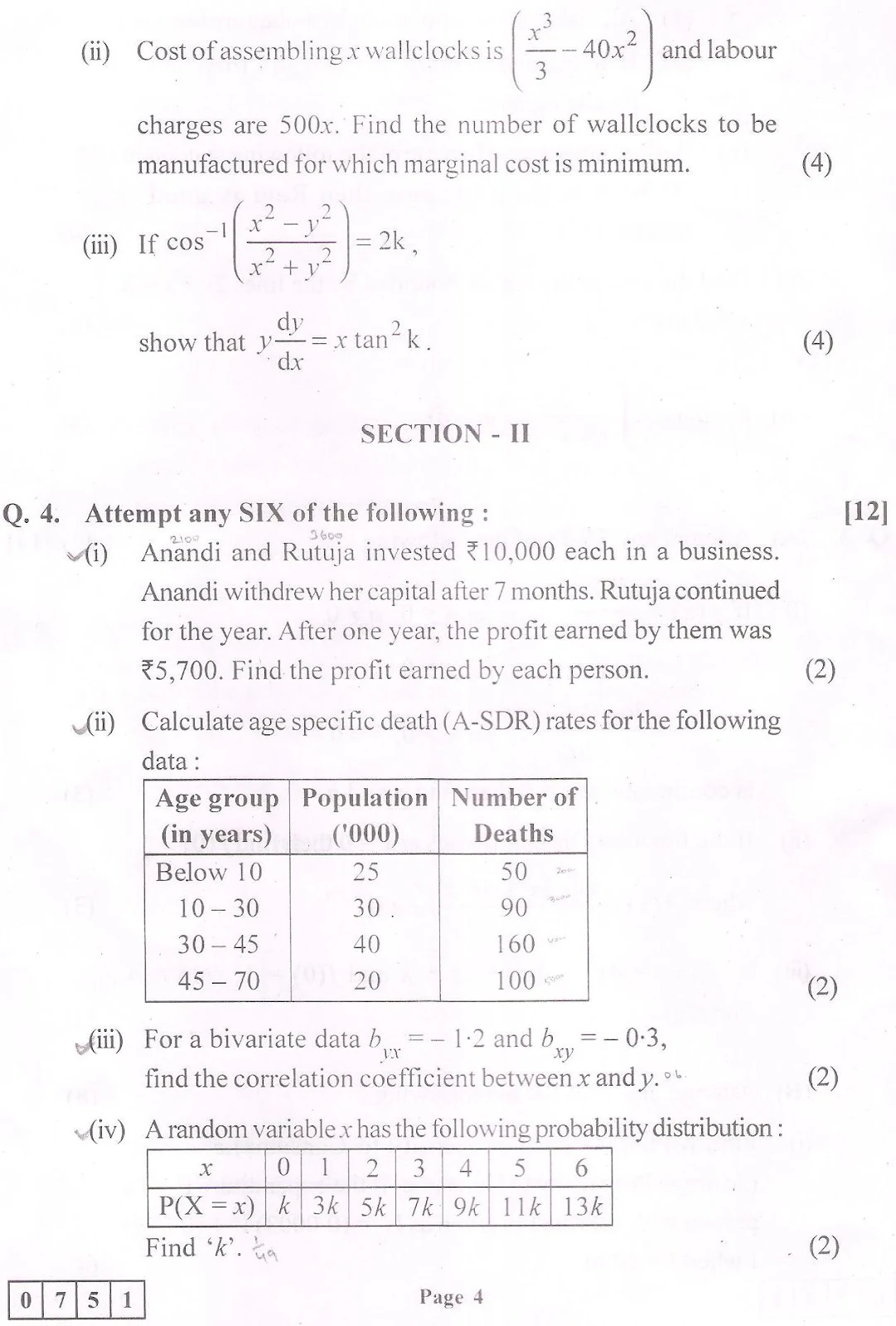
Total Cost \( C = \text{Assembly Cost} + \text{Labour Cost} \)
$$C = \frac{x^3}{3} - 40x^2 + 500x$$
Marginal Cost \( MC = \frac{dC}{dx} \):
$$MC = x^2 - 80x + 500$$
To minimize MC, differentiate it w.r.t x and equate to 0:
$$\frac{d(MC)}{dx} = 2x - 80$$
$$2x - 80 = 0 \implies 2x = 80 \implies x = 40$$
Check second derivative: \( \frac{d^2(MC)}{dx^2} = 2 > 0 \) (Minimum).
$$\frac{x^2 - y^2}{x^2 + y^2} = \cos 2k$$
By Componendo and Dividendo:
$$\frac{(x^2 - y^2) + (x^2 + y^2)}{(x^2 - y^2) - (x^2 + y^2)} = \frac{\cos 2k + 1}{\cos 2k - 1}$$
$$\frac{2x^2}{-2y^2} = \frac{1 + \cos 2k}{-(1 - \cos 2k)}$$
$$\frac{-x^2}{y^2} = \frac{2\cos^2 k}{-2\sin^2 k}$$
$$\frac{x^2}{y^2} = \cot^2 k$$
Taking square root (considering magnitudes):
$$\frac{x}{y} = \cot k$$
$$y = x \tan k$$
Differentiating w.r.t x:
$$\frac{dy}{dx} = \tan k$$
Multiply both sides by y:
$$y \frac{dy}{dx} = y \tan k$$
Substitute \( y = x \tan k \) on RHS:
$$y \frac{dy}{dx} = (x \tan k) \tan k$$

Please send me the solution of this paper..
ReplyDeleteThank you very much!
niveviyer01@Gmail.com
did you get the solution
DeleteSend the solution of this paper
Deleteplease send me pdf of march 2018,2017,2016 maths solutions
ReplyDeleteYeah plz
ReplyDeleteSnd me solution of this paper plzzz
ReplyDelete@abdullamj02@gmail.com
Plz send me solutions of this paper
ReplyDeletePlease send solution of all maths paper
ReplyDeleteSend solutions for maths 2 for march2016, July 2017 and October 2015 on email id rajseewarang@gmail.com
ReplyDeleteSolution
ReplyDeleteSend solution for maths2 march 2016-17 hsc commerce
ReplyDeleteSend solution 2016 -17-18
DeleteFor. rashmitilekar@gmail.com
DeletePlzzz send mee this paper solution and march2016 and March 2017
ReplyDeleteSend commerce maths march2016 solution on
ReplyDeletePriyajais1001@gmail.com
Did u get it?
DeleteCan i get solution for march 16, maths
ReplyDeletePlzzz send mee this paper solution and march2016 and March 2017
ReplyDeletePlease send me solution of march 2016 maths commerce
ReplyDeleteSend Mai solution of 2016 2017 plzz
ReplyDeleteSend me solution
ReplyDeleteSend me soln if march 2016 soln
ReplyDeletePls send me solution of this paper on
ReplyDeleteosurve98@gmail.com
Plssssss can anyone help me
ReplyDeletePlease send me solution of march 2016 maths commerce
ReplyDeletePls send me tha solution on shubhamgk1450@gmail.com
ReplyDeletePlease send me solution of maths question paper of 2016 2017 2018 of both months
ReplyDeletePlease send me solution of maths question paper of March 2015 2016,2017,2018
ReplyDeleteCan i get mathsjuly 2019 question paper with solutions
ReplyDeleteSend me on priyathesia54@gmail.com
ReplyDeletePlzzzzzz sent the answers
ReplyDeleteDamnnn where's the solutionnnnn
ReplyDeleteGive me solution for all maths papers of boards
ReplyDeleteGive me the solution of this paper
ReplyDeleteplz send me the solutions to maths paper 16,17,18 to email id ps91520009@gmail.com
ReplyDeletePlz send d solution of maths commerce...march 2016 on akashpoojari50@gmail.com
ReplyDeleteWhen we get solutions
ReplyDeletePlz share the solution sir
ReplyDeletePlz send the solution of this paper
ReplyDeleteSend the solution
ReplyDeleteSolution please
ReplyDeleteyashmetrani96@gmail.com
OMTEX MADARCHOD
ReplyDeleteGalat batate ho tumlog sale
ReplyDeletePs: 1+1=7
Sorry 1+1=11
ReplyDeleteAnd now I'm gonna fail🙆🏻♂️
ReplyDeleteThis is not fair na☹️
ReplyDeleteMy friend also fail in maths now ☹️ vo to SP wala tha fir BHI🙆🏻♂️
ReplyDeleteAnd ronak tooo
ReplyDeleteMadhrchod mera naam kyu???
ReplyDeleteNahi Tu chutiya Tu fail
ReplyDeleteFor 2020 maths paper call me
ReplyDelete+917900136173
And can also call us on.
Delete+919699486512
+918104753346
For any paid service for boys call on.
ReplyDelete+918104753346
+919699486512