

Maharashtra Board Question Paper: March 2016
Subject: Mathematics & Statistics (Commerce) - Paper I
Time: 1 Hr 30 Min | Marks: 40
Section - I
Q.1. Attempt any SIX of the following: (12 Marks)
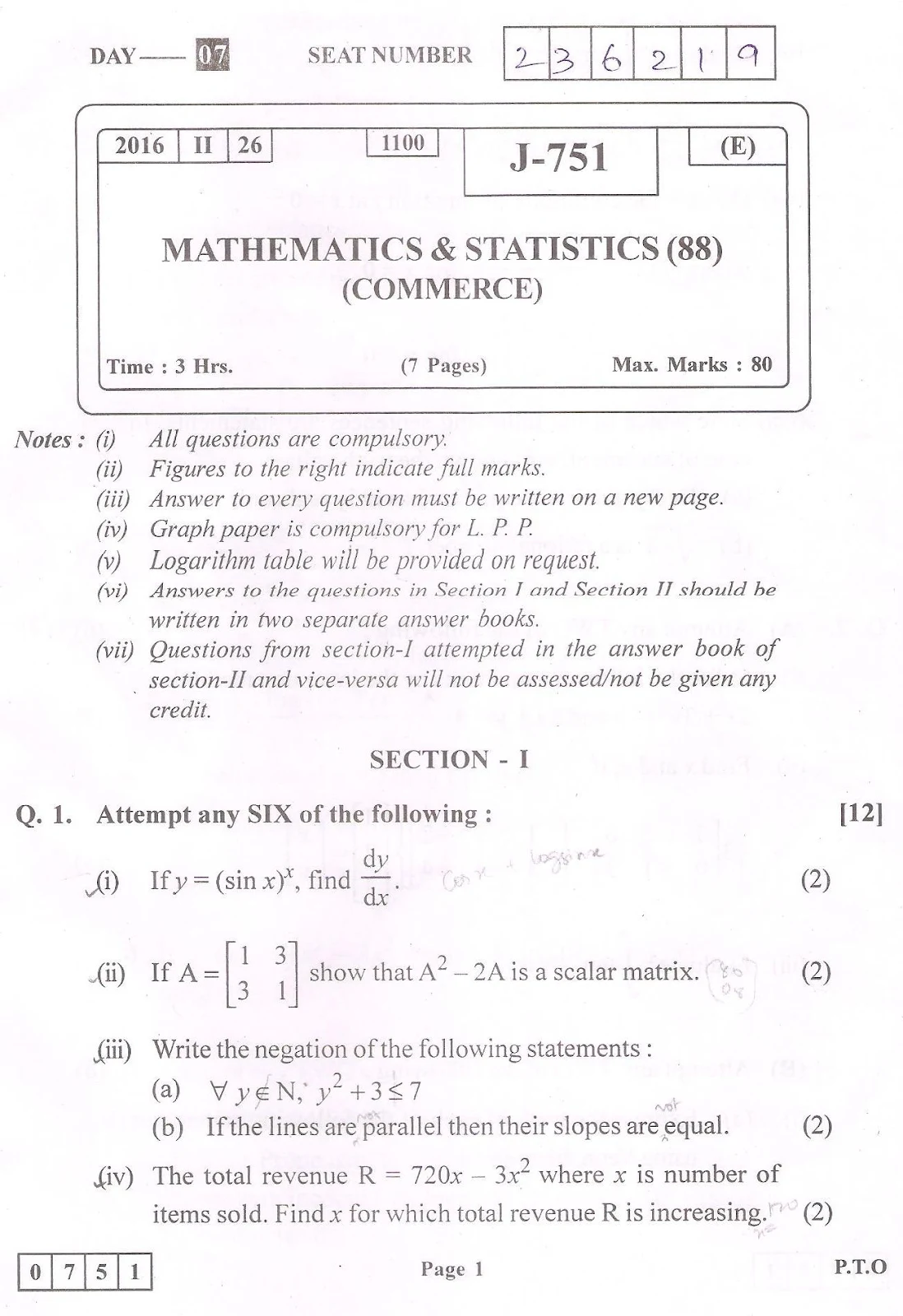
Given \( y = (\sin x)^x \)
Taking logarithm on both sides:
$$\log y = \log (\sin x)^x$$
$$\log y = x \cdot \log(\sin x)$$
Differentiating with respect to x:
$$\frac{1}{y} \frac{dy}{dx} = x \cdot \frac{d}{dx}[\log(\sin x)] + \log(\sin x) \cdot \frac{d}{dx}[x]$$
$$\frac{1}{y} \frac{dy}{dx} = x \cdot \frac{1}{\sin x} \cdot \cos x + \log(\sin x) \cdot 1$$
$$\frac{dy}{dx} = y [x \cot x + \log(\sin x)]$$
First, find \( A^2 \):
$$A^2 = A \cdot A = \begin{bmatrix}1 & 3 \\ 3 & 1\end{bmatrix} \begin{bmatrix}1 & 3 \\ 3 & 1\end{bmatrix}$$
$$= \begin{bmatrix} 1(1)+3(3) & 1(3)+3(1) \\ 3(1)+1(3) & 3(3)+1(1) \end{bmatrix} = \begin{bmatrix} 10 & 6 \\ 6 & 10 \end{bmatrix}$$
Now find \( 2A \):
$$2A = 2 \begin{bmatrix}1 & 3 \\ 3 & 1\end{bmatrix} = \begin{bmatrix}2 & 6 \\ 6 & 2\end{bmatrix}$$
Compute \( A^2 - 2A \):
$$\begin{bmatrix} 10 & 6 \\ 6 & 10 \end{bmatrix} - \begin{bmatrix}2 & 6 \\ 6 & 2\end{bmatrix} = \begin{bmatrix} 8 & 0 \\ 0 & 8 \end{bmatrix}$$
Since the non-diagonal elements are zero and diagonal elements are equal, it is a scalar matrix.
(a) \( \forall y \in N, y^2 + 3 \le 7 \)
(b) If the lines are parallel then their slopes are equal.
(a) The negation of a universal quantifier (\( \forall \)) is an existential quantifier (\( \exists \)), and the inequality is reversed.
(b) Let \( p \): The lines are parallel.
Let \( q \): Their slopes are equal.
Given statement is \( p \rightarrow q \).
Negation is \( p \land \sim q \).
Given \( R = 720x - 3x^2 \)
Differentiating w.r.t x:
$$\frac{dR}{dx} = 720 - 6x$$
For R to be increasing, \( \frac{dR}{dx} > 0 \).
$$720 - 6x > 0$$
$$720 > 6x$$
$$120 > x \implies x < 120$$
Since the number of items cannot be negative:
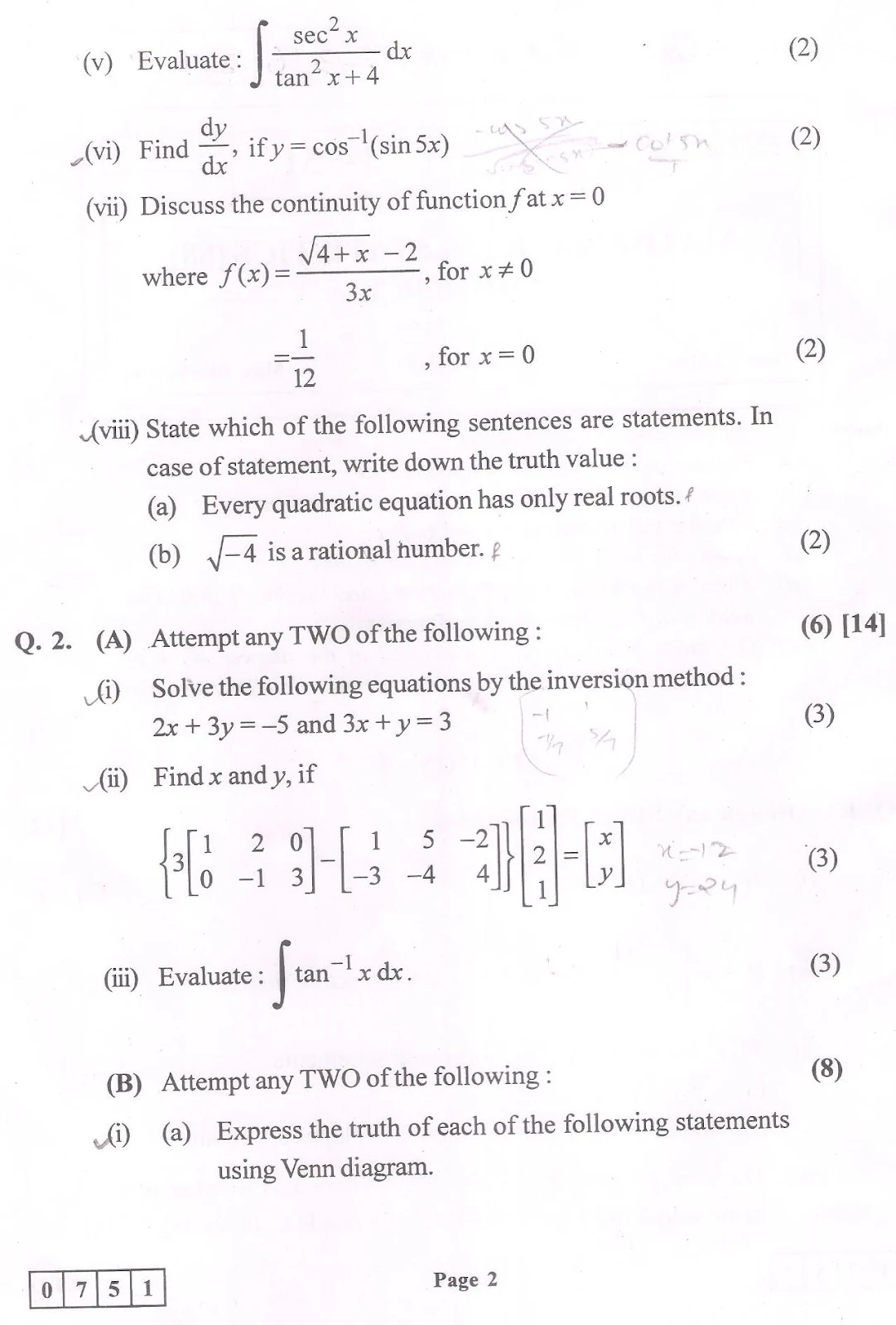
Let \( I = \int \frac{\sec^2 x}{\tan^2 x + 4} dx \)
Put \( \tan x = t \), then \( \sec^2 x dx = dt \).
$$I = \int \frac{1}{t^2 + 4} dt = \int \frac{1}{t^2 + 2^2} dt$$
Using formula \( \int \frac{1}{x^2+a^2}dx = \frac{1}{a}\tan^{-1}(\frac{x}{a}) + c \):
$$I = \frac{1}{2} \tan^{-1}\left(\frac{t}{2}\right) + c$$
Note: Question paper says \( \frac{dy}{dr} \), assuming typo for \( \frac{dy}{dx} \).
$$y = \cos^{-1}(\sin 5x)$$
We know that \( \sin \theta = \cos(\frac{\pi}{2} - \theta) \).
$$y = \cos^{-1}\left[ \cos\left(\frac{\pi}{2} - 5x\right) \right]$$
$$y = \frac{\pi}{2} - 5x$$
Differentiating w.r.t x:
\( f(x) = \frac{\sqrt{4+x}-2}{3x} \), for \( x \ne 0 \)
\( f(x) = \frac{1}{12} \), for \( x = 0 \)
Given \( f(0) = \frac{1}{12} \)
Evaluate limit at \( x \to 0 \):
$$\lim_{x \to 0} f(x) = \lim_{x \to 0} \frac{\sqrt{4+x}-2}{3x}$$
Rationalize the numerator:
$$= \lim_{x \to 0} \frac{\sqrt{4+x}-2}{3x} \times \frac{\sqrt{4+x}+2}{\sqrt{4+x}+2}$$
$$= \lim_{x \to 0} \frac{(4+x)-4}{3x(\sqrt{4+x}+2)} = \lim_{x \to 0} \frac{x}{3x(\sqrt{4+x}+2)}$$
$$= \lim_{x \to 0} \frac{1}{3(\sqrt{4+x}+2)} = \frac{1}{3(\sqrt{4+0}+2)}$$
$$= \frac{1}{3(2+2)} = \frac{1}{12}$$
Since \( \lim_{x \to 0} f(x) = f(0) = \frac{1}{12} \), the function is continuous at \( x=0 \).
(a) Every quadratic equation has only real roots.
(b) \( \sqrt{-4} \) is a rational number.
(a) It is a statement. Truth Value: False (F) (Quadratic equations can have complex roots).
(b) It is a statement. Truth Value: False (F) (\( \sqrt{-4} = 2i \), which is an imaginary number, not rational).
Q.2. (A) Attempt any TWO of the following: (6 Marks)
\( 2x + 3y = -5 \) and \( 3x + y = 3 \)
Matrix form \( AX = B \):
$$\begin{bmatrix} 2 & 3 \\ 3 & 1 \end{bmatrix} \begin{bmatrix} x \\ y \end{bmatrix} = \begin{bmatrix} -5 \\ 3 \end{bmatrix}$$
Determinant \( |A| = (2)(1) - (3)(3) = 2 - 9 = -7 \ne 0 \). Hence \( A^{-1} \) exists.
Adjoint of A for \( 2 \times 2 \) matrix: Swap diagonal, change signs of off-diagonal.
$$Adj A = \begin{bmatrix} 1 & -3 \\ -3 & 2 \end{bmatrix}$$
$$A^{-1} = \frac{1}{|A|} Adj A = \frac{-1}{7} \begin{bmatrix} 1 & -3 \\ -3 & 2 \end{bmatrix}$$
Using \( X = A^{-1}B \):
$$\begin{bmatrix} x \\ y \end{bmatrix} = \frac{-1}{7} \begin{bmatrix} 1 & -3 \\ -3 & 2 \end{bmatrix} \begin{bmatrix} -5 \\ 3 \end{bmatrix}$$
$$= \frac{-1}{7} \begin{bmatrix} (1)(-5) + (-3)(3) \\ (-3)(-5) + (2)(3) \end{bmatrix}$$
$$= \frac{-1}{7} \begin{bmatrix} -5 - 9 \\ 15 + 6 \end{bmatrix} = \frac{-1}{7} \begin{bmatrix} -14 \\ 21 \end{bmatrix}$$
$$= \begin{bmatrix} 2 \\ -3 \end{bmatrix}$$
Let's simplify the term inside the curly braces first:
$$3\begin{bmatrix}1 & 2 & 0 \\ 0 & -1 & 3\end{bmatrix} = \begin{bmatrix}3 & 6 & 0 \\ 0 & -3 & 9\end{bmatrix}$$
Subtracting the second matrix:
$$\begin{bmatrix}3 & 6 & 0 \\ 0 & -3 & 9\end{bmatrix} - \begin{bmatrix}1 & 5 & -2 \\ -3 & -4 & 4\end{bmatrix} = \begin{bmatrix} 2 & 1 & 2 \\ 3 & 1 & 5 \end{bmatrix}$$
Now multiply by the column matrix:
$$\begin{bmatrix} 2 & 1 & 2 \\ 3 & 1 & 5 \end{bmatrix} \begin{bmatrix}1 \\ 2 \\ 1\end{bmatrix} = \begin{bmatrix}x \\ y\end{bmatrix}$$
$$\begin{bmatrix} 2(1) + 1(2) + 2(1) \\ 3(1) + 1(2) + 5(1) \end{bmatrix} = \begin{bmatrix}x \\ y\end{bmatrix}$$
$$\begin{bmatrix} 2 + 2 + 2 \\ 3 + 2 + 5 \end{bmatrix} = \begin{bmatrix}x \\ y\end{bmatrix}$$
$$\begin{bmatrix} 6 \\ 10 \end{bmatrix} = \begin{bmatrix}x \\ y\end{bmatrix}$$
Use Integration by Parts. Let \( u = \tan^{-1}x \) and \( v = 1 \).
$$\int u v dx = u \int v dx - \int (\frac{du}{dx} \int v dx) dx$$
$$= \tan^{-1}x \cdot x - \int \frac{1}{1+x^2} \cdot x dx$$
$$= x \tan^{-1}x - \frac{1}{2} \int \frac{2x}{1+x^2} dx$$
Using \( \int \frac{f'(x)}{f(x)}dx = \log|f(x)| \):
Q.2. (B) Attempt any TWO of the following: (8 Marks)
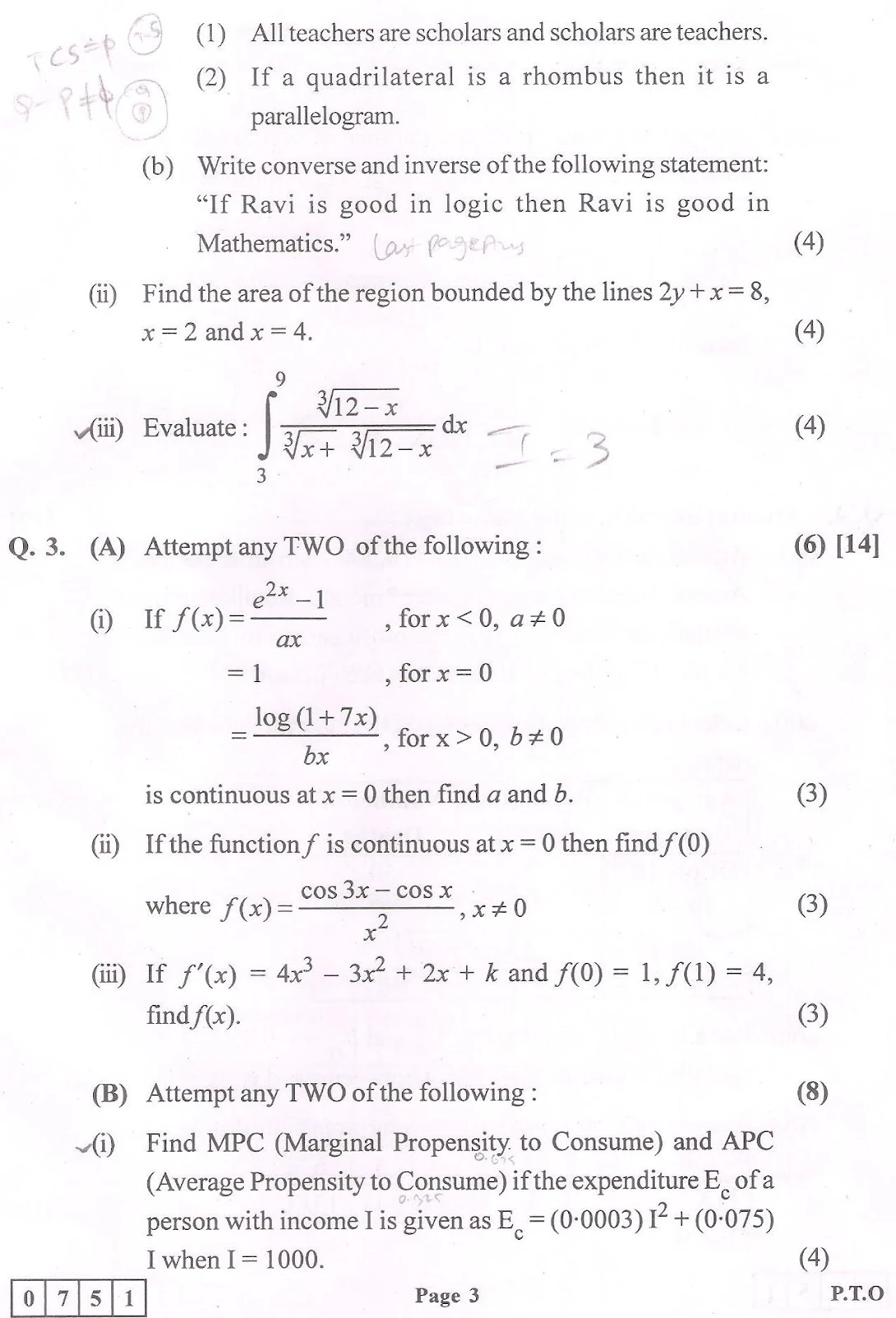
(1) All teachers are scholars and scholars are teachers.
(2) If a quadrilateral is a rhombus then it is a parallelogram.
(b) Write converse and inverse of the following statement:
"If Ravi is good in logic then Ravi is good in Mathematics."
(a) Venn Diagrams:
- (1) Since all teachers are scholars AND all scholars are teachers, the set of Teachers (T) and Scholars (S) are identical. Diagram: A single circle labelled T=S within the Universal set U.
- (2) All rhombuses are parallelograms. Diagram: A circle for Rhombus (R) completely inside a larger circle for Parallelogram (P), within Universal set U.
(b) Logic:
Let \( p \): Ravi is good in Logic.
Let \( q \): Ravi is good in Mathematics.
Given: \( p \rightarrow q \).
Converse (\( q \rightarrow p \)): If Ravi is good in Mathematics then Ravi is good in logic.
Inverse (\( \sim p \rightarrow \sim q \)): If Ravi is not good in logic then Ravi is not good in Mathematics.
Equation of line: \( 2y = 8 - x \implies y = \frac{8-x}{2} \).
Area \( A = \int_{a}^{b} y dx \)
Limits are \( x=2 \) to \( x=4 \).
$$A = \int_{2}^{4} \frac{8-x}{2} dx = \frac{1}{2} \left[ 8x - \frac{x^2}{2} \right]_2^4$$
$$= \frac{1}{2} \left[ (32 - \frac{16}{2}) - (16 - \frac{4}{2}) \right]$$
$$= \frac{1}{2} \left[ (32 - 8) - (16 - 2) \right]$$
$$= \frac{1}{2} [ 24 - 14 ] = \frac{1}{2} [ 10 ] = 5$$
Note: The limits of integration are missing in the source. Assuming limits \( a \) and \( b \) such that \( a+b=12 \) (e.g., 4 to 8) for the standard property to apply.
Let \( I = \int_a^b \frac{\sqrt[3]{12-x}}{\sqrt[3]{x}+\sqrt[3]{12-x}} dx \) ... (1)
Using property \( \int_a^b f(x)dx = \int_a^b f(a+b-x)dx \):
Here \( a+b = 12 \). Replace \( x \) with \( 12-x \).
$$I = \int_a^b \frac{\sqrt[3]{12-(12-x)}}{\sqrt[3]{12-x}+\sqrt[3]{12-(12-x)}} dx$$
$$I = \int_a^b \frac{\sqrt[3]{x}}{\sqrt[3]{12-x}+\sqrt[3]{x}} dx$$ ... (2)
Adding (1) and (2):
$$2I = \int_a^b \frac{\sqrt[3]{12-x} + \sqrt[3]{x}}{\sqrt[3]{x}+\sqrt[3]{12-x}} dx$$
$$2I = \int_a^b 1 dx = [x]_a^b = b-a$$
$$I = \frac{b-a}{2}$$
Q.3. (A) Attempt any TWO of the following: (6 Marks)
Since f is continuous at x=0, \( \lim_{x \to 0^-} f(x) = f(0) = \lim_{x \to 0^+} f(x) \).
Left Hand Limit (x < 0):
$$\lim_{x \to 0} \frac{e^{2x}-1}{ax} = \frac{1}{a} \lim_{x \to 0} \frac{e^{2x}-1}{2x} \cdot 2$$
$$= \frac{2}{a} (1) = \frac{2}{a}$$
Given \( f(0) = 1 \), so \( \frac{2}{a} = 1 \implies a = 2 \).
Right Hand Limit (x > 0):
$$\lim_{x \to 0} \frac{\log(1+7x)}{bx} = \frac{1}{b} \lim_{x \to 0} \frac{\log(1+7x)}{7x} \cdot 7$$
$$= \frac{7}{b} (1) = \frac{7}{b}$$
Given \( f(0) = 1 \), so \( \frac{7}{b} = 1 \implies b = 7 \).
If f is continuous, \( f(0) = \lim_{x \to 0} f(x) \).
$$\lim_{x \to 0} \frac{\cos 3x - \cos x}{x^2}$$
Use formula \( \cos C - \cos D = -2\sin(\frac{C+D}{2})\sin(\frac{C-D}{2}) \):
$$= \lim_{x \to 0} \frac{-2\sin(\frac{3x+x}{2})\sin(\frac{3x-x}{2})}{x^2}$$
$$= -2 \lim_{x \to 0} \frac{\sin(2x) \sin(x)}{x \cdot x}$$
$$= -2 [\lim_{x \to 0} \frac{\sin 2x}{2x} \cdot 2] [\lim_{x \to 0} \frac{\sin x}{x}]$$
$$= -2 [1 \cdot 2] [1] = -4$$
Integrate \( f'(x) \) to find \( f(x) \):
$$f(x) = \int (4x^3 - 3x^2 + 2x + k) dx$$
$$f(x) = 4\frac{x^4}{4} - 3\frac{x^3}{3} + 2\frac{x^2}{2} + kx + c$$
$$f(x) = x^4 - x^3 + x^2 + kx + c$$
Using \( f(0) = 1 \):
$$0 - 0 + 0 + 0 + c = 1 \implies c = 1$$
Using \( f(1) = 4 \) and \( c = 1 \):
$$(1)^4 - (1)^3 + (1)^2 + k(1) + 1 = 4$$
$$1 - 1 + 1 + k + 1 = 4 \implies 2 + k = 4 \implies k = 2$$
Q.3. (B) Attempt any TWO of the following: (8 Marks)
1. APC (Average Propensity to Consume):
$$APC = \frac{E_c}{I} = \frac{0.0003I^2 + 0.075I}{I} = 0.0003I + 0.075$$
At \( I = 1000 \):
$$APC = 0.0003(1000) + 0.075 = 0.3 + 0.075 = 0.375$$
2. MPC (Marginal Propensity to Consume):
$$MPC = \frac{dE_c}{dI} = \frac{d}{dI}(0.0003I^2 + 0.075I)$$
$$MPC = 0.0006I + 0.075$$
At \( I = 1000 \):
$$MPC = 0.0006(1000) + 0.075 = 0.6 + 0.075 = 0.675$$
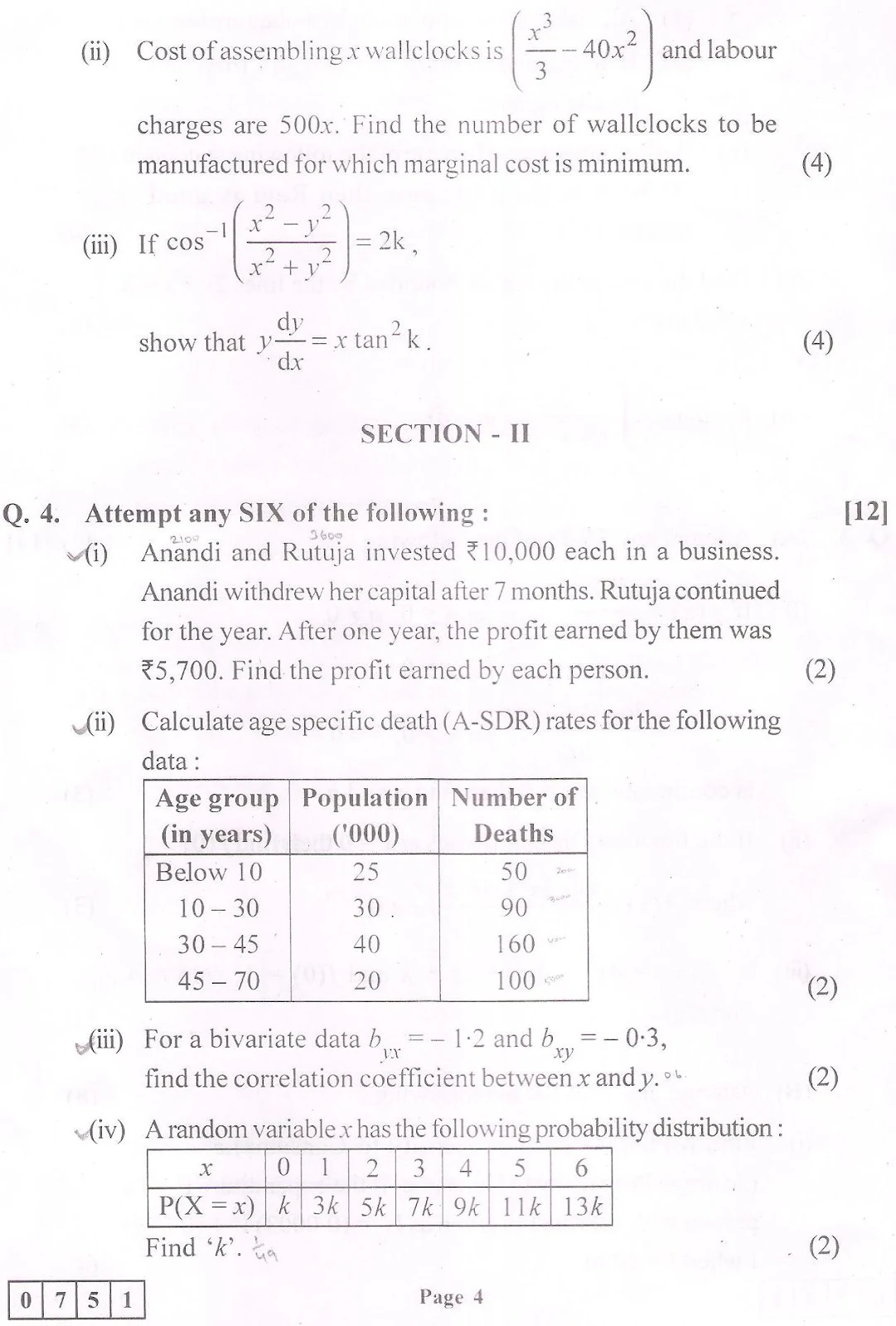
Total Cost \( C = \text{Assembly Cost} + \text{Labour Cost} \)
$$C = \frac{x^3}{3} - 40x^2 + 500x$$
Marginal Cost \( MC = \frac{dC}{dx} \):
$$MC = x^2 - 80x + 500$$
To minimize MC, differentiate it w.r.t x and equate to 0:
$$\frac{d(MC)}{dx} = 2x - 80$$
$$2x - 80 = 0 \implies 2x = 80 \implies x = 40$$
Check second derivative: \( \frac{d^2(MC)}{dx^2} = 2 > 0 \) (Minimum).
$$\frac{x^2 - y^2}{x^2 + y^2} = \cos 2k$$
By Componendo and Dividendo:
$$\frac{(x^2 - y^2) + (x^2 + y^2)}{(x^2 - y^2) - (x^2 + y^2)} = \frac{\cos 2k + 1}{\cos 2k - 1}$$
$$\frac{2x^2}{-2y^2} = \frac{1 + \cos 2k}{-(1 - \cos 2k)}$$
$$\frac{-x^2}{y^2} = \frac{2\cos^2 k}{-2\sin^2 k}$$
$$\frac{x^2}{y^2} = \cot^2 k$$
Taking square root (considering magnitudes):
$$\frac{x}{y} = \cot k$$
$$y = x \tan k$$
Differentiating w.r.t x:
$$\frac{dy}{dx} = \tan k$$
Multiply both sides by y:
$$y \frac{dy}{dx} = y \tan k$$
Substitute \( y = x \tan k \) on RHS:
$$y \frac{dy}{dx} = (x \tan k) \tan k$$