Construction Problem
Geometric Drawing Challenge
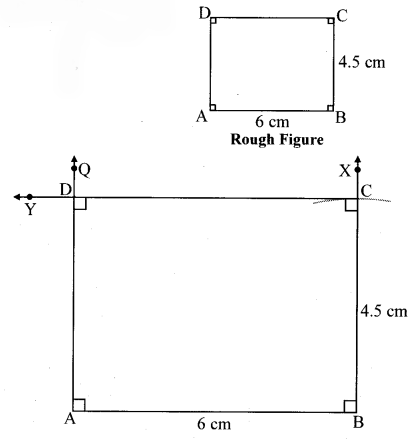
Draw a rectangle ABCD such that l(AB) = 6.0 cm and l(BC) = 4.5 cm.
Solution: Steps of Construction
- Draw a line segment AB of length 6 cm.
- At point B, construct a ray BX such that the angle ∠ABX is a right angle (90º).
- With B as the centre and a radius of 4.5 cm, draw an arc that intersects the ray BX. Name this point C.
- With C as the centre and a radius equal to the length of AB (6 cm), draw an arc.
- With A as the centre and a radius equal to the length of BC (4.5 cm), draw another arc that intersects the arc from the previous step. Name this point D.
- Join the points A to D and C to D to complete the figure.
Glossary of Terms
Rectangle
A quadrilateral (a four-sided shape) where all four internal angles are right angles (90°). Opposite sides are equal in length.
Notation: l(AB)
This is a standard mathematical notation that means "the length of the line segment between point A and point B".
Notation: ∠ABX
This notation describes an angle. The middle letter (B) is the vertex, or the corner point of the angle. The angle is formed by the line segments AB and BX.
Ray
A part of a line that has a fixed starting point but extends infinitely in one direction. In this construction, BX is a ray starting at B.
Arc
A portion of the circumference (the curved edge) of a circle. Arcs are used in geometric constructions to measure and transfer distances.
Radius
The distance from the center of a circle to any point on its circumference. When drawing an arc, the radius is the distance set on the compass.