Board Question Paper: March 2017 - Algebra
Time: 2 Hours
Max. Marks: 40
Note:
- All questions are compulsory.
- Use of calculator is not allowed.
Q. 1. Attempt any five of the following subquestions: [5]
i.
State whether the following sequence is an Arithmetic Progression or not:
$$3, 6, 12, 24, \dots$$
ii.
There are 15 tickets bearing the numbers from 1 to 15 in a bag and one ticket is drawn from this bag at random. Write the sample space (S) and \(n(S)\).
iii.
If one root of the quadratic equation is \(3-2\sqrt{5}\), then write another root of the equation.
iv.
Find the class mark of the class 35-39.
v.
Write the next two terms of A.P. whose first term is 3 and the common difference is 4.
vi.
Find the values of \(a, b, c\) for the quadratic equation \(2x^{2}=x+3\) by comparing with standard form \(ax^{2}+bx+c=0\).
Q. 2. Attempt any four of the following subquestions: [8]
i.
Find the first two terms of the sequence for which \(S_{n}\) is given below:
$$S_{n}=n^{2}(n+1)$$
ii.
Find the value of discriminant (\(\Delta\)) for the quadratic equation:
$$x^{2}+7x+6=0$$
iii.
Write the equation of X-axis. Hence, find the point of intersection of the graph of the equation \(x+y=5\) with the X-axis.
iv.
For a certain frequency distribution, the values of Assumed mean \((A)=1300\), \(\Sigma f_{i}d_{i}=900\) and \(\Sigma f_{i}=100\). Find the value of mean (\(\bar{x}\)).
v.
Two coins are tossed simultaneously. Write the sample space (S), \(n(S)\), the following event A using set notation and \(n(A)\) where 'A is the event of getting at least one head.'
vi.
Find the value of \(k\) for which the given simultaneous equations have infinitely many solutions:
$$kx+4y=10$$
$$3x+2y=5$$
Q. 3. Attempt any three of the following subquestions: [9]
i.
How many three digit natural numbers are divisible by 5?
ii.
Solve the following quadratic equation by factorization method:
$$3x^{2}-29x+40=0$$
iii.
Solve the following simultaneous equations by using Cramer's rule:
$$3x-y=7$$
$$x+4y=11$$
iv.
Two dice are thrown. Find the probability of the event that the product of numbers on their upper faces is 12.
v.
The following is the frequency distribution of waiting time at ATM centre; draw histogram to represent the data:
| Waiting time (in seconds) | Number of Customers |
|---|---|
| 0-30 | 15 |
| 30-60 | 23 |
| 60-90 | 64 |
| 90-120 | 50 |
| 120-150 | 5 |
Q. 4. Attempt any two of the following subquestions: [8]
i.
Three horses A, B and C are in a race, A is twice as likely to win as B and B is twice as likely to win as C. What are their probabilities of winning?
ii.
The following is the distribution of the size of certain farms from a taluka (tehasil):
Find median size of farms.
| Size of Farms (in acres) | Number of Farms |
|---|---|
| 5-15 | 7 |
| 15-25 | 12 |
| 25-35 | 17 |
| 35-45 | 25 |
| 45-55 | 31 |
| 55-65 | 5 |
| 65-75 | 3 |
iii.
The following pie diagram represents the sectorwise loan amount in crores of rupees distributed by a bank. From the information answer the following questions:
Agriculture
\(120^{\circ}\)
\(120^{\circ}\)
Dairy
\(40^{\circ}\)
\(40^{\circ}\)
Industry
(Remaining)
(Remaining)
- If the dairy sector receives 20 crores, then find the total loan disbursed.
- Find the loan amount for agriculture sector and also for industrial sector.
- How much additional amount did industrial sector receive than agriculture sector?
Q. 5. Attempt any two of the following subquestions: [10]
i.
If the cost of bananas is increased by ₹10 per dozen, one can get 3 dozen less for ₹600. Find the original cost of one dozen of bananas.
ii.
If the sum of first \(p\) terms of an A.P. is equal to the sum of first \(q\) terms, then show that the sum of its first \((p+q)\) terms is zero where \(p \neq q\).
iii.
Solve the following simultaneous equations:
$$\frac{1}{3x}-\frac{1}{4y}+1=0$$
$$\frac{1}{5x}+\frac{1}{2y}=\frac{4}{15}$$
Solutions & Answer Key
Solution Q.1
i. Sequence check:
Sequence: 3, 6, 12, 24...
Here, \(t_2/t_1 = 6/3 = 2\) and \(t_3/t_2 = 12/6 = 2\).
The ratio of consecutive terms is constant (Geometric Progression), but the difference (\(t_2-t_1 \neq t_3-t_2\)) is not constant.
Ans: The given sequence is NOT an Arithmetic Progression.
Sequence: 3, 6, 12, 24...
Here, \(t_2/t_1 = 6/3 = 2\) and \(t_3/t_2 = 12/6 = 2\).
The ratio of consecutive terms is constant (Geometric Progression), but the difference (\(t_2-t_1 \neq t_3-t_2\)) is not constant.
Ans: The given sequence is NOT an Arithmetic Progression.
ii. Sample Space:
Tickets are numbered 1 to 15.
\(S = \{1, 2, 3, 4, 5, 6, 7, 8, 9, 10, 11, 12, 13, 14, 15\}\)
Ans: \(n(S) = 15\)
Tickets are numbered 1 to 15.
\(S = \{1, 2, 3, 4, 5, 6, 7, 8, 9, 10, 11, 12, 13, 14, 15\}\)
Ans: \(n(S) = 15\)
iii. Quadratic Roots:
Irrational roots occur in conjugate pairs.
Given root: \(3-2\sqrt{5}\)
Ans: The other root is \(3+2\sqrt{5}\).
Irrational roots occur in conjugate pairs.
Given root: \(3-2\sqrt{5}\)
Ans: The other root is \(3+2\sqrt{5}\).
iv. Class Mark:
Class: 35-39
Class Mark = \(\frac{\text{Lower Limit} + \text{Upper Limit}}{2}\)
\( = \frac{35+39}{2} = \frac{74}{2} = 37\)
Ans: 37
Class: 35-39
Class Mark = \(\frac{\text{Lower Limit} + \text{Upper Limit}}{2}\)
\( = \frac{35+39}{2} = \frac{74}{2} = 37\)
Ans: 37
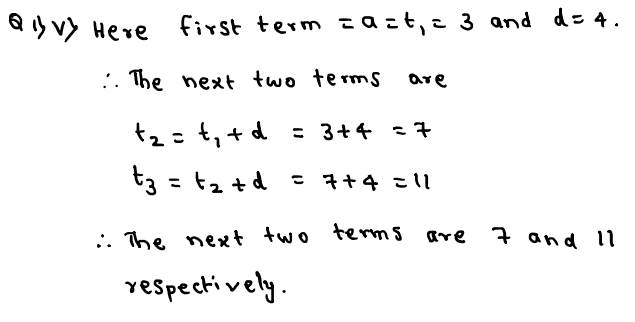
v. A.P. Terms:
\(a = 3, d = 4\)
First term \(t_1 = 3\)
\(t_2 = t_1 + d = 3 + 4 = 7\)
\(t_3 = t_2 + d = 7 + 4 = 11\)
Ans: The next two terms are 7 and 11.
\(a = 3, d = 4\)
First term \(t_1 = 3\)
\(t_2 = t_1 + d = 3 + 4 = 7\)
\(t_3 = t_2 + d = 7 + 4 = 11\)
Ans: The next two terms are 7 and 11.
vi. Standard Form:
Equation: \(2x^2 = x + 3\)
Standard form: \(2x^2 - x - 3 = 0\)
Comparing with \(ax^2+bx+c=0\):
Ans: \(a=2, b=-1, c=-3\)
Equation: \(2x^2 = x + 3\)
Standard form: \(2x^2 - x - 3 = 0\)
Comparing with \(ax^2+bx+c=0\):
Ans: \(a=2, b=-1, c=-3\)
Solution Q.2
i. Sequence from \(S_n\):
Given \(S_n = n^2(n+1)\)
For \(n=1\): \(S_1 = 1^2(1+1) = 2\). So, \(t_1 = 2\).
For \(n=2\): \(S_2 = 2^2(2+1) = 4(3) = 12\).
We know \(t_2 = S_2 - S_1 = 12 - 2 = 10\).
Ans: The first two terms are 2 and 10.
Given \(S_n = n^2(n+1)\)
For \(n=1\): \(S_1 = 1^2(1+1) = 2\). So, \(t_1 = 2\).
For \(n=2\): \(S_2 = 2^2(2+1) = 4(3) = 12\).
We know \(t_2 = S_2 - S_1 = 12 - 2 = 10\).
Ans: The first two terms are 2 and 10.
ii. Discriminant (\(\Delta\)):
\(x^2 + 7x + 6 = 0\)
Here \(a=1, b=7, c=6\).
\(\Delta = b^2 - 4ac\)
\(\Delta = (7)^2 - 4(1)(6) = 49 - 24\)
Ans: \(\Delta = 25\)
\(x^2 + 7x + 6 = 0\)
Here \(a=1, b=7, c=6\).
\(\Delta = b^2 - 4ac\)
\(\Delta = (7)^2 - 4(1)(6) = 49 - 24\)
Ans: \(\Delta = 25\)
iii. X-axis intersection:
The equation of the X-axis is \(y=0\).
Put \(y=0\) in \(x+y=5\):
\(x+0=5 \Rightarrow x=5\).
Ans: Equation of X-axis is \(y=0\). Point of intersection is \((5, 0)\).
The equation of the X-axis is \(y=0\).
Put \(y=0\) in \(x+y=5\):
\(x+0=5 \Rightarrow x=5\).
Ans: Equation of X-axis is \(y=0\). Point of intersection is \((5, 0)\).
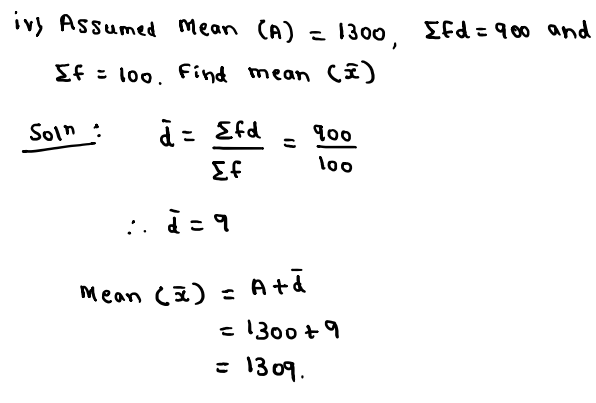
iv. Mean Calculation:
\(\bar{d} = \frac{\Sigma f_id_i}{\Sigma f_i} = \frac{900}{100} = 9\)
Mean \(\bar{x} = A + \bar{d} = 1300 + 9\)
Ans: Mean \(\bar{x} = 1309\)
\(\bar{d} = \frac{\Sigma f_id_i}{\Sigma f_i} = \frac{900}{100} = 9\)
Mean \(\bar{x} = A + \bar{d} = 1300 + 9\)
Ans: Mean \(\bar{x} = 1309\)
v. Probability (Two Coins):
\(S = \{HH, HT, TH, TT\}\), \(n(S) = 4\).
Event A: At least one head.
\(A = \{HH, HT, TH\}\)
Ans: \(n(A) = 3\)
\(S = \{HH, HT, TH, TT\}\), \(n(S) = 4\).
Event A: At least one head.
\(A = \{HH, HT, TH\}\)
Ans: \(n(A) = 3\)
vi. Infinitely Many Solutions:
Condition: \(\frac{a_1}{a_2} = \frac{b_1}{b_2} = \frac{c_1}{c_2}\)
Eq 1: \(kx + 4y = 10\)
Eq 2: \(3x + 2y = 5\)
Ratio: \(\frac{k}{3} = \frac{4}{2} = \frac{10}{5}\)
\(\frac{k}{3} = 2 \Rightarrow k = 6\)
Ans: \(k = 6\)
Condition: \(\frac{a_1}{a_2} = \frac{b_1}{b_2} = \frac{c_1}{c_2}\)
Eq 1: \(kx + 4y = 10\)
Eq 2: \(3x + 2y = 5\)
Ratio: \(\frac{k}{3} = \frac{4}{2} = \frac{10}{5}\)
\(\frac{k}{3} = 2 \Rightarrow k = 6\)
Ans: \(k = 6\)
Solution Q.3
i. Three digit numbers divisible by 5:
Smallest: 100, Largest: 995.
A.P.: 100, 105, 110, ..., 995.
Here \(a=100, d=5, t_n=995\).
Formula: \(t_n = a + (n-1)d\)
\(995 = 100 + (n-1)5\)
\(895 = (n-1)5\)
\(n-1 = 179 \Rightarrow n = 180\)
Ans: There are 180 such numbers.
Smallest: 100, Largest: 995.
A.P.: 100, 105, 110, ..., 995.
Here \(a=100, d=5, t_n=995\).
Formula: \(t_n = a + (n-1)d\)
\(995 = 100 + (n-1)5\)
\(895 = (n-1)5\)
\(n-1 = 179 \Rightarrow n = 180\)
Ans: There are 180 such numbers.
ii. Factorization:
\(3x^2 - 29x + 40 = 0\)
Find factors of \(3 \times 40 = 120\) that sum to -29.
Factors are -24 and -5.
\(3x^2 - 24x - 5x + 40 = 0\)
\(3x(x - 8) - 5(x - 8) = 0\)
\((x - 8)(3x - 5) = 0\)
Ans: \(x = 8\) or \(x = \frac{5}{3}\)
\(3x^2 - 29x + 40 = 0\)
Find factors of \(3 \times 40 = 120\) that sum to -29.
Factors are -24 and -5.
\(3x^2 - 24x - 5x + 40 = 0\)
\(3x(x - 8) - 5(x - 8) = 0\)
\((x - 8)(3x - 5) = 0\)
Ans: \(x = 8\) or \(x = \frac{5}{3}\)
iii. Cramer's Rule:
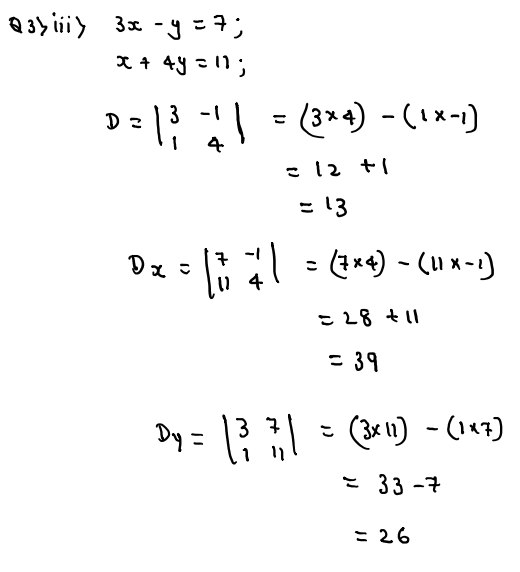
Eqs: \(3x - y = 7\) and \(x + 4y = 11\)
\(D = \begin{vmatrix} 3 & -1 \\ 1 & 4 \end{vmatrix} = (12) - (-1) = 13\)
\(D_x = \begin{vmatrix} 7 & -1 \\ 11 & 4 \end{vmatrix} = (28) - (-11) = 39\)
\(D_y = \begin{vmatrix} 3 & 7 \\ 1 & 11 \end{vmatrix} = (33) - (7) = 26\)
\(x = D_x/D = 39/13 = 3\)
\(y = D_y/D = 26/13 = 2\)
Ans: \(x=3, y=2\)
Eqs: \(3x - y = 7\) and \(x + 4y = 11\)
\(D = \begin{vmatrix} 3 & -1 \\ 1 & 4 \end{vmatrix} = (12) - (-1) = 13\)
\(D_x = \begin{vmatrix} 7 & -1 \\ 11 & 4 \end{vmatrix} = (28) - (-11) = 39\)
\(D_y = \begin{vmatrix} 3 & 7 \\ 1 & 11 \end{vmatrix} = (33) - (7) = 26\)
\(x = D_x/D = 39/13 = 3\)
\(y = D_y/D = 26/13 = 2\)
Ans: \(x=3, y=2\)
iv. Probability (Two Dice):
\(n(S) = 36\).
Event A: Product is 12.
Possible pairs: \((2,6), (3,4), (4,3), (6,2)\).
\(n(A) = 4\).
\(P(A) = \frac{4}{36} = \frac{1}{9}\)
Ans: Probability is \(\frac{1}{9}\)
\(n(S) = 36\).
Event A: Product is 12.
Possible pairs: \((2,6), (3,4), (4,3), (6,2)\).
\(n(A) = 4\).
\(P(A) = \frac{4}{36} = \frac{1}{9}\)
Ans: Probability is \(\frac{1}{9}\)
Solution Q.4
i. Probability of Horses:
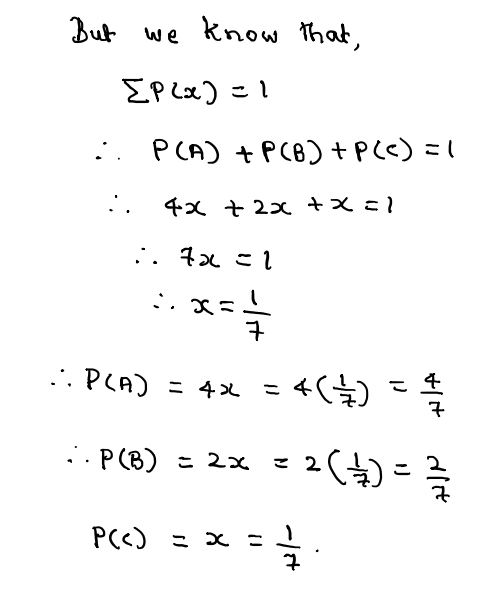
Given: \(P(A) = 2P(B)\) and \(P(B) = 2P(C)\).
Let \(P(C) = x\).
Then \(P(B) = 2x\) and \(P(A) = 2(2x) = 4x\).
Sum of probabilities = 1.
\(x + 2x + 4x = 1 \Rightarrow 7x = 1 \Rightarrow x = 1/7\).
Ans: P(A) = 4/7, P(B) = 2/7, P(C) = 1/7
Given: \(P(A) = 2P(B)\) and \(P(B) = 2P(C)\).
Let \(P(C) = x\).
Then \(P(B) = 2x\) and \(P(A) = 2(2x) = 4x\).
Sum of probabilities = 1.
\(x + 2x + 4x = 1 \Rightarrow 7x = 1 \Rightarrow x = 1/7\).
Ans: P(A) = 4/7, P(B) = 2/7, P(C) = 1/7
ii. Median of Farms:
Cumulative Frequency Table:
5-15: 7 (cf 7)
15-25: 12 (cf 19)
25-35: 17 (cf 36)
35-45: 25 (cf 61) <-- Median Class
45-55: 31 (cf 92)
\(N = 100\), so \(N/2 = 50\). Median class is 35-45.
\(L = 35, f = 25, cf = 36, h = 10\).
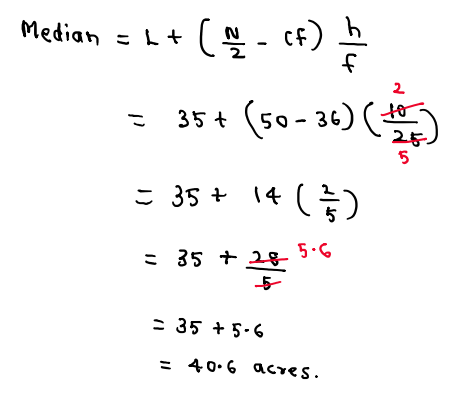
Median \(= L + [\frac{N/2 - cf}{f}] \times h\)
\(= 35 + [\frac{50 - 36}{25}] \times 10\)
\(= 35 + [\frac{14}{25}] \times 10\)
\(= 35 + 5.6 = 40.6\)
Ans: Median size is 40.6 acres.
Cumulative Frequency Table:
5-15: 7 (cf 7)
15-25: 12 (cf 19)
25-35: 17 (cf 36)
35-45: 25 (cf 61) <-- Median Class
45-55: 31 (cf 92)
\(N = 100\), so \(N/2 = 50\). Median class is 35-45.
\(L = 35, f = 25, cf = 36, h = 10\).
Median \(= L + [\frac{N/2 - cf}{f}] \times h\)
\(= 35 + [\frac{50 - 36}{25}] \times 10\)
\(= 35 + [\frac{14}{25}] \times 10\)
\(= 35 + 5.6 = 40.6\)
Ans: Median size is 40.6 acres.
iii. Pie Chart Analysis:
Agriculture = \(120^{\circ}\), Dairy = \(40^{\circ}\).
Industry = \(360^{\circ} - (120^{\circ} + 40^{\circ}) = 200^{\circ}\).
a) Total Loan:
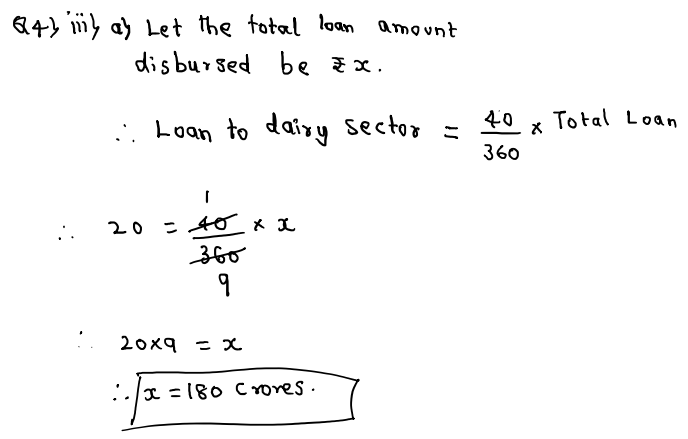
Let total loan be \(X\).
\(\frac{40}{360} \times X = 20 \text{ cr}\)
\(X = \frac{20 \times 360}{40} = 180 \text{ cr}\).
b) Sector Amounts:
Agriculture: \(\frac{120}{360} \times 180 = 60 \text{ cr}\).
Industry: \(\frac{200}{360} \times 180 = 100 \text{ cr}\).
c) Difference:
Industry - Agriculture = \(100 - 60 = 40 \text{ cr}\).
Ans: a) 180 cr, b) Ag: 60cr, Ind: 100cr, c) 40 cr.
Agriculture = \(120^{\circ}\), Dairy = \(40^{\circ}\).
Industry = \(360^{\circ} - (120^{\circ} + 40^{\circ}) = 200^{\circ}\).
a) Total Loan:
Let total loan be \(X\).
\(\frac{40}{360} \times X = 20 \text{ cr}\)
\(X = \frac{20 \times 360}{40} = 180 \text{ cr}\).
b) Sector Amounts:
Agriculture: \(\frac{120}{360} \times 180 = 60 \text{ cr}\).
Industry: \(\frac{200}{360} \times 180 = 100 \text{ cr}\).
c) Difference:
Industry - Agriculture = \(100 - 60 = 40 \text{ cr}\).
Ans: a) 180 cr, b) Ag: 60cr, Ind: 100cr, c) 40 cr.
Solution Q.5
i. Cost of Bananas:
Let original cost be ₹\(x\) per dozen.
Original quantity = \(600/x\).
New cost = \(x+10\). New quantity = \(600/(x+10)\).
Given: Old Qty - New Qty = 3.
\(\frac{600}{x} - \frac{600}{x+10} = 3\)
\(600 [\frac{x+10 - x}{x(x+10)}] = 3\)
\(200 [\frac{10}{x^2+10x}] = 1\)
\(x^2 + 10x - 2000 = 0\)
\((x+50)(x-40) = 0\).
Since cost cannot be negative, \(x = 40\).
Ans: Original cost is ₹40 per dozen.
Let original cost be ₹\(x\) per dozen.
Original quantity = \(600/x\).
New cost = \(x+10\). New quantity = \(600/(x+10)\).
Given: Old Qty - New Qty = 3.
\(\frac{600}{x} - \frac{600}{x+10} = 3\)
\(600 [\frac{x+10 - x}{x(x+10)}] = 3\)
\(200 [\frac{10}{x^2+10x}] = 1\)
\(x^2 + 10x - 2000 = 0\)
\((x+50)(x-40) = 0\).
Since cost cannot be negative, \(x = 40\).
Ans: Original cost is ₹40 per dozen.
ii. Sum of A.P.:
Given \(S_p = S_q\).
\(\frac{p}{2}[2a+(p-1)d] = \frac{q}{2}[2a+(q-1)d]\)
\(2ap + p(p-1)d = 2aq + q(q-1)d\)
\(2a(p-q) + d(p^2 - p - q^2 + q) = 0\)
\(2a(p-q) + d[(p-q)(p+q) - (p-q)] = 0\)
Dividing by \((p-q)\) (since \(p \neq q\)):
\(2a + d(p+q-1) = 0\)
Now, \(S_{p+q} = \frac{p+q}{2} [2a + (p+q-1)d]\)
Substitute the value 0:
\(S_{p+q} = \frac{p+q}{2} [0] = 0\).
Ans: Hence Proved.
Given \(S_p = S_q\).
\(\frac{p}{2}[2a+(p-1)d] = \frac{q}{2}[2a+(q-1)d]\)
\(2ap + p(p-1)d = 2aq + q(q-1)d\)
\(2a(p-q) + d(p^2 - p - q^2 + q) = 0\)
\(2a(p-q) + d[(p-q)(p+q) - (p-q)] = 0\)
Dividing by \((p-q)\) (since \(p \neq q\)):
\(2a + d(p+q-1) = 0\)
Now, \(S_{p+q} = \frac{p+q}{2} [2a + (p+q-1)d]\)
Substitute the value 0:
\(S_{p+q} = \frac{p+q}{2} [0] = 0\).
Ans: Hence Proved.
iii. Simultaneous Equations:
Let \(\frac{1}{x} = u\) and \(\frac{1}{y} = v\).
1) \(\frac{u}{3} - \frac{v}{4} = -1 \Rightarrow 4u - 3v = -12\)
2) \(\frac{u}{5} + \frac{v}{2} = \frac{4}{15} \Rightarrow 6u + 15v = 8\) (Multiplying by 30)
Multiply (1) by 5: \(20u - 15v = -60\)
Add to (2): \(26u = -52 \Rightarrow u = -2\).
Substitute \(u\) in (1): \(4(-2) - 3v = -12 \Rightarrow -8 -3v = -12 \Rightarrow -3v = -4 \Rightarrow v = 4/3\).
Resubstitute \(x\) and \(y\):
\(x = 1/u = -1/2\)
\(y = 1/v = 3/4\)
Ans: \(x = -1/2, y = 3/4\)
Let \(\frac{1}{x} = u\) and \(\frac{1}{y} = v\).
1) \(\frac{u}{3} - \frac{v}{4} = -1 \Rightarrow 4u - 3v = -12\)
2) \(\frac{u}{5} + \frac{v}{2} = \frac{4}{15} \Rightarrow 6u + 15v = 8\) (Multiplying by 30)
Multiply (1) by 5: \(20u - 15v = -60\)
Add to (2): \(26u = -52 \Rightarrow u = -2\).
Substitute \(u\) in (1): \(4(-2) - 3v = -12 \Rightarrow -8 -3v = -12 \Rightarrow -3v = -4 \Rightarrow v = 4/3\).
Resubstitute \(x\) and \(y\):
\(x = 1/u = -1/2\)
\(y = 1/v = 3/4\)
Ans: \(x = -1/2, y = 3/4\)


10th Standard Algebra March 2017 Board Paper Solution